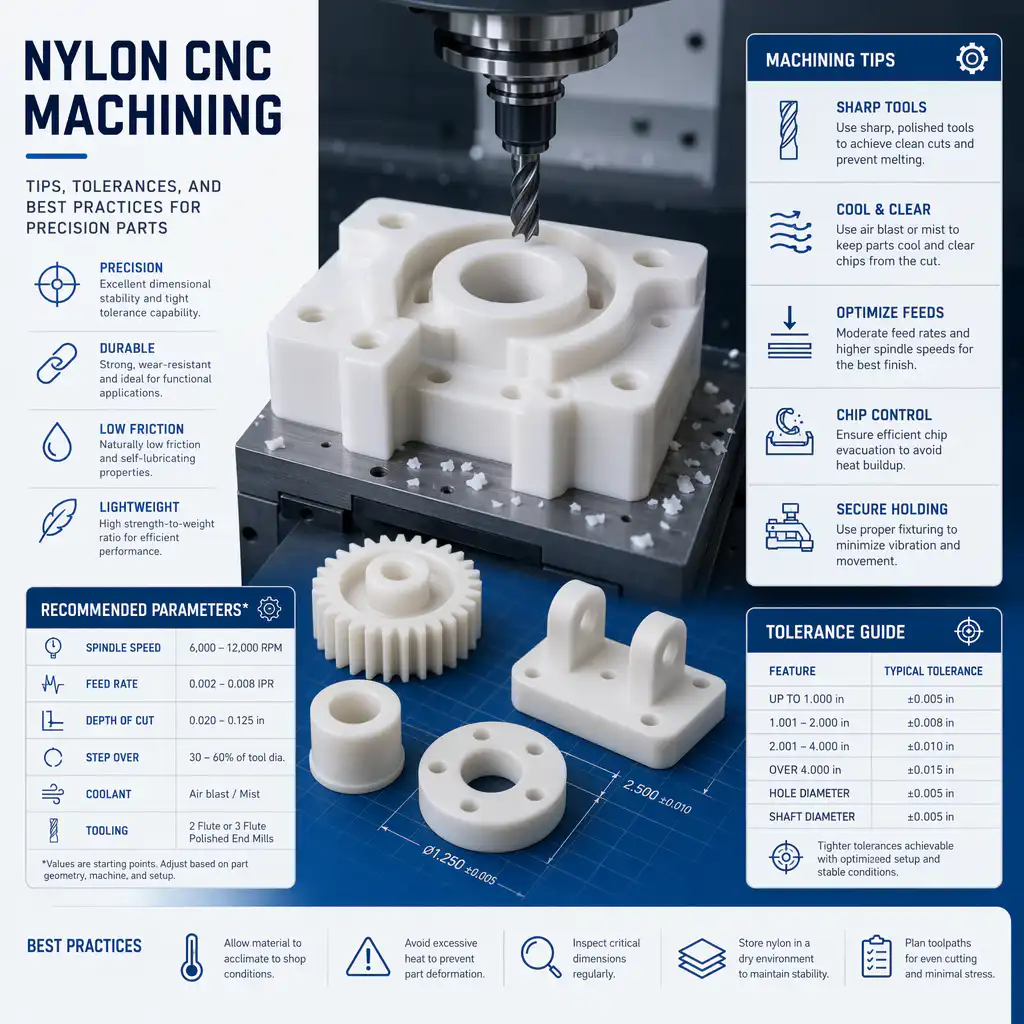
Nylon CNC machining requires specific techniques to achieve optimal results. As a semi-crystalline thermoplastic, nylon exhibits unique machining characteristics that differ from metals and even other plastics.
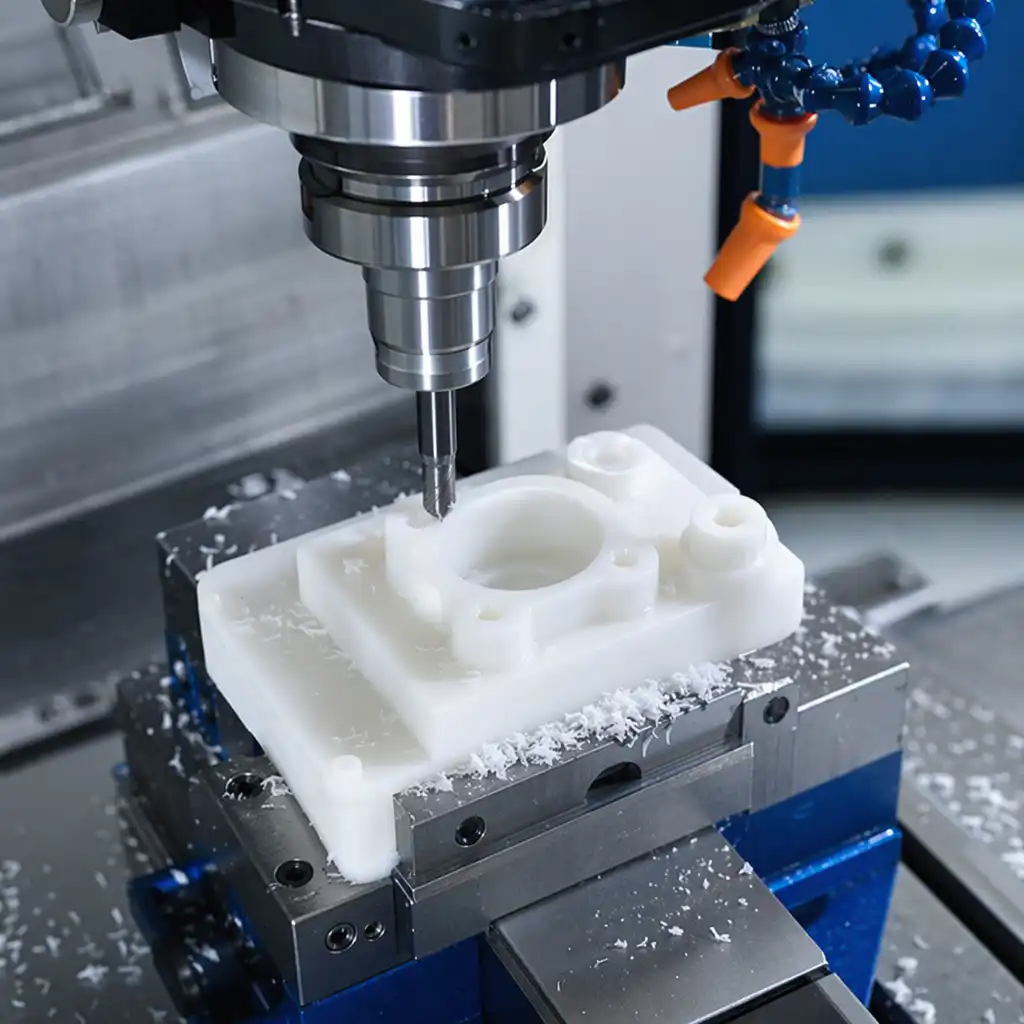
Nylon Machining Characteristics
Nylon (PA6, PA66, PA12) offers excellent machinability when proper techniques are applied:
- Low cutting forces — requires less power than metals
- Good chip formation — produces continuous chips that clear easily
- Heat sensitivity — can soften if excessive heat builds up
- Moisture absorption — dimensional changes possible before/after machining
Recommended Machining Parameters
| Operation | Speed (m/min) | Feed (mm/rev) | Depth (mm) |
|---|---|---|---|
| Turning | 200-400 | 0.1-0.3 | 0.5-3.0 |
| Milling | 150-300 | 0.05-0.2/tooth | 0.5-2.0 |
| Drilling | 50-100 | 0.1-0.3 | Through hole |
Critical Considerations
Moisture Management
Nylon absorbs moisture from the atmosphere, causing dimensional changes. Best practices:
- Dry stock before machining (80°C for 4-6 hours)
- Machine in controlled humidity environment
- Store machined parts in sealed bags with desiccant
Tool Selection
- Sharp tools essential — dull tools generate heat and poor finish
- Positive rake angles — 5-15° for clean cutting
- Polished flutes — prevent chip welding
- Carbide tools — standard HSS works, carbide lasts longer
Achievable Tolerances
بالنسبة لـ precision nylon parts:
- Standard: ±0.1mm
- Precision: ±0.05mm with proper technique
- High precision: ±0.025mm possible under controlled conditions
Why Choose Our Nylon CNC Machining Services
Nylon is one of the most versatile engineering plastics, and our CNC facilities are optimized to machine it to its full potential:
- 300+ CNC machines — optimized cutting parameters for nylon’s specific thermal and mechanical properties
- دقة ± 0.005 مم — tight tolerances for bearings, gears, and functional components
- All nylon grades — PA6, PA66, MC nylon, reinforced nylon (glass/carbon fiber filled)
- Proper drying & storage — nylon absorbs moisture; we control the environment from machining to packaging
- موك 1 قطعة — prototype to mass production; 100,000-piece capacity within 15 days
Nylon’s self-lubricating properties make it ideal for bearings, bushings, and wear pads. Our engineers understand how fiber orientation, moisture content, and machining direction affect final part performance.
Need machined nylon parts? Specify your grade, dimensions, and tolerance requirements — get your quote in 24 hours.
الأسئلة الشائعة
When is Nylon CNC Machining: Tips, Tolerances, and Best Practices for Precision Parts the right choice?
Nylon CNC Machining: Tips, Tolerances, and Best Practices for Precision Parts is the right choice when the part requires machined accuracy, controlled surfaces, repeatable features, and a material that can be cut reliably.
What should be confirmed before ordering Nylon CNC Machining: Tips, Tolerances, and Best Practices for Precision Parts?
قم بتأكيد إصدار الرسم، ودرجة المواد، والتفاوتات المسموح بها، والكمية، والأبعاد الحرجة، وتشطيب السطح، ومتطلبات الفحص قبل بدء الإنتاج.
What usually drives cost in Nylon CNC Machining: Tips, Tolerances, and Best Practices for Precision Parts?
وعادةً ما تكون التكلفة مدفوعة بالمواد، ووقت الإعداد، ووقت الماكينة، وصعوبة التفاوت، والتركيبات، والوصول إلى الأدوات، والتشطيب، والفحص، وكمية الطلب.
How can quality risk be reduced in Nylon CNC Machining: Tips, Tolerances, and Best Practices for Precision Parts?
يتم تقليل مخاطر الجودة من خلال وضع علامات واضحة على السمات الحرجة، وتجنب التفاوتات الضيقة غير الضرورية، والتأكد من قابلية التصنيع في وقت مبكر، واستخدام بيانات الفحص للأبعاد المهمة.