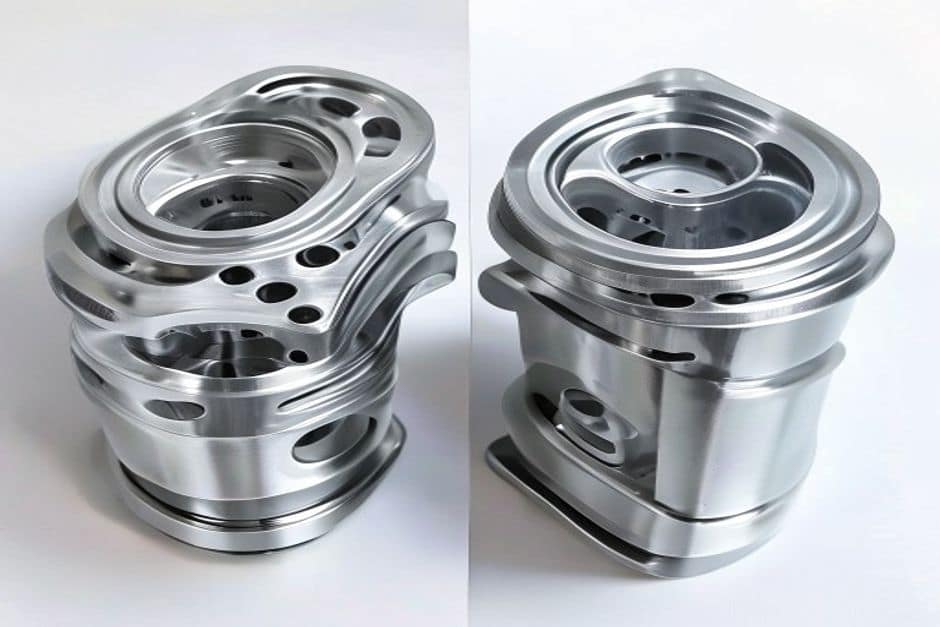
For engineering teams producing plastic components, the choice between CNC machining and injection molding is one of the most consequential manufacturing decisions they will face. Both processes can produce high-quality plastic parts from materials like Nylon, POM, and PEEK, yet they differ fundamentally in cost structure, production speed, design freedom, and material performance. Making the right choice requires understanding not just the technical differences but the economic and strategic implications for your specific application.
Process Fundamentals
التصنيع الآلي باستخدام الحاسب الآلي
CNC machining is a subtractive process. Starting from a solid block, rod, or sheet of material, rotating cutting tools progressively remove material until the desired geometry emerges. The machine follows G-code instructions generated from a CAD model, executing toolpaths with precision measured in microns. No tooling investment is required beyond standard cutting tools and workholding fixtures. Setup time is measured in hours, not weeks.
القولبة بالحقن
Injection molding is a formative process. Plastic pellets are melted and injected under high pressure into a precision-machined steel or aluminum mold cavity. The material cools and solidifies into the cavity shape, and the mold opens to eject the finished part. The process is highly repeatable — once the mold is qualified, millions of identical parts can be produced. However, mold fabrication is a significant upfront investment, typically requiring 4-12 weeks and costing $5,000 to $100,000+ depending on complexity.

Head-to-Head Comparison
| Factor | التصنيع الآلي باستخدام الحاسب الآلي | القولبة بالحقن |
|---|---|---|
| تكلفة الأدوات | Minimal ($0-$1,000) | High ($5,000-$100,000+) |
| Unit Cost at 1-100 Units | Moderate ($10-$500 per part) | Very High (tooling amortization) |
| Unit Cost at 10,000+ Units | Linear — no significant decrease | Very Low ($0.10-$5 per part) |
| Lead Time (First Part) | 1-7 days | 4-12 weeks (mold fabrication) |
| Design Changes | Quick — reprogram, no tooling change | Slow — modify or replace mold |
| خواص المواد | Original material properties preserved | Properties altered by melt process |
| التفاوتات المسموح بها | ±0.001-0.005 inches | ±0.002-0.010 inches (varies) |
| تشطيب السطح | Visible tool marks, post-processable | Mold finish replicated, consistent |
| Material Waste | Moderate-high (subtractive) | Minimal (runners/risers recyclable) |
When to Choose CNC Machining
CNC machining is the superior choice when:
- Production volumes are low-to-moderate (1-1,000 units)
- Rapid prototyping and design iteration are priorities
- Material properties must be preserved without thermal history
- Tight tolerances (±0.001 inches) are required on critical features
- Design changes are anticipated during development
- Part geometry is too complex for mold ejection (undercuts, internal threads)
- Lead time from order to first article must be minimized
When to Choose Injection Molding
Injection molding becomes the economically superior process when:
- Production volumes exceed 1,000-5,000 units annually
- Design is stable and unlikely to change
- Material costs dominate unit economics (molding uses less material per part)
- Surface finish must be consistent and aesthetically uniform
- Multiple identical parts must be produced per machine cycle
- Labor costs are a significant concern (molding is highly automated)
Hybrid Approach: The Smart Strategy
Many manufacturers adopt a hybrid strategy: CNC machining for prototyping and initial production, transitioning to injection molding once the design is validated and volumes justify the tooling investment. This approach combines the speed and flexibility of CNC machining during development with the unit economics of injection molding at scale.
مقالات ذات صلة
Explore our complete guide to engineering plastics and precision manufacturing. For material-specific guidance, review our technical articles on nylon grades, POM/Delrin machining, and CNC process optimization.
الأسئلة الشائعة
What industries rely most on this technology?
Aerospace, automotive, medical device manufacturing, and industrial equipment production are the primary industries. Defense contractors, energy sector manufacturers, and consumer electronics producers also depend heavily on precision machining and advanced manufacturing processes.
How does material selection affect the manufacturing outcome?
Material properties—strength, thermal behavior, machinability, and chemical resistance—directly determine tool selection, cutting parameters, and achievable tolerances. Engineering plastics such as Nylon and POM require different feeds, speeds, and coolant strategies compared to metals like aluminum or stainless steel.
What are the typical lead times for production?
Simple parts with standard materials can be produced in 1–3 business days. Complex multi-axis components or large production volumes typically require 2–6 weeks, including programming, machine setup, and quality inspection phases.
Can prototyping and production use the same process?
Yes. One of the primary advantages is that the same programs, tools, and quality standards can be used from prototype through production. This ensures design intent is preserved and validated before scaling to full production volumes.