
Complete guide to injection molding nylon — melt temperatures, mold temperatures, drying, troubleshooting common defects, and optimization strategies.
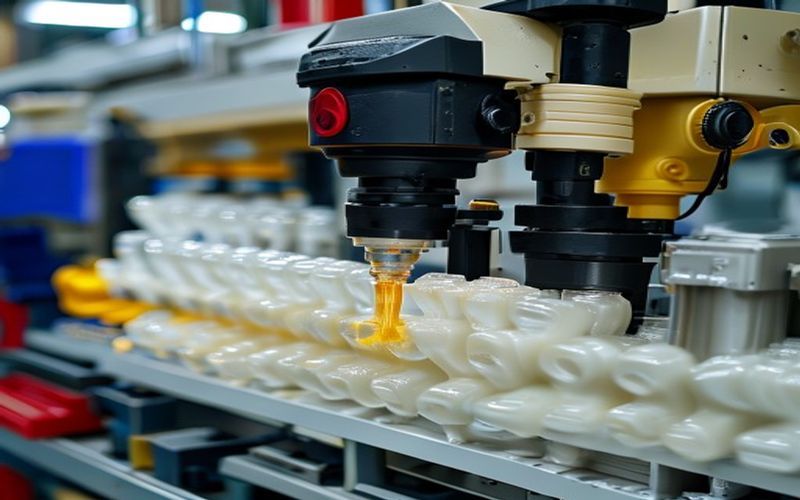
Why Nylon Requires Special Processing Attention
Nylon is one of the most challenging materials to injection mold successfully. Its combination of high melt temperature, extreme moisture sensitivity, high melt viscosity, and tendency toward warpage means that small deviations in processing parameters cause large quality variations. A molding machine running polycarbonate without incident may produce entirely rejected parts when switching to unfilled PA66 without adjusting for its specific requirements.
This guide provides the complete parameter framework and troubleshooting methodology for injection molding engineers working with nylon materials.
Core Processing Parameters
Temperature Settings:
| Parameter | PA6 | PA66 | PA12 | PA6-GF30 | PA66-GF30 |
|---|---|---|---|---|---|
| Melt Temp (°C) | 230-260 | 270-290 | 240-270 | 240-270 | 280-300 |
| Mold Temp (°C) | 60-80 | 80-100 | 40-60 | 80-100 | 80-110 |
| Nozzle Temp (°C) | 230-260 | 270-290 | 240-270 | 245-275 | 285-300 |
| Front Zone | 230-250 | 265-280 | 235-255 | 235-255 | 270-285 |
|---|---|---|---|---|---|
| Rear Zone | 230-250 | 265-280 | 235-255 | 235-255 | 270-285 |
Why higher mold temperature for PA66?
PA66 has higher melt viscosity and higher crystallinity. Low mold temperature produces parts with low crystallinity that continue to crystallize after ejection, causing warpage and dimensional instability. Higher mold temperature (80-100°C) locks in crystallinity during the cycle, producing dimensionally stable parts.
Drying: The Non-Negotiable First Step:
Never mold nylon that hasn’t been properly dried. Required drying conditions:
| Material | Temperatura | Hours | Max Moisture |
|---|---|---|---|
| PA6 | 80°C | 4-6h | 0.20% |
| PA66 | 85°C | 4-6h | 0.15% |
|---|---|---|---|
| All GF/CF grades | 85°C | 4-6h | 0.12% |
Use desiccant dryers with dew point monitoring. Verify with moisture analyzers for critical parts.
Injection and Pressure Parameters
Injection Speed and Pressure:
Nylon’s high melt viscosity requires higher injection pressure than polypropylene or polystyrene:
| Injection Pressure | 80-120 MPa | 100-140 MPa | 70-100 MPa |
|---|
| Pack Pressure | 60-80 MPa | 70-100 MPa | 50-70 MPa |
|---|---|---|---|
| Back Pressure | 0.3-0.5 MPa | 0.3-0.7 MPa | 0.2-0.4 MPa |
Injection Speed: Medium to fast. Too slow causes cold shuts and short shots. Too fast causes jetting and burn marks. Aim for fill time of 1-3 seconds for most parts.
Pack and Hold:
Nylon has high thermal contraction during cooling (1.5-2.5% linear shrinkage). Insufficient pack pressure results in sink marks and voids. Recommended pack time: 2-5 seconds depending on wall thickness.
Shrinkage:
| Material | Shrinkage Parallel (%) | Shrinkage Perpendicular (%) | Anisotropy |
|---|---|---|---|
| PA6 | 0.8 | 1.4 | 0.6% |
| PA66 | 1.0 | 1.7 | 0.7% |
| PA12 | 0.8 | 1.2 | 0.4% |
| PA6-GF30 | 0.4 | 1.1 | 0.7% |
|---|---|---|---|
| PA6-CF30 | 0.2 | 0.5 | 0.3% |
GF and CF reinforcement significantly reduce overall shrinkage but increase anisotropy. CF30 has the most balanced shrinkage.
Common Defects and Solutions
Bubbles and Voids
Causes: Moisture, excessive melt temperature, inadequate pack pressure
Solutions: Verify drying (Karl Fischer <0.15%), reduce melt temp 10°C, increase pack/hold pressure
Silver Streaks / Flow Lines
Causes: Moisture vapor flashing off during injection, contamination
Solutions: Improve drying (dew point < -40°C), purge barrel thoroughly, check for resin contamination
Short Shots
Causes: Insufficient injection pressure/speed, cold mold, high melt viscosity
Solutions: Increase injection pressure 10-20%, raise mold temperature, raise melt temperature slightly (but not above recommended max)
Sink Marks
Causes: Insufficient pack/hold pressure or time, thick sections, high local shrinkage
Solutions: Increase pack pressure 20%, extend hold time, reduce wall thickness variation, add ribs with generous radii
Warpage
Causes: Differential shrinkage from orientation, temperature gradients, uneven cooling
Solutions: Increase mold temperature, use balanced gating, counter-gate thick parts, anneal after molding
Jetting
Causes: Injection speed too fast, cold mold, gate too small
Solutions: Reduce injection speed at start of fill, increase mold temperature, enlarge gate diameter
Flash
Causes: Injection pressure too high, mold wear, insufficient clamp force
Solutions: Reduce injection pressure, check mold for damage, verify clamp force (minimum 3-5 tons/in² projected area)
Cycle Time Optimization
Nylon cycle time is dominated by cooling requirements:
Cooling Time Estimates:
| Material | Cooling Time Factor (sec/mm wall) | Notas |
|---|---|---|
| PA6 | 0.8-1.0 | Faster than PA66 due to lower mold temp |
| PA66 | 1.0-1.3 | Higher mold temp = longer cooling |
| PA12 | 0.5-0.7 | Lowest mold temp requirement |
|---|---|---|
| PA66-GF30 | 1.2-1.6 | High mold temp extends cycle |
Cooling System Design:
Baffle and bubbler cooling channels are essential for thick-section nylon parts. Design cooling to maintain uniform mold surface temperature within ±5°C. Hot runner systems significantly reduce scrap and improve consistency for PA66.
Cycle Time Reduction Strategies:
1. Reduce wall thickness where possible — thinner walls cool exponentially faster
2. Optimize mold temperature: Use the minimum mold temperature that produces acceptable crystallinity. Even 5°C reduction can save 10-20 seconds/cycle.
3. Increase cooling water flow: Maintain ΔT of 5-8°C across cooling channels
4. Use conformal cooling for complex geometries — 3D-printed steel inserts enable near-net-shape cooling channels
5. Annealing vs. longer cycle: For parts requiring high dimensional stability, 1-hour annealing post-molding may allow shorter cycles vs. achieving crystallinity in-mold
Material Changeover and Purging
Purging Nylon from the Barrel:
When switching from another material to nylon:
1. Purge with PA6 or PA66 at normal processing temperature
2. Use glass-filled purge compounds for heavily contaminated barrels
3. For color changes: purge with natural material, then new color
Purging TO another material from nylon:
Nylon leaves carbonized residue at high temperatures. Best approach:
1. Drop melt temperature to 250°C
2. Purge with polycarbonate or acrylic (good solvents for carbon deposits)
3. Increase temperature and purge with target material
4. Inspect screw and barrel for degradation if nylon was processed at temperatures above recommended max
Shelf Life and Storage:
Nylon resin has limited shelf life when exposed to humidity:
- Sealed packaging: 1+ years if unopened, stored at <30°C
- Opened bags: Process within 48-72 hours or re-dry
- Regrind: Can be reused at 10-30% loadings (never 100% regrind — property degradation)
- Moisture-damaged resin: Will produce steam bubbles during molding — always dry before use regardless of apparent dryness
PREGUNTAS FRECUENTES
When does Injection Molding Nylon: Processing Parameters and Troubleshooting make sense?
Injection Molding Nylon: Processing Parameters and Troubleshooting makes sense when the part volume, material choice, geometry, and repeatability needs justify mold design and tooling investment.
What design factors matter most for Injection Molding Nylon: Processing Parameters and Troubleshooting?
Wall thickness, ribs, bosses, draft angle, gate location, shrinkage, parting line, and ejection all affect molded part quality.
What information is needed before mold production?
The supplier should confirm the 3D model, material, expected annual volume, appearance requirements, tolerance needs, and any assembly or functional testing requirements.
What is the biggest risk in Injection Molding Nylon: Processing Parameters and Troubleshooting?
The biggest risk is approving tooling before material behavior, shrinkage, flow, and part function are fully checked against the real application.

 English
  Dutch
Dutch  German
  French
  Korean
  Russian
  Japanese
  Spanish
  Vietnamese
  Chinese
  Portuguese
  Arabic