
What Is PBT GF30?
PBT GF30 is polybutylene terephthalate reinforced with 30% glass fiber by weight. It is one of the most widely specified glass-filled engineering thermoplastics in automotive and electrical applications — and for good reason.
Adding 30% short glass fiber to an unfilled PBT resin more than doubles its tensile strength, quadruples its flexural modulus, and pushes its heat deflection temperature (HDT) from approximately 60°C to above 200°C. These gains make PBT GF30 the default choice whenever designers need a stiff, dimensionally stable polyester that survives underhood temperatures and retains its electrical properties in humid environments.
For procurement teams and design engineers searching for PBT GF30 datasheets, grade comparisons, or supplier alternatives, this page covers the critical data points — mechanical properties, thermal limits, processing parameters, common grades, and how PBT GF30 stacks up against competing materials.
PBT GF30 Typical Properties
The table below consolidates datasheet values from multiple commercial PBT GF30 grades. Exact figures vary by manufacturer and additive package, but these ranges represent what you can expect from a standard 30% glass-filled PBT.
| プロパティ | Test Method | Typical Value | Unit |
|---|---|---|---|
| 密度 | ISO 1183 / ASTM D792 | 1.52 – 1.65 | g/cm³ |
| Water Absorption (24h, 23°C) | ISO 62 / ASTM D570 | 0.05 – 0.12 | % |
| Tensile Strength at Break | ISO 527 / ASTM D638 | 120 – 140 | MPa |
| Tensile Modulus | ISO 527 / ASTM D638 | 9,500 – 11,500 | MPa |
| 破断伸度 | ISO 527 / ASTM D638 | 2.0 – 3.5 | % |
| Flexural Strength | ISO 178 / ASTM D790 | 190 – 210 | MPa |
| 曲げ弾性率 | ISO 178 / ASTM D790 | 8,000 – 10,500 | MPa |
| Charpy Notched Impact (23°C) | ISO 179-1eA | 7 – 12 | kJ/m² |
| Izod Notched Impact (23°C) | ASTM D256 | 80 – 110 | J/m |
| HDT @ 1.80 MPa | ISO 75 / ASTM D648 | 200 – 220 | °C |
| HDT @ 0.45 MPa | ISO 75 / ASTM D648 | 215 – 225 | °C |
| 溶融温度 | DSC | 220 – 225 | °C |
| Molding Shrinkage (flow) | ISO 294-4 | 0.2 – 0.5 | % |
| 体積抵抗率 | IEC 60093 / ASTM D257 | 10¹⁵ – 10¹⁶ | Ω·cm |
| Dielectric Strength | IEC 60243 / ASTM D149 | 18 – 22 | kV/mm |
| Flammability (1.6 mm) | UL 94 | HB (standard); V-0 (FR grades) | — |
Glass Fiber Content Comparison: PBT GF10 to PBT GF50
PBT is commercially available with glass fiber loadings from 10% to 50%. Each step trades ductility for stiffness, and the sweet spot depends on the application.
| グレード | GF Content | 引張強さ (MPa) | 曲げ弾性率 (MPa) | HDT @ 1.8 MPa (°C) | Impact (kJ/m²) | 密度 (g/cm³) |
|---|---|---|---|---|---|---|
| Unfilled PBT | 0% | 50 – 60 | 2,200 – 2,600 | 50 – 60 | 4 – 5 | 1.30 – 1.31 |
| PBT GF10 | 10% | 85 – 95 | 4,000 – 4,800 | 190 – 200 | 4 – 6 | 1.38 – 1.40 |
| PBT GF15 | 15% | 100 – 115 | 5,500 – 6,500 | 195 – 205 | 5 – 7 | 1.42 – 1.46 |
| PBT GF20 | 20% | 105 – 120 | 6,500 – 7,500 | 200 – 210 | 6 – 9 | 1.45 – 1.50 |
| PBT GF30 | 30% | 120 – 140 | 8,000 – 10,500 | 200 – 220 | 7 – 12 | 1.52 – 1.65 |
| PBT GF40 | 40% | 135 – 155 | 10,500 – 13,000 | 210 – 223 | 8 – 11 | 1.60 – 1.72 |
| PBT GF50 | 50% | 145 – 165 | 14,000 – 17,000 | 215 – 225 | 9 – 13 | 1.68 – 1.78 |
Key takeaway: PBT GF30 lands in the center of the cost-performance curve. It delivers roughly 90% of the stiffness of GF50 at a lower price per kilogram and with better moldability. Below GF20, you lose significant HDT and creep resistance. Above GF40, warpage, viscosity, and tool wear become harder to manage.
Common PBT GF30 Commercial Grades
| Manufacturer | グレード | Key Feature | Typical Application |
|---|---|---|---|
| BASF | Ultradur B4300G6 | Standard GF30, high flow | Automotive housings, connectors |
| BASF | Ultradur B4300G6 HR | GF30 + hydrolysis resistant | Underhood connectors, sensor bodies |
| BASF | Ultradur B4406G6 | GF30 + flame retardant | Electrical enclosures, relays |
| Celanese | Celanex 3300 GF30 | Standard GF30, good surface | Appliance components, handles |
| Polyplastics | Duranex 3300 GF30 | Standard GF30 | General industrial parts |
| SABIC | Valox 420 | GF30, UL94 HB | Electrical, lighting |
| SABIC | Valox 420SEO | GF30 + V-0 FR | Circuit breaker housings |
| Ensinger | TECADUR PBT GF30 | Stock shape (rod/plate) | Machined precision components |
| Lanxess | Pocan B3235 | GF30, impact modified | Automotive interior, door handles |
PBT GF30 vs. Competing Materials
PBT GF30 vs. PA66 GF30
| プロパティ | PBT GF30 | PA66 GF30 | 備考 |
|---|---|---|---|
| 密度 | 1.52 – 1.65 | 1.35 – 1.38 | PA66 GF30 is lighter |
| 引張強度 | 120 – 140 MPa | 170 – 190 MPa | PA66 stronger in dry state |
| HDT @ 1.8 MPa | 200 – 220°C | 240 – 255°C | PA66 higher short-term heat |
| 水分吸収 | 0.05 – 0.12% | 1.5 – 2.5% | PBT major advantage |
| Dimensional Stability (humid) | 素晴らしい | Poor (swells with moisture) | Decisive for electrical parts |
| 耐薬品性 | Good vs fuels/oils/acids | Good vs oils, poor vs acids | PBT broader chemical tolerance |
| Dielectric Strength | 18 – 22 kV/mm | 18 – 24 kV/mm | Comparable dry, PBT wins wet |
| ノッチ付きインパクト | 7 – 12 kJ/m² | 10 – 15 kJ/m² | PA66 tougher |
| Price (relative) | Moderate | より低い | PA66 typically cheaper per kg |
When to choose PBT GF30 over PA66 GF30: If your part lives in a humid environment and must hold tight tolerances, PBT wins every time. Electrical connectors, sensor housings, and precision mechanical parts exposed to ambient moisture are textbook PBT territory. PA66 swells — PBT does not.
PBT GF30 vs. PET GF30
PBT and PET are both thermoplastic polyesters, and both benefit from 30% glass reinforcement. PBT crystallizes faster, which translates to shorter molding cycles (a 20–30% productivity advantage in injection molding). PET GF30 pushes HDT slightly higher (225–235°C) and offers better surface gloss, but processes slower and requires higher mold temperatures (120–140°C vs. 60–80°C for PBT). For most injection-molded components, PBT GF30 is the more economical choice.
PBT GF30 vs. PPS GF40
PPS GF40 operates in the 260°C+ continuous-use range, far above PBT’s ceiling. It also provides inherently flame-retardant performance (V-0 without additives). But PPS costs 3–5× more than PBT. Unless your application demands sustained exposure above 180°C, PBT GF30 is the cost-effective route.
Processing Guidelines: Injection Molding PBT GF30
| Parameter | 推奨値 |
|---|---|
| Pre-drying | 120°C for 3–4 hours (dew point ≤ -30°C) |
| Melt Temperature | 250 – 270°C |
| 金型温度 | 60 – 80°C (up to 100°C for high-gloss) |
| Injection Speed | Medium to fast |
| Holding Pressure | 50 – 80 MPa |
| Back Pressure | Low, 3 – 7 MPa |
| Screw Speed | 50 – 100 rpm |
Critical notes for PBT GF30 processing:
- Moisture sensitivity: PBT hydrolyzes at melt temperatures. Anything above 0.02% moisture content will degrade mechanical properties. Dry it — every time.
- Fiber orientation: Glass fibers align with flow direction, creating anisotropic shrinkage. Expect 0.2–0.5% shrinkage parallel to flow and 0.5–1.0% perpendicular. Gate placement matters.
- Tool wear: 30% glass fiber is abrasive. Use hardened tool steel (HRC 54+) or hard chrome plating on mold surfaces.
- 溶接ライン: Glass-filled PBT forms visible, mechanically weaker weld lines. Position gates so knit lines occur in non-structural, low-visibility zones.
Key Applications of PBT GF30
| 産業 | Application | Why PBT GF30 |
|---|---|---|
| 自動車 | ECU housings, sensor bodies, connector shells | Dimensional stability underhood, moisture resistance |
| 自動車 | Door handles, mirror housings, wiper system brackets | Stiffness, surface finish, chemical resistance |
| Electrical / Electronics | Relay bases, circuit breaker housings, terminal blocks | Dielectric strength, arc tracking resistance, low moisture pickup |
| Electrical / Electronics | Bobbin / coil formers, connector insulators | Heat resistance for soldering, stable dielectric properties |
| Appliance | Iron handles, toaster end plates, oven knobs | Heat deflection above 200°C + UL94 FR option |
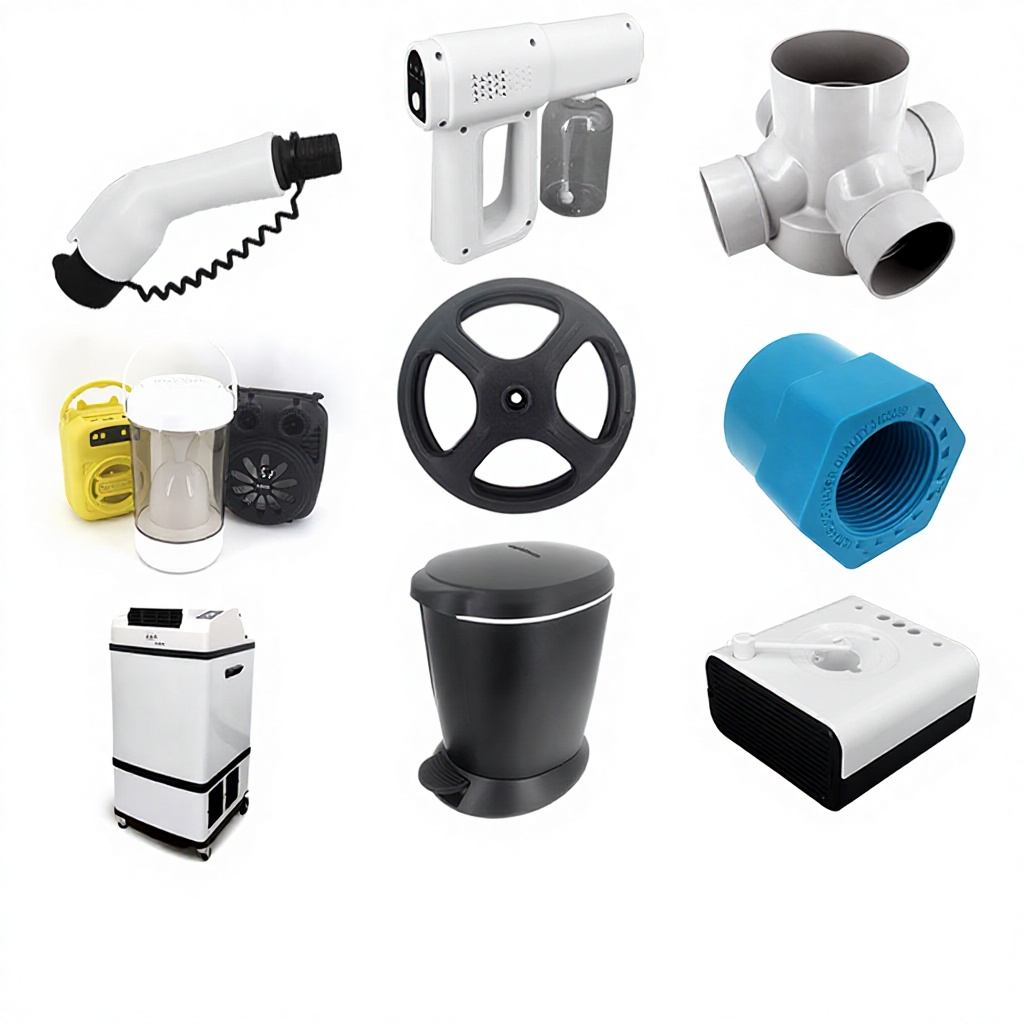
| インダストリアル | Pump housings, valve bodies, gear wheels | Creep resistance, wear performance (especially lubricated grades) |
| Lighting | LED heat sinks, lamp holders, reflector bases | Heat resistance + high reflectivity white grades available |
Flame Retardant PBT GF30 (V-0 Grades)
Standard PBT GF30 carries a UL94 HB rating. For electrical applications requiring self-extinguishing behavior, a parallel family of PBT GF30 FR V-0 grades exists. These use halogenated or halogen-free flame retardant packages to achieve V-0 at 1.6 mm or thinner.
Notable V-0 grades include:
- BASF Ultradur B4406G6 — halogenated FR, GF30, V-0 at 0.75 mm
- SABIC Valox 420SEO — industry benchmark, GF30 V-0
- Celanex 3316 — GF30, non-halogen FR option available
The trade-off: FR additives typically reduce tensile strength by 5–10% and impact resistance by 15–25% compared to unfilled FR grades. Specify carefully based on whether electrical safety or mechanical load is the primary design constraint.
PBT GF30 vs. Mineral-Filled PBT
Glass-filled PBT is not the only reinforcement option. Mineral-filled PBT (typically MD20–MD40, using talc, calcium carbonate, or wollastonite) delivers lower warpage and better isotropic shrinkage at a lower cost — but sacrifices strength and HDT compared to GF grades.
| プロパティ | PBT GF30 | PBT MD30 (Mineral 30%) |
|---|---|---|
| 引張強度 | 120 – 140 MPa | 55 – 65 MPa |
| 曲げ弾性率 | 8,000 – 10,500 MPa | 4,000 – 5,500 MPa |
| HDT @ 1.8 MPa | 200 – 220°C | 70 – 100°C |
| Warpage | Moderate-high (anisotropic) | Low (isotropic) |
| 表面仕上げ | Matte, fiber-visible | Smooth, paintable |
| コスト | より高い | より低い |
Choose mineral-filled PBT for large, flat parts where flatness trumps strength — motor end caps, large housings, lighting bezels. Choose PBT GF30 when structural load and thermal resistance matter.
よくあるご質問
What does PBT GF30 mean?
PBT GF30 means polybutylene terephthalate (PBT) resin compounded with 30% glass fiber (GF) by weight. The glass fibers are typically short-cut E-glass strands, 3–6 mm in pellet length, that disperse during injection molding to create a stiff, strong composite.
Is PBT GF30 suitable for outdoor use?
Yes — with the right stabilization package. Standard PBT has good inherent UV resistance compared to unfilled nylons, and GF30 grades are commonly used in exterior automotive components (door handles, mirror housings). For prolonged outdoor exposure, specify a UV-stabilized grade such as BASF Ultradur B4300G6 LS (light-stabilized).
Can PBT GF30 be laser-marked?
Yes. PBT responds well to Nd:YAG laser marking. Most GF30 grades produce dark marks on the natural beige/grey base, and laser-markable grades (e.g., BASF B4300G6 LM) are available for high-contrast applications like connector identification.
What is the difference between PBT GF30 and PBT+PET GF30?
PBT+PET GF30 blends combine the faster crystallization of PBT with the higher gloss and slightly better HDT of PET. These blends are common in automotive exterior trim where surface appearance matters and cycle time must stay competitive. Pure PBT GF30 typically offers better chemical resistance.
Does PBT GF30 need to be dried before molding?
Absolutely. PBT is sensitive to hydrolysis at processing temperatures. Material must be dried to below 0.02% moisture content — typically 120°C for 3–4 hours in a desiccant dryer with a dew point of -30°C or lower. Skipping this step will produce brittle parts with degraded tensile and impact properties.
Need PBT GF30 pellets, stock shapes, or machined parts? We supply glass-filled PBT grades from major manufacturers. Contact us with your specification — grade, quantity, and delivery target — and we’ll return a quote.
Last updated: June 2026. Datasheet values are typical ranges; always verify specific grade properties with the manufacturer’s current technical data sheet.
 English
 Dutch
Dutch German
 French
 Korean
 Russian
 Japanese
 Spanish
 Vietnamese
 Chinese
 Portuguese
 Arabic