

Understanding the Nylon Family
Polyamide (nylon) materials differ in molecular structure, affecting properties and applications.
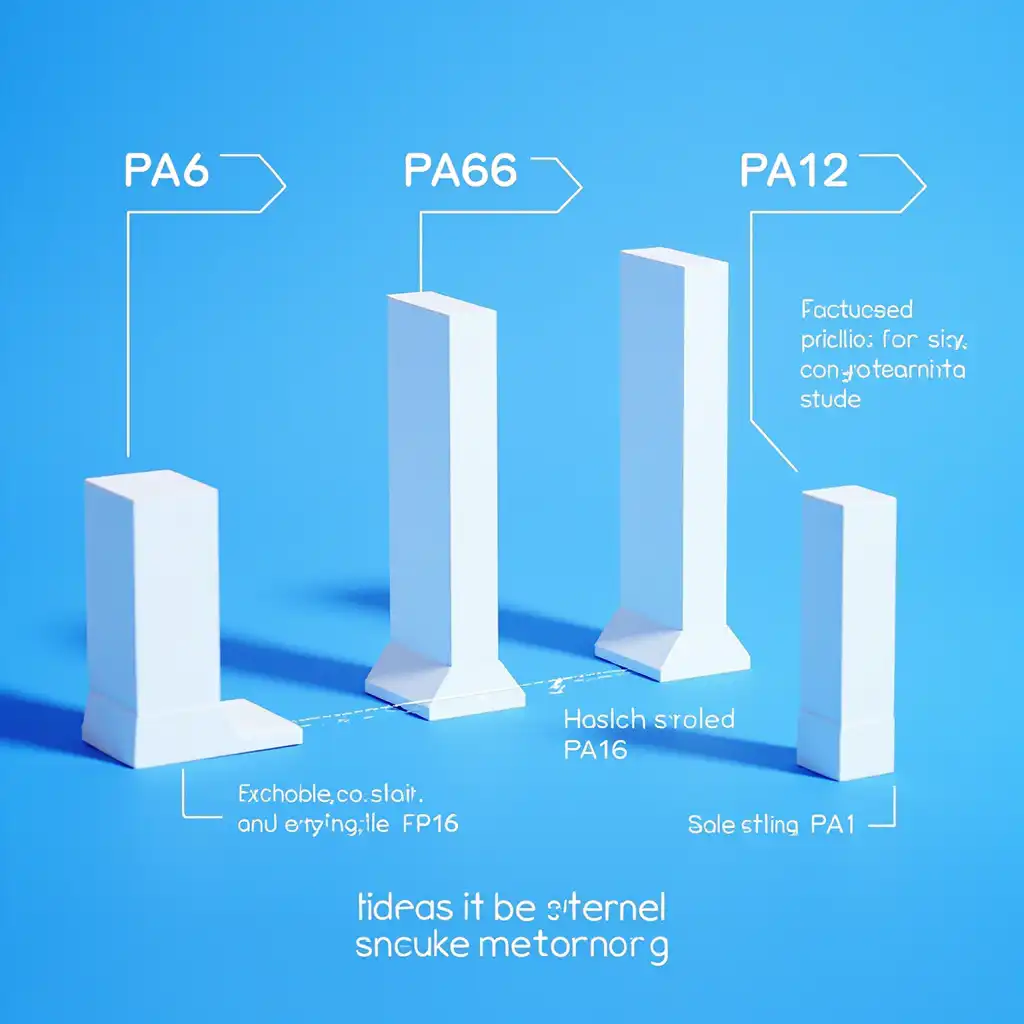
PA6 — Polyamide 6
- Melting Point: 220°C
- Advantages: Better impact resistance, lower cost, easier processing
- Best for: General mechanical parts, 3D printing, consumer products
PA66 — Polyamide 66
- Melting Point: 265°C
- Advantages: Higher heat resistance, superior mechanical strength
- Best for: Automotive engine parts, high-temperature applications
PA12 — Polyamide 12
- Melting Point: 180°C
- Advantages: Lowest moisture absorption, best chemical resistance
- Best for: Fuel lines, outdoor applications, moisture-sensitive environments
Selection Guide
Choose PA66 for heat, PA6 for cost/impact, PA12 for moisture/chemical resistance.
よくあるご質問
How do you know whether PA6 vs PA66 vs PA12 — Complete Nylon Material Family Comparison Guide fits a part?
PA6 vs PA66 vs PA12 — Complete Nylon Material Family Comparison Guide fits a part when its load capacity, temperature range, moisture exposure, wear behavior, and processing method match the real service conditions.
What properties should be checked for PA6 vs PA66 vs PA12 — Complete Nylon Material Family Comparison Guide?
Check strength, stiffness, impact resistance, heat resistance, moisture absorption, dimensional stability, friction, wear, and chemical compatibility.
What is the biggest selection risk for PA6 vs PA66 vs PA12 — Complete Nylon Material Family Comparison Guide?
The biggest risk is choosing from a datasheet value without considering actual environment, processing method, part geometry, and long-term use.
When should PA6 vs PA66 vs PA12 — Complete Nylon Material Family Comparison Guide be tested before production?
Testing is recommended when the part faces load, heat, chemicals, moisture, tight tolerances, regulatory requirements, or a new operating environment.


 English
 Dutch
Dutch German
 French
 Korean
 Russian
 Japanese
 Spanish
 Vietnamese
 Chinese
 Portuguese
 Arabic