
The core and cavity are the two halves that form every injection molded part — the core creates internal features (holes, pockets, ribs), and the cavity forms the external surface. Getting their design right determines part quality, cycle time, and tooling cost. Poor core-cavity design is the most common root cause of warp, sink marks, and short shots in molded nylon and engineering plastic parts.
Core and Cavity Basics
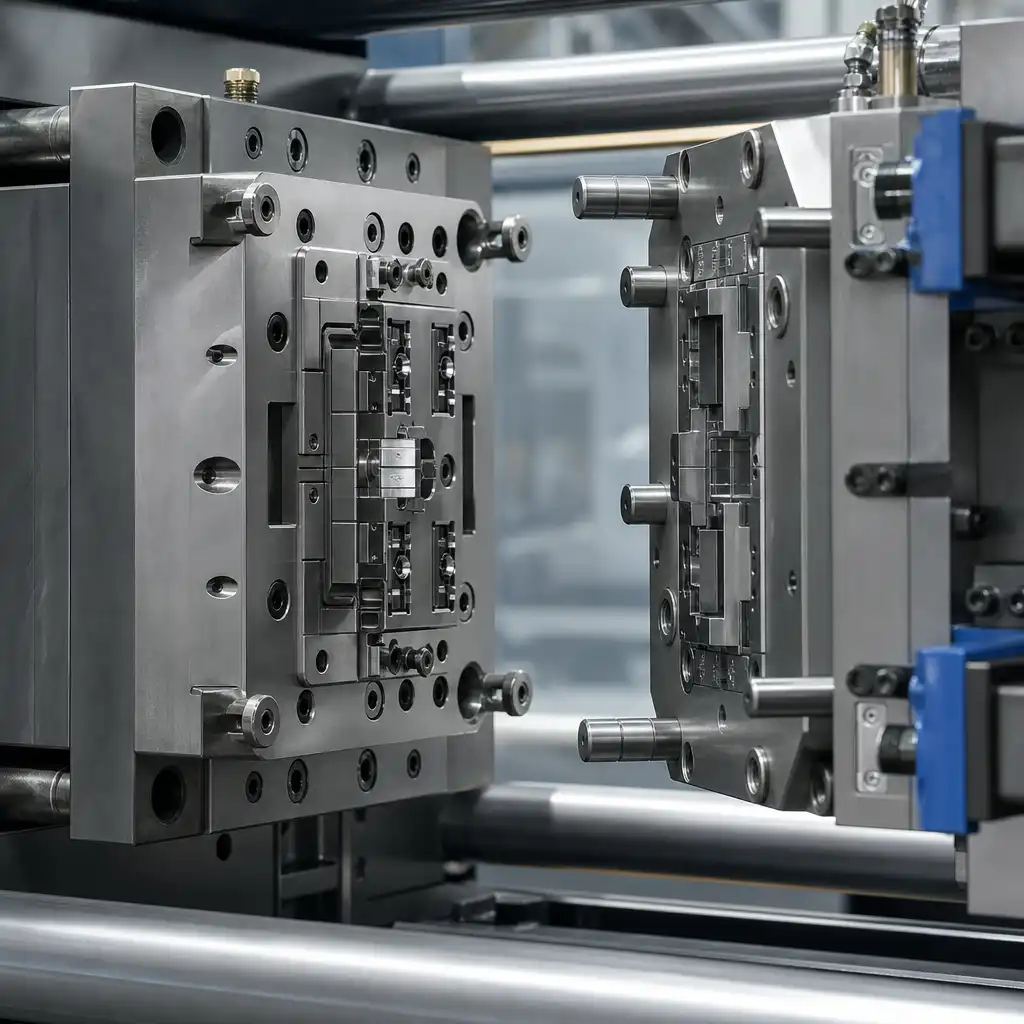
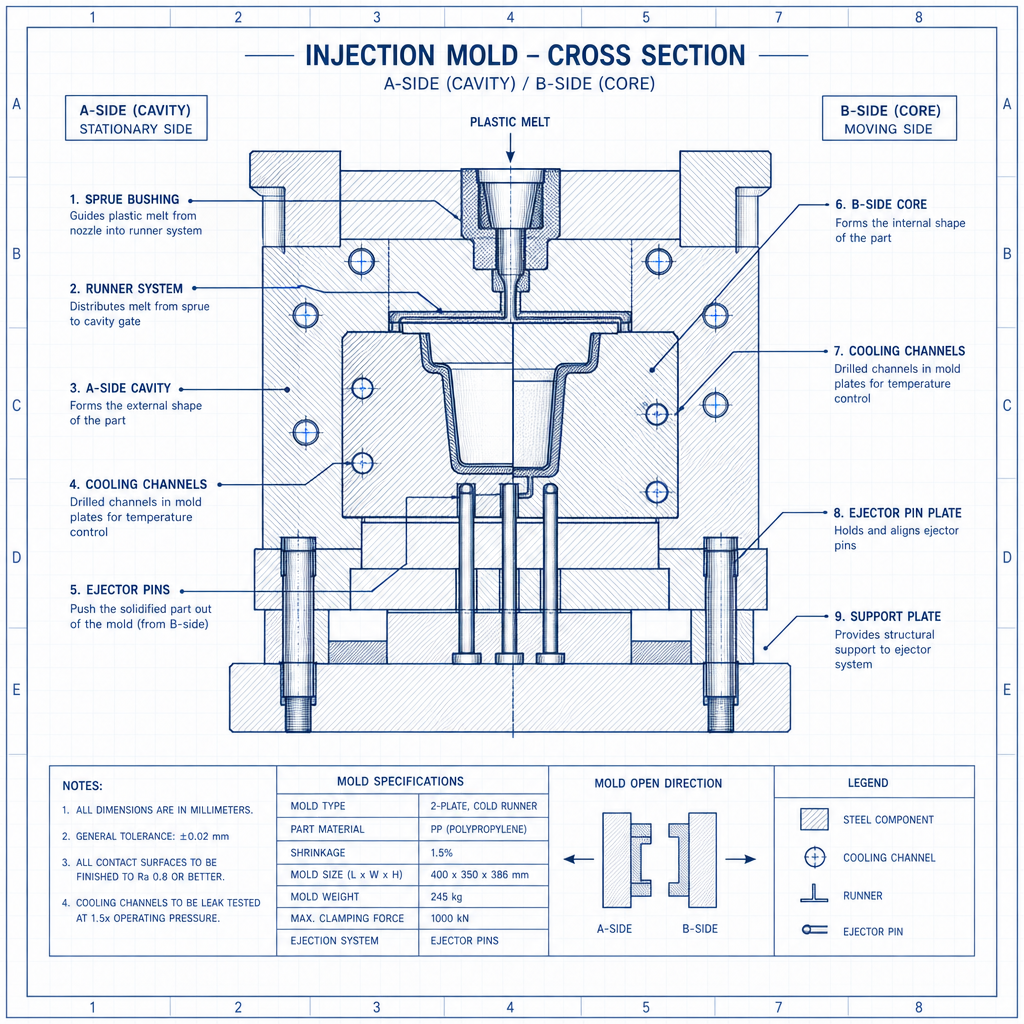
In every injection mold, the A-side (cavity) mounts to the stationary platen and forms the exterior of the part — the surface the customer sees. The B-side (core) mounts to the moving platen and forms internal geometry. When the mold opens, the part typically stays on the core side and is ejected by pins or a stripper plate. The parting line where the two halves meet is always visible on the final part — place it where it matters least aesthetically.
| Feature | Cavity (A-Side) | Core (B-Side) |
|---|---|---|
| Function | Forms external surfaces | Forms internal features |
| Typical Draft | 0.5-1.0° | 1.0-2.0° |
| 표면 마감 | High polish (SPI A-1 to A-3) | Matte or textured (SPI B-1 to C-1) |
| Steel Grade | P20, H13, S136 (cosmetic) | P20, 718H, H13 |
Draft Angles: Why the Core Side Needs More
Plastic shrinks onto the core as it cools. Nylon 6, for example, shrinks 0.8-1.5% — meaning it grips the core tightly. The core side needs at least 1-2° of draft to overcome this shrinkage grip. If your core has tall standing features (deep ribs, tall bosses), increase draft to 3-5° or you’ll get drag marks and ejection deformation. The cavity side can get away with 0.5° because the plastic naturally shrinks away from the outer walls.
Tooling Steel Selection
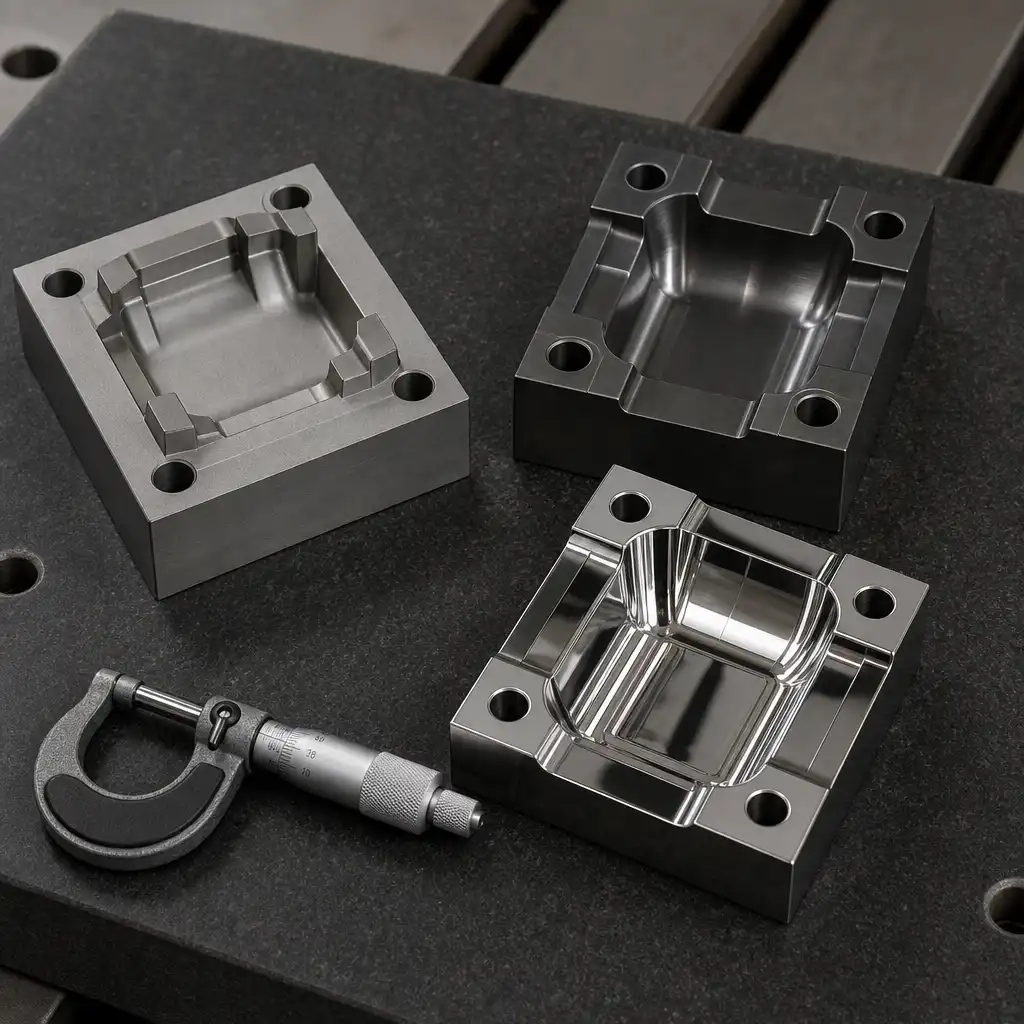
For prototyping and low volumes (under 10,000 shots), P20 pre-hardened steel is standard and economical. For production molds running glass-filled nylon (20-40% GF) or abrasive engineering plastics, upgrade to H13 hardened to 48-52 HRC. Glass fibers wear down P20 cavity edges within 5,000-10,000 shots, causing flash at the parting line and dimensional drift.
자주 묻는 질문
Why does my part stick to the wrong mold half?
Insufficient draft on the core side or polishing the core too smooth. The part should naturally stay on the core (B-side) for ejection. Increase core draft to 2° minimum and consider a slight undercut or texture to retain the part on the ejector side.
How long does a production mold last?
For unfilled nylon at moderate temperatures, P20 molds typically last 100,000-500,000 shots before requiring refurbishment. Glass-filled materials reduce this to 50,000-150,000 shots. Hardened H13 tools with proper maintenance can exceed 1 million shots.
What parting line placement is best?
Place it along a natural edge or feature line where it’s least visible. Avoid placing the parting line on cosmetic surfaces. For cylindrical parts, splitting along the diameter typically gives the cleanest result with simplest tooling.
Can you change core/cavity design after the mold is cut?
You can add material to the core (making the part thinner) by welding and re-machining, but removing material from the core (making the part thicker) requires either a new insert or starting over. Always prototype and validate dimensions before cutting production steel.
Need injection mold design support?
We review every mold design for draft, wall thickness, and ejection before cutting steel. Send your 3D file for a DFM analysis.


 English
 Dutch
Dutch German
 French
 Korean
 Russian
 Japanese
 Spanish
 Vietnamese
 Chinese
 Portuguese
 Arabic