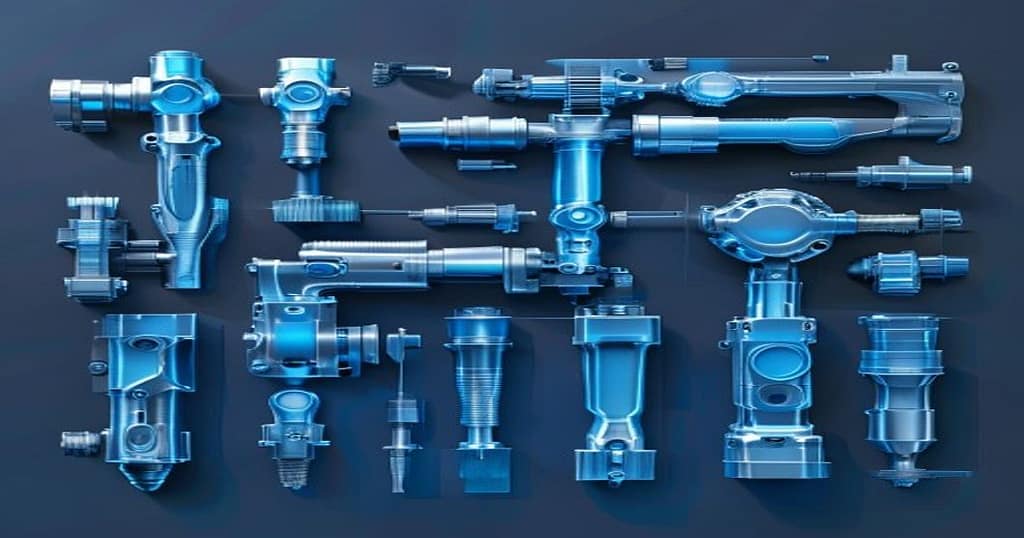
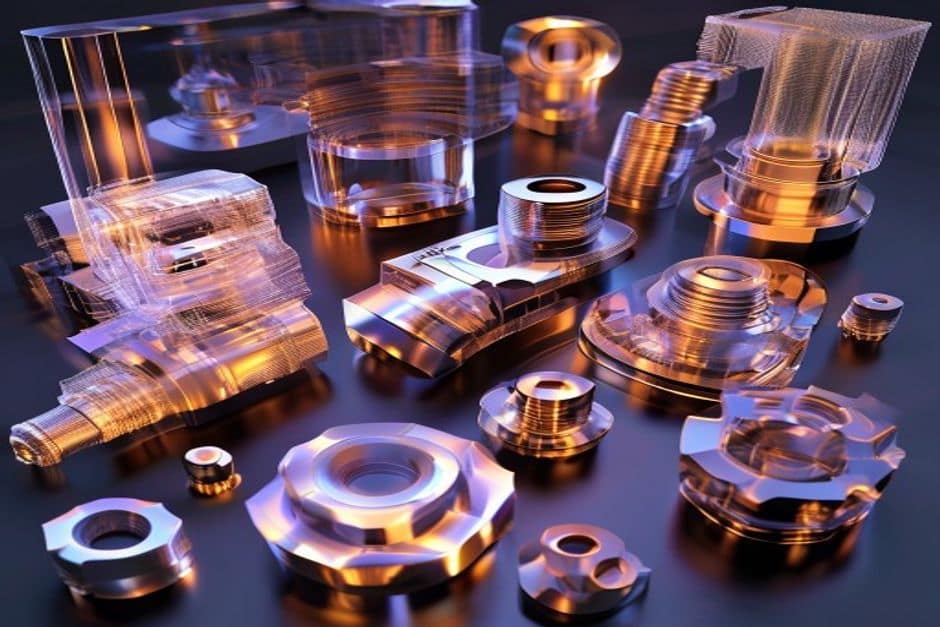
Digital Light Synthesis (DLS) is a proprietary vat photopolymerization technology developed by Carbon that represents a significant advancement over conventional SLA. While SLA uses a single-point laser to trace each layer, DLS uses a digital light projector (DLP) to project an entire cross-sectional image — a entire layer — at once. This “projection” approach enables dramatically faster build speeds and consistent part quality across the entire build platform, producing engineering-grade parts with excellent surface finish, mechanical properties, and reproducibility.
How DLS 3D Printing Works
In a DLS system, a UV light projector positioned below a transparent resin tank projects a mask image of the entire cross-section of the part onto a thin film at the bottom of the tank. The light triggers photoinitiators in the resin, causing it to polymerize (cure) all pixels of the layer simultaneously. A movable platform pulls the cured layer up, fresh resin flows into the gap, and the next layer is projected — repeating until the part is complete.
Carbon’s proprietary CLIP (Continuous Liquid Interface Production) process takes this further by maintaining an oxygen-permeable window at the bottom of the resin tank, creating a dead zone where resin remains liquid. This allows continuous upward motion without the layer-by-layer pause cycle, dramatically increasing speed while producing isotropic, fully-dense parts.

Key Advantages of DLS Technology
Speed and Scalability
Because entire layers are projected simultaneously rather than traced by a laser, DLS builds up to 100 times faster than conventional SLA for large parts. Build speed is limited only by the speed of part separation from the film window, making DLS economically viable for both prototypes and end-use production at volume.
Engineering-Grade Materials
DLS materials are specifically formulated for production applications, not prototyping. Carbon’s material library includes engineering-grade resins with mechanical properties that rival or exceed injection-molded thermoplastics — including high-temperature resistance, impact strength, and chemical resistance.
Isotropic Mechanical Properties
Unlike SLA where layer lines can create directional weakness, DLS produces fully isotropic parts — the material properties are consistent throughout the entire volume of the part in all directions. This makes DLS parts suitable for demanding functional applications where predictability of material behavior is critical.
Excellent Surface Finish
The pixel-based projection system produces smooth, uniform surfaces without the fine stair-stepping visible on SLA parts. This results in parts with excellent surface aesthetics and reduced post-processing requirements.
DLS Material Portfolio
| 재료 | 주요 속성 | 애플리케이션 |
|---|---|---|
| EPX 82 (Epoxy) | High strength, heat-resistant, Z-axis CTE matched to aluminum | Functional brackets, structural parts, tooling |
| EPX 150 (Epoxy) | High modulus, excellent surface quality | Housing, enclosures, consumer electronics |
| CE 221 (Cyanate Ester) | Extreme high-temperature (HDT 230°C), aerospace-grade | Aerospace ducts, high-temp jigs and fixtures |
| SIL 30 (Silicone) | 40A Shore durometer, tear-resistant silicone | Seals, gaskets, medical devices, wearables |
| RPU 70 (Flexible PU) | Impact-resistant, versatile engineering resin | Consumer products, automotive, functional prototypes |
Common Applications
- 자동차: End-use production parts including ducts, light guides, and structural brackets — with materials matched to automotive environmental requirements
- Consumer products: Durable consumer goods, wearable device components, and production parts for products that previously required injection molding
- Aerospace: High-temperature ducting, lightweight structural components, and tooling with aerospace-grade materials
- Medical devices: Biocompatible surgical instruments, custom medical device components, and patient-matched devices
- Industrial manufacturing: Production jigs, fixtures, and tooling that previously required CNC machining or metal fabrication
Design Considerations
DLS requires support structures for overhangs steeper than approximately 45°. Parts should be designed with minimum wall thicknesses of 1.0mm for structural sections. As DLS parts are fully dense after printing, they do not require post-curing — but may benefit from support removal and light sanding for cosmetic surfaces.
자주 묻는 질문
What is the typical lead time for DLS 3D printing?
Standard DLS parts ship within 3-5 business days. Due to the faster build speeds of DLS compared to conventional SLA, even complex parts typically fall within the standard lead time range.
How does DLS compare to injection molding?
DLS produces parts with mechanical properties comparable to injection molding for many engineering resins. For low-to-medium volume production (up to thousands of parts), DLS is often more cost-effective than injection molding since there are no mold tooling costs. For very high volumes, injection molding becomes more economical on a per-part basis.
Are DLS parts suitable for functional end-use?
Yes, DLS parts are specifically designed for functional end-use applications. Materials like EPX 82 offer mechanical properties comparable to glass-filled thermoplastics, making them suitable for structural and demanding functional applications — not just prototypes.
What is the maximum part size for DLS?
Our DLS systems support build volumes of up to 144 x 81 x 200mm. For larger parts, we recommend splitting the design into subsections for assembly or considering alternative processes like SLS or MJF for larger geometries.