
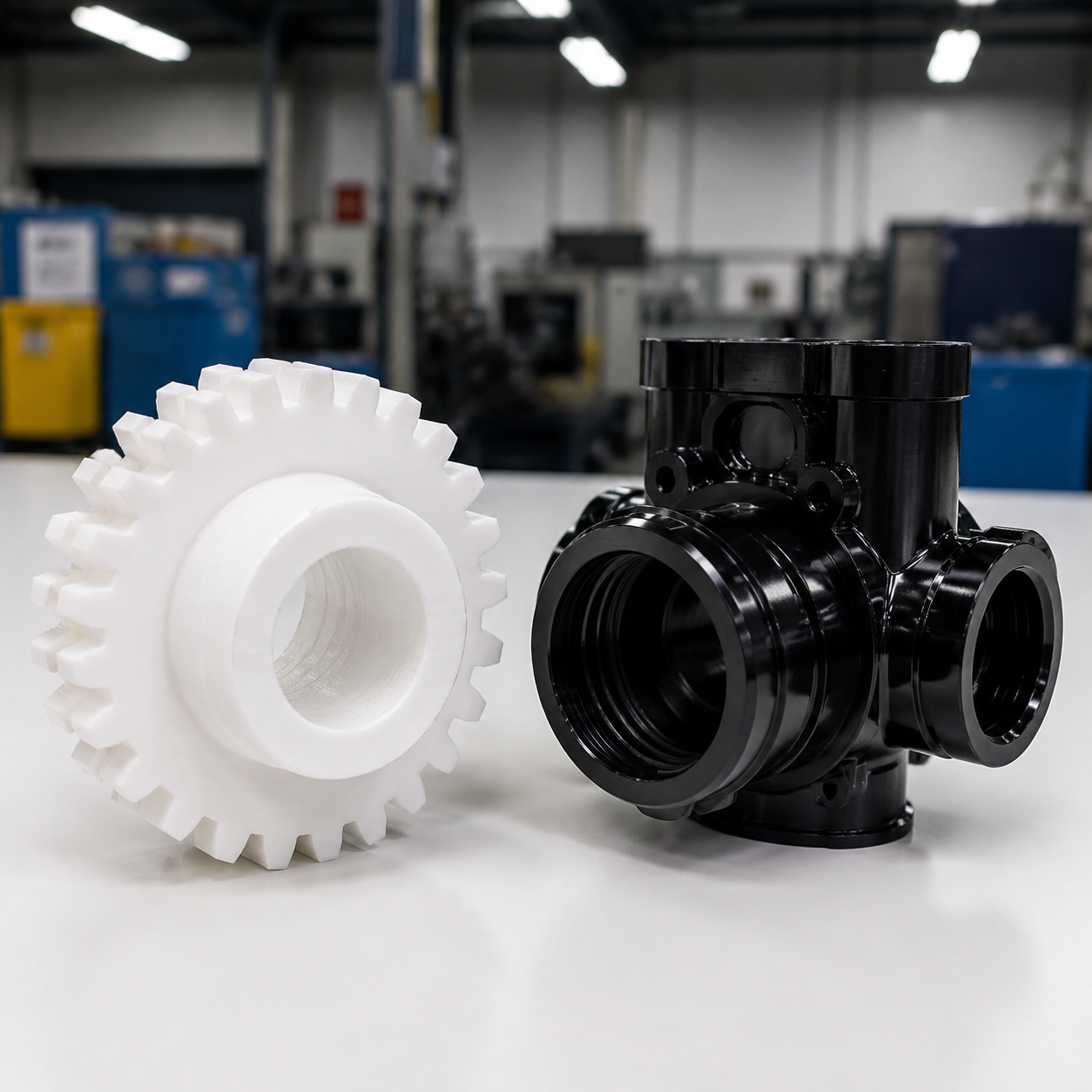
Quick answer for engineers and procurement teams: Delrin is DuPont’s registered brand name for acetal homopolymer (POM-H). When a drawing specifies “acetal” without qualification, suppliers may supply either homopolymer or copolymer (POM-C) — and the two behave differently enough to cause field failures. For tight-tolerance CNC gears, high-cycle fatigue applications, and parts requiring the best surface finish out of the machine — choose Delrin homopolymer. For applications involving hot water, acidic environments, or large-diameter turned parts where centerline porosity would be a problem — choose acetal copolymer.
This guide is written for engineers who need to specify the right material on the PO, not just understand the chemistry. We draw on machining data from over 500 industrial acetal parts produced at our facility, across both grades and three manufacturing processes.
Material Basics: Homopolymer vs Copolymer — What Changes on the Shop Floor
Both grades belong to the polyoxymethylene (POM) family, but their molecular structure differs at a level that affects every downstream process:
- Delrin (POM-H): Uniform repeating -CH2O- units. Higher crystallinity (~75-85%) means harder, stiffer, better fatigue resistance — but also higher residual stress after machining.
- Acetal Copolymer (POM-C): Contains occasional -CH2CH2O- co-monomer units that interrupt crystallinity. This reduces stiffness slightly but dramatically improves chemical resistance and dimensional stability after machining.
Head-to-Head Property Comparison
| Imóveis | Delrin (POM-H) | Acetal Copolymer (POM-C) | Why It Matters |
|---|---|---|---|
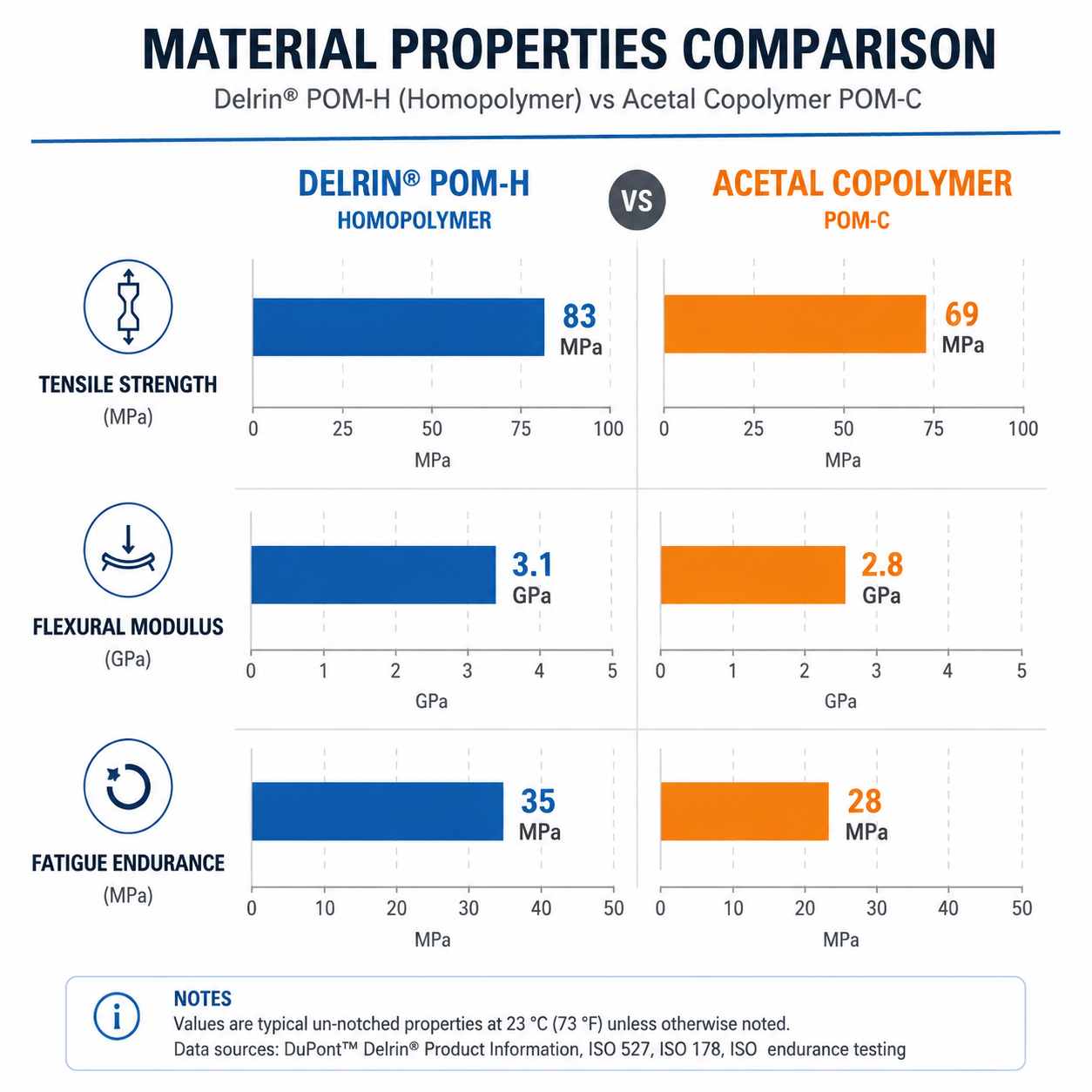
| Resistência à tração (MPa) | 70-83 | 60-69 | Delrin handles ~20% higher static load before yield |
| Módulo de flexão (GPa) | 2.8-3.1 | 2.4-2.8 | Stiffer feel — critical for snap-fit retention force |
| Fatigue Endurance @10&sup6; cycles (MPa) | 35 | 28 | Key differentiator for gears and springs |
| Izod Impact, Notched (J/m @23°C) | 69-122 | 53-163 | Copolymer has wider range; grade selection matters |
| Water Absorption, 24h (%) | 0.25 | 0.22 | Similar at room temp; diverges above 60°C |
| Continuous Service Temp, Max (°C) | 90-100 | 100-110 | Copolymer wins for hot environments |
| Creep Strain after 1000h @23°C, 10MPa (%) | ~0.5 | ~0.8 | Delrin holds dimension better under constant load |
| Coefficient of Friction (dry vs steel) | 0.2-0.35 | 0.25-0.40 | Delrin is slightly more slippery — better for bearings |
Design Rules for Delrin and Acetal Parts
These rules come directly from our CNC machining cell and apply equally to prototype quantities and production runs. Adapt them for molding by adding draft angles (1-2° minimum for both materials).
Design Rules for Acetal Parts (from the Shop Floor)
Based on machining data from 500+ industrial acetal parts produced at our facility (Q1 2026). Apply these directly in your CAD drawings.
| Parâmetro | Delrin (POM-H) | Acetal Copolymer (POM-C) |
|---|---|---|
| Minimum wall thickness | 1.0 mm | 0.8 mm |
| Recommended corner radius | R ≥ 0.5 mm | R ≥ 0.3 mm |
| Hole diameter tolerance (CNC) | ±0.025 mm | ±0.05 mm |
| Maximum aspect ratio (depth/dia) | 6:1 | 5:1 |
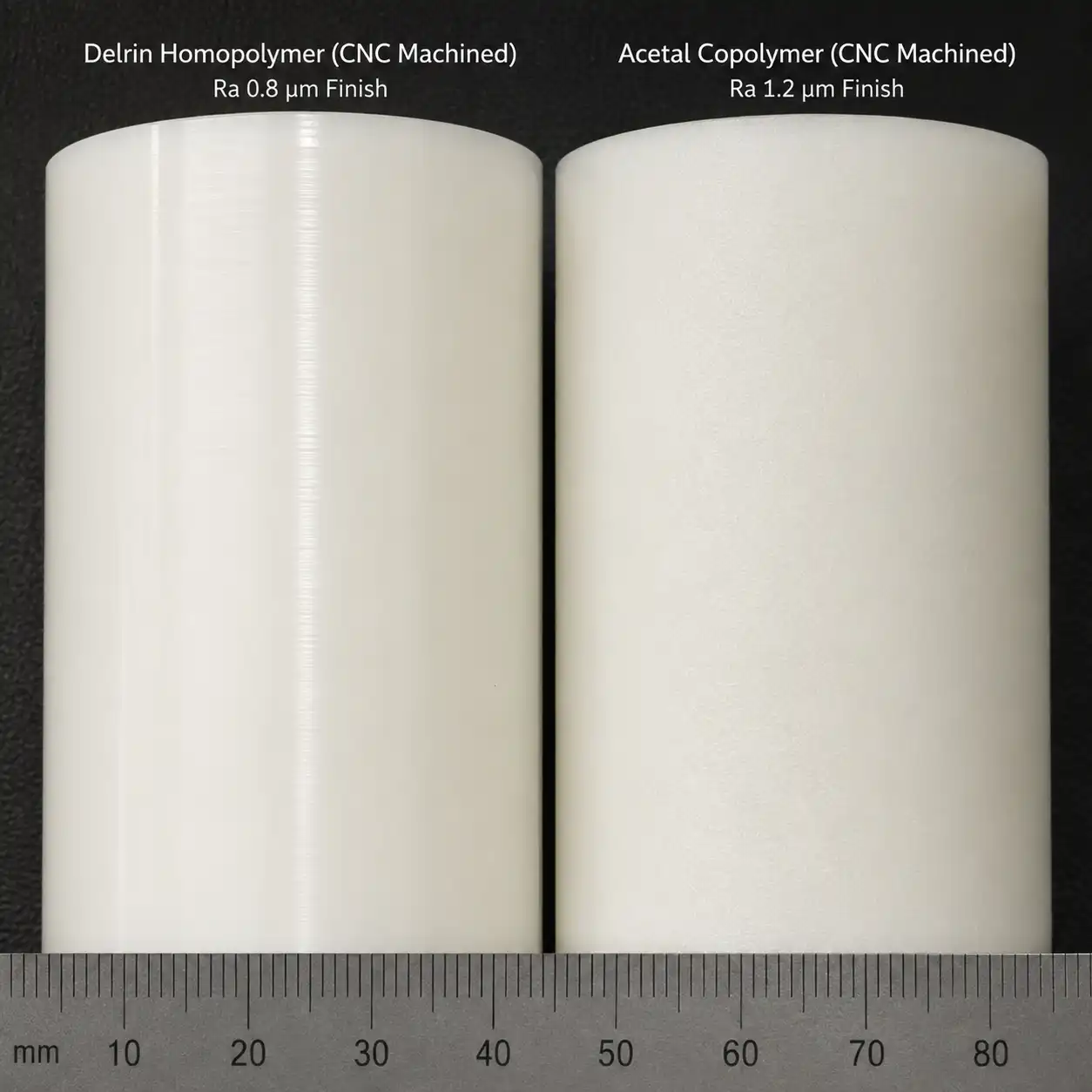
| Surface finish as-machined (Ra) | 0.8 μm | 1.2 μm |
| Post-machining warpage risk | Moderate (stress relief recommended) | Low (better dimensional stability) |
These values assume standard machining conditions at 20°C, sharp carbide tooling, and dry cutting. For injection molding design rules, refer to our engineering team consultation.
Why Centerline Porosity Changes Part Design
One of the least-discussed differences between the two materials is centerline porosity in Delrin extruded rod. As the rod diameter increases beyond 40 mm, POM-H extrusion typically develops a porous center core (0.5-2 mm diameter) due to shrinkage during cooling. If your part design places a critical sealing surface or tight-tolerance bore on the rod centerline, this porosity causes leaks or out-of-spec bores. Copolymer does not have this problem — the co-monomer disrupts crystallization enough to eliminate centerline voids.
Practical rule: If your part has a through-hole or sealing surface passing through the rod center and the rod diameter exceeds 40 mm, specify acetal copolymer. One customer saved 18% on a returned batch for a water valve component by making this single material switch.
Industry Applications: Where Each Grade Wins
| Indústria | Typical Parts | Preferred Grade | Selection Rationale |
|---|---|---|---|
| Automóvel | Fuel system valves, seat belt components, window regulator gears | Delrin (POM-H) | Higher fatigue strength for 100k+ cycle durability; low fuel permeability |
| Dispositivos médicos | Inhaler mechanisms, insulin pen bodies, surgical instrument handles | Acetal Copolymer (POM-C) | Better resistance to sterilization chemicals; lower extractables |
| Máquinas industriais | Conveyor rollers, bearing cages, pump impellers, wear strips | Delrin (POM-H) | Superior wear resistance and low friction (self-lubricating); higher hardness |
| Eletrónica de consumo | Keyboard mechanisms, printer gears, camera lens barrels | Acetal Copolymer (POM-C) | Better hot water resistance for dishwasher-safe applications; lower creep under constant spring load |
| Plumbing & Fluid Handling | Valve seats, shower mixer components, water meter internals | Acetal Copolymer (POM-C) | Lower hot water swelling; avoids centerline porosity issues that can cause leaks in POM-H |
| Food Processing | Filling nozzles, conveyor guides, cutting board liners | Both (FDA-compliant grades) | Use homopolymer for dry-contact apps; copolymer for wet/hot-contact per NSF 51 |
The pattern is clear: Delrin dominates in dynamic mechanical applications (gears, bearings, springs) where fatigue life and low friction are primary requirements. Acetal copolymer dominates in applications involving fluids, chemicals, or sterilization — and anywhere the part geometry makes centerline porosity risky.
Tolerance Comparison by Manufacturing Process
The achievable tolerance depends as much on the manufacturing process as the material choice. Below is a practical reference for engineers writing drawing callouts.
| Manufacturing Process | Delrin (POM-H) Tolerance | Acetal Copolymer (POM-C) Tolerance | Melhor para |
|---|---|---|---|
| Maquinação CNC | ±0.025 mm | ±0.05 mm | Prototypes, low-mid volume (<1,000 pcs), tight-tolerance parts |
| Moldagem por injeção | ±0.10 mm | ±0.08 mm | High volume (>5,000 pcs); copolymer molds more consistently |
| 3D Printing (FDM) | ±0.20 mm | ±0.15 mm | Rapid prototypes only; not recommended for functional testing |
Tolerances are achievable under standard shop conditions. Tighter tolerances available on request with additional process controls.
Note that copolymer’s lower post-machining stress relaxation gives it a slight tolerance advantage in injection molding — the part comes out of the mold closer to its final dimensions and drifts less over the first 72 hours.
Cost Decision Framework: When to Pay for Delrin
Cost Decision Framework: Delrin vs Acetal Copolymer
Material cost is only ~15-20% of total part cost for machined components. The real difference is in process efficiency and rejection rate:
- Raw material price: Delrin rod is typically 10-15% more expensive than generic acetal copolymer rod at the same diameter.
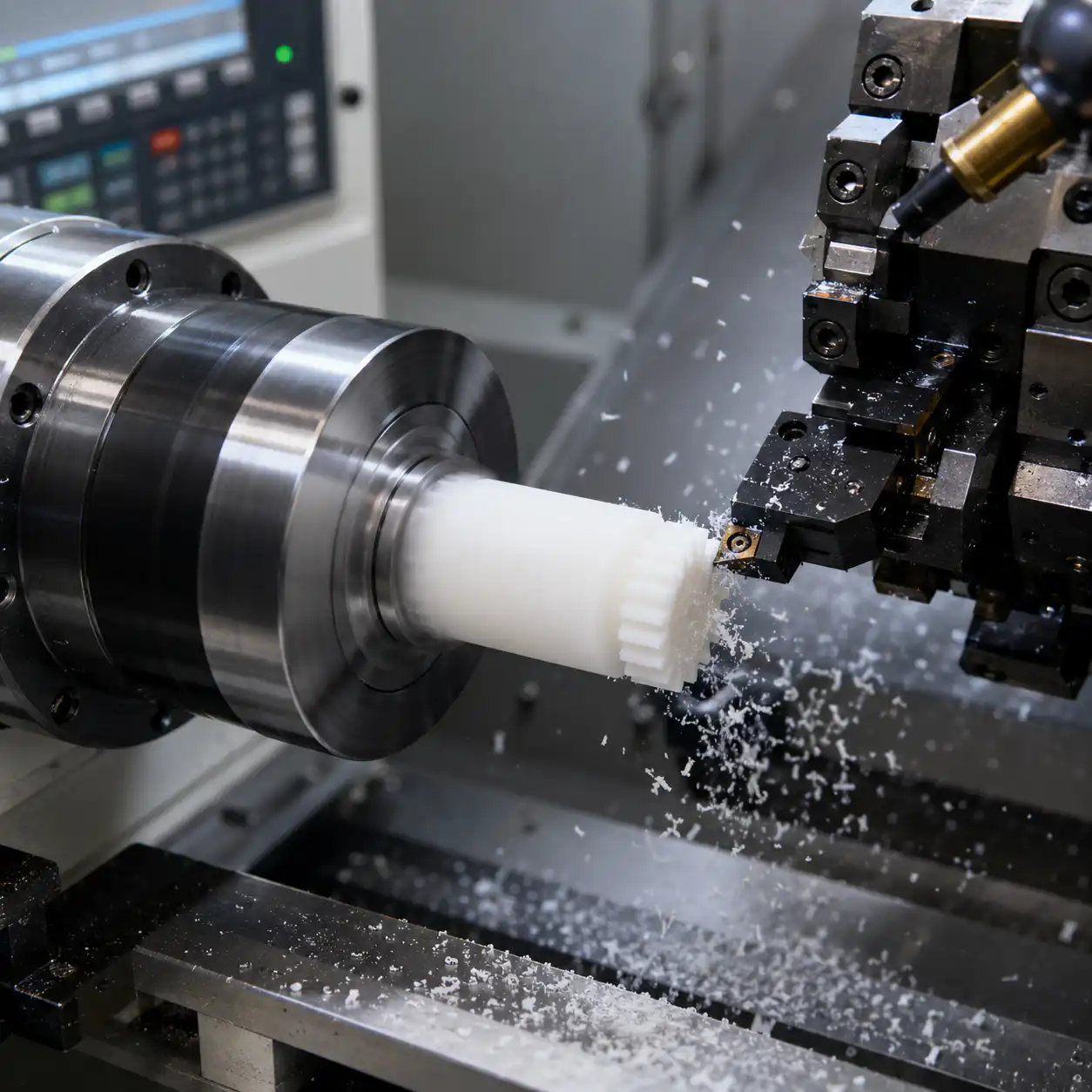
- Machining time: Delrin cuts cleaner and faster — expect 8-12% shorter cycle time per part vs. copolymer at equivalent tolerance.
- Rejection rate (internal data): Copolymer parts have higher visual defects (center porosity streaks) — 3-5% rejection vs. ~1% for Delrin in CNC turning operations.
- Break-even point: If your annual volume exceeds 2,000 parts, the reduced rejection rate of Delrin offsets the raw material premium. Below 2,000, generic copolymer is more cost-effective.
- Hidden cost: Copolymer proposed for dimensional-critical assemblies may accumulate 1-2% scrap from dimensional drift post-machining due to residual stress release over the first 72 hours.
The cost decision often comes down to a simple question: “What happens if this part fails?” For non-critical cosmetic or spacing components, copolymer saves money. For load-bearing, safety-critical, or high-cycle components, the Delrin premium pays for itself in reduced field returns.
Common Defects and How to Fix Them
When an acetal part fails or is rejected at incoming QC, the root cause is often a material mismatch. Here are the four most frequent issues we see when customers bring parts to us for rework:
| Problem | Likely Material Cause | Fix |
|---|---|---|
| Gear tooth wear after < 50k cycles | Copolymer used where homopolymer needed (28 MPa vs 35 MPa fatigue limit) | Switch to Delrin 100 or 150 grade for gears; add PTFE-filled grade (Delrin 500AF) if unlubricated |
| Surface cracking after 6+ months in service | Environmental stress cracking from acidic environment (common in POM-H) | Switch to POM-C; verify chemical compatibility with your process fluid |
| Dimensional growth in hot water application | POM-H absorbs more water at elevated temperature (~0.8% at 80°C) | Use POM-C (0.6% absorption); pre-condition parts by soaking in 60°C water for 24h before final QC |
| Porosity visible on turned surfaces | Centerline porosity — inherent to POM-H extrusion process | Specify POM-C for parts with large turned diameters (>50 mm); request “low-porosity” grade from supplier |
Specifying Acetal Correctly on Your Purchase Order
Avoid the most common procurement mistake: writing “Acetal” on the PO without specifying the grade. A correctly specified PO should include:
- Material family and type: “Acetal Homopolymer (Delrin 150)” or “Acetal Copolymer (equivalent to Celcon M90)”
- Form: “Extruded rod, diameter 50 mm” or “Injection molding pellets”
- Tolerance requirement: “Per ISO 2768-m” or specific callout
- Any special grade requirements: “FDA-compliant,” “UV-stabilized (Delrin 527),” “PTFE-filled (Delrin 500AF)”
This level of specificity prevents the supplier from substituting copolymer for homopolymer when the drawing only says “acetal” — a practice that is more common than most engineers realize.
Conclusion and Recommendations
The Delrin vs acetal decision is not about which material is “better” — it is about matching the right grade to the right application. Use Delrin homopolymer for dynamic mechanical parts where fatigue life, surface finish, and low friction are critical. Use acetal copolymer for fluid-contact applications, hot or chemically aggressive environments, and large-diameter turned parts where centerline porosity is a risk.
Still unsure which grade fits your design? Our engineering team reviews material selection as part of every quote. Send your drawing or 3D file and we will recommend the optimal grade for your application at no charge.
Precision Manufacturing
CNC tolerance ±0.01mm across 50+ engineering plastics
ISO 9001 Certified
Full QC with CMM reports per order
15-25 Day Delivery
Prototype to production, global shipping
Global Shipping
DDP available to US, EU, Asia-Pacific
Get the Complete Engineering Plastics Machining Handbook (PDF)
Covers design rules, tolerance tables, and material selection guides for Delrin, Nylon, PEEK, ABS, PTFE, and 8 more engineering plastics. Based on 15+ years of machining data from our factory floor.
No registration required. Updated Q1 2026.
Artigos relacionados
Perguntas mais frequentes
Can I substitute acetal copolymer for Delrin in an existing gear design without changing dimensions?
Yes, with caveats. Copolymer has approximately 20% lower fatigue endurance (28 MPa vs 35 MPa at 10&sup6; cycles) and slightly higher creep under constant load. For static-load gears operating under moderate torque and thin walls, direct substitution works. For high-cycle dynamic-load gears or non-lubricated bearing sleeves, expect up to 30 microns of additional radial play after the first month of operation. Dimensionally, identical tooling can be used — but if switching from homopolymer to copolymer, consider increasing wall thickness by 8-10% to compensate for lower stiffness.
Why does my CNC machined Delrin part warp after sitting on the shelf for a week?
This is residual stress release — a known characteristic of acetal homopolymer. During extrusion, the outer surface of the rod cools faster than the core, creating a stress gradient. When you machine away material asymmetrically, the stress imbalance causes warpage within 24-72 hours. Three solutions: (1) rough-machine first, let the part rest for 24 hours, then finish-machine; (2) anneal the rod at 160°C for 1 hour per 25 mm of thickness before machining; (3) switch to acetal copolymer for parts with significant asymmetric material removal. We typically recommend annealing for any Delrin part where flatness or cylindricity must stay within 0.05 mm.
Which grade performs better in hot water or steam environments?
Acetal copolymer (POM-C) outperforms Delrin (POM-H) in hot water above 60°C. Copolymer absorbs less water at elevated temperature (~0.6% vs ~0.8% at 80°C), swells less, and is significantly more resistant to hydrolysis — the chemical breakdown of the polymer chain by water. For applications like shower mixer components, dishwasher parts, or coffee machine internals, copolymer is the standard choice. If the application also requires FDA compliance, specify a food-grade copolymer such as Celcon M25 or equivalent.
What surface finishes are available for Delrin and acetal copolymer parts?
As-machined Delrin achieves the best natural finish (Ra 0.8 μm with sharp carbide tooling at 5,000-8,000 RPM). Acetal copolymer as-machined is typically Ra 1.0-1.2 μm. Neither material accepts paint or plating well due to low surface energy. Bead blasting produces a uniform matte finish on both (Ra 2.0-3.0 μm) and is the most common secondary finish. For a glossy appearance, flame polishing works on both grades but requires careful temperature control to avoid surface melting. Neither material should be vapor-polished (common for acrylic) — the solvents used attack acetal.


 English
 Dutch
Dutch German
 French
 Korean
 Russian
 Japanese
 Spanish
 Vietnamese
 Chinese
 Portuguese
 Arabic