

Comprehensive technical data on nylon/PA material properties — thermal, mechanical, chemical resistance, electrical, and comparison tables across grades.
Overview of Nylon Material Properties
Nylon (polyamide) materials occupy a unique position in engineering thermoplastics: they offer the highest combination of strength, toughness, and wear resistance among non-reinforced plastics, while remaining processable on standard injection molding and extrusion equipment. This technical reference compiles the key properties that engineers, designers, and procurement specialists need when evaluating nylon for specific applications.
All data in this reference applies to conditioned material (23°C, 50% RH) unless otherwise noted. Moisture content significantly affects mechanical properties — dry-as-molded values can be 20-40% higher than conditioned values for unfilled nylon.
Mechanical Properties by Nylon Grade
Tensile Properties:
| Tài sản | PA6 | PA66 | PA46 | PA12 | PA6-GF30 | PA66-GF30 |
|---|---|---|---|---|---|---|
| Độ bền kéo (MPa) | 80 | 82 | 90 | 55 | 170 | 185 |
| Độ giãn dài khi đứt (%) | 150 | 60 | 45 | 200 | 3 | 3 |
| Tensile Modulus (GPa) | 2.8 | 3.0 | 3.2 | 1.7 | 9.0 | 10.0 |
| Flexural Strength (MPa) | 100 | 110 | 130 | 75 | 240 | 270 |
| Mô đun uốn (GPa) | 2.6 | 2.8 | 2.9 | 1.6 | 8.5 | 9.2 |
| Notched Izod Impact (J/m) | 55 | 45 | 60 | 45 | 100 | 105 |
| Unnotched Izod (J/m) | No break | No break | 450 | No break | 600 | 700 |
Key Observations: – PA6 has higher elongation (more ductile) but PA66 has higher strength – Glass fiber reinforcement (GF30 = 30% glass fiber) increases strength 2-2.5× but dramatically reduces ductility – PA46 outperforms all standard nylons in both strength and thermal resistance, at higher cost – PA12 is the softest and most flexible — lowest strength but best impact resistance at low temperatures
Thermal Properties
Thermal performance is often the deciding factor in grade selection:
| Tài sản | PA6 | PA66 | PA46 | PA12 | PA6-GF30 |
|---|---|---|---|---|---|
| Melting Point (°C) | 225 | 265 | 295 | 180 | 225 |
| Glass Transition Temp (°C) | 50-60 | 65-70 | 75 | 40-45 | 50-60 |
| HDT @ 0.45 MPa (°C) | 170 | 250 | 285 | 145 | 215 |
| HDT @ 1.82 MPa (°C) | 65 | 90 | 160 | 55 | 195 |
| Continuous Service Temp (°C) | 100-115 | 130-150 | 170-180 | 80-95 | 140-160 |
| Thermal Conductivity (W/m·K) | 0.25 | 0.25 | 0.30 | 0.23 | 0.47 |
| Specific Heat (J/g·K) | 1.7 | 1.7 | 1.4 | 1.6 | 1.3 |
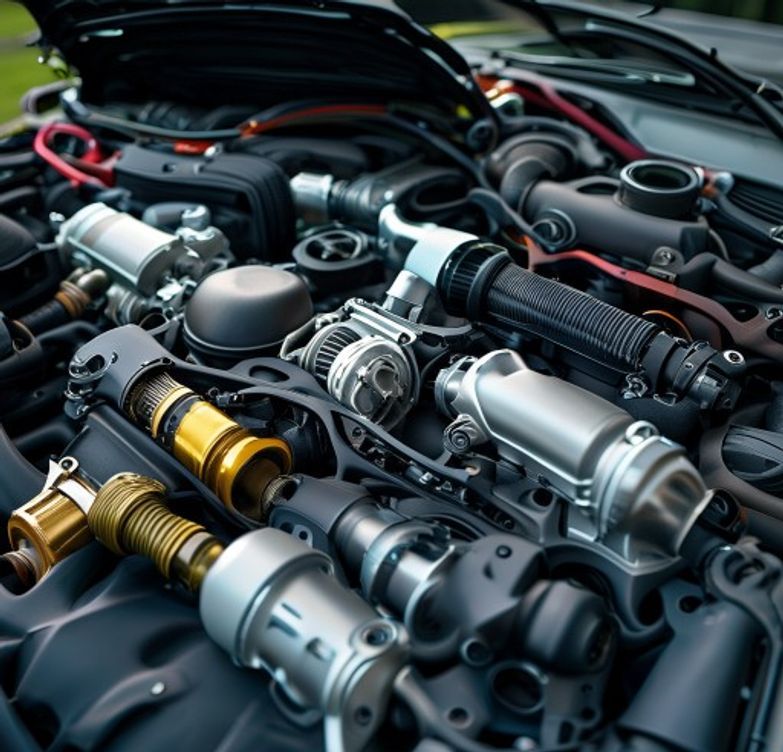
HDT Notes: – Heat Deflection Temperature (HDT) measures temperature at which a specimen deflects 0.25mm under specified load – Glass fiber reinforcement dramatically improves HDT — GF30 grades achieve 2-3× the HDT of unfilled grades at 1.82 MPa – PA66-GF30 at 1.82 MPa: 250°C — suitable for under-hood automotive applications – PA12’s low HDT limits use to room-temperature applications
PC 3D Printing Guide Engineering Plastics Cost Outdoor Plastic Selection Nylon Moisture Drying Guide Nylon Chemical Resistance
Moisture Absorption and Environmental Effects
Nylon’s moisture absorption is a critical consideration — more so than almost any other engineering plastic:
| Hạng | Moisture Absorption (24h, 50% RH) | Moisture Absorption (saturation, 23°C/50% RH) | Equilibrium Humidity |
|---|---|---|---|
| PA6 | 1.6% | 9.5% | 2.5-3.0% |
| PA66 | 1.2% | 8.5% | 2.5% |
| PA46 | 1.2% | 6.5% | 2.0% |
| PA12 | 0.3% | 1.5% | 0.7% |
| PA11 | 0.4% | 2.0% | 0.8% |
Impact of Moisture on Properties: – Tensile strength decreases 15-25% at saturated condition vs. dry-as-molded – Impact resistance INCREASES with moisture absorption (nylon becomes tougher when conditioned) – Dimensional change: PA6 swells approximately 0.4% per 1% moisture absorbed — must be accounted for in precision parts – Electrical insulation properties degrade significantly with moisture (dielectric constant increases 2×)
Design Recommendations: – PA12 for parts exposed to humid environments or water immersion – Dry-as-molded properties for designing dimensional tolerances in molds – Condition parts to equilibrium before measuring critical dimensions
Chemical Resistance of Nylon
Nylon’s chemical resistance profile determines suitability for industrial environments:
Good Resistance (no significant attack at 23°C): – Aliphatic hydrocarbons (gasoline, mineral oils, diesel) – Alcohols (methanol, ethanol, isopropanol) – Esters and ketones (acetone, MEK — limited exposure) – Weak acids (acetic acid, citric acid — verify case-by-case) – Dilute alkalis and salts
Poor Resistance (attack or degradation): – Concentrated mineral acids (HCl, H2SO4, HNO3) — rapid hydrolysis – Strong oxidizing agents (hydrogen peroxide >10%) – Phenol and formic acid — dissolves nylon – Calcium chloride (desiccant) — causes stress cracking – Strong alkalis at elevated temperature
Specialty Grades for Chemical Service: – PA12 for automotive fuel lines — resistant to aromatic fuels and alcohol blends – PA6I/6T (transparent nylon) for chemical contact applications requiring clarity – Glass-filled grades for chemical pump housings and valve components
Electrical and Flammability Properties
Electrical Properties (at 50% RH conditioning):
| Tài sản | PA6 | PA66 | PA12 |
|---|---|---|---|
| Dielectric Strength (kV/mm) | 20 | 20 | 18 |
| Volume Resistivity (Ω·cm) | 10^15 | 10^15 | 10^14 |
| Surface Resistivity (Ω) | 10^13 | 10^13 | 10^12 |
| Dielectric Constant (1 MHz) | 3.8 | 3.6 | 3.1 |
| Dissipation Factor (1 MHz) | 0.02 | 0.02 | 0.03 |
Flammability Ratings:
| Hạng | UL94 Rating | Oxygen Index (%) |
|---|---|---|
| — | — | PA6 |
| HB | 24 | PA66 |
| HB | 24 | PA12 |
| HB | 22 | PA6-GF30 |
| HB | 23 | FR grades |
| V-0 | 32+ |
Nylon burns with a self-sustaining flame and drips. For electrical enclosures or components requiring flame retardancy, specify FR (flame retardant) grades — typically PA66 with halogen or phosphorus-based flame retardants.
ESD properties + 5x stiffness — specialty line
Custom nylon parts from CAD to delivery — ISO9001
Câu hỏi thường gặp
When is Nylon Material Properties: A Complete Technical Reference a good option?
Nylon Material Properties: A Complete Technical Reference is a good option when fast iteration, complex geometry, low tooling cost, or low-volume production is more important than molded-part unit cost.
What should be checked before choosing Nylon Material Properties: A Complete Technical Reference?
Kiểm tra kích thước chi tiết, tính chất vật liệu, độ nhám bề mặt, dung sai kích thước, mức độ tiếp xúc với nhiệt, hướng tải trọng và xem có cần xử lý sau gia công hay không.
How does Nylon Material Properties: A Complete Technical Reference compare with CNC machining?
In 3D có thể tạo ra các hình dạng phức tạp một cách nhanh chóng, trong khi gia công CNC thường mang lại độ bền cao hơn cho các bề mặt chính xác, dung sai chặt chẽ hơn và sử dụng vật liệu đạt tiêu chuẩn sản xuất.
What affects the cost of Nylon Material Properties: A Complete Technical Reference?
Chi phí phụ thuộc vào vật liệu, thể tích in, thời gian in, độ dày lớp, việc tháo khung đỡ, hoàn thiện, kiểm tra và số lượng chi tiết trong mô hình.


 English
  Dutch
Dutch  German
  French
  Korean
  Russian
  Japanese
  Spanish
  Vietnamese
  Chinese
  Portuguese
  Arabic