

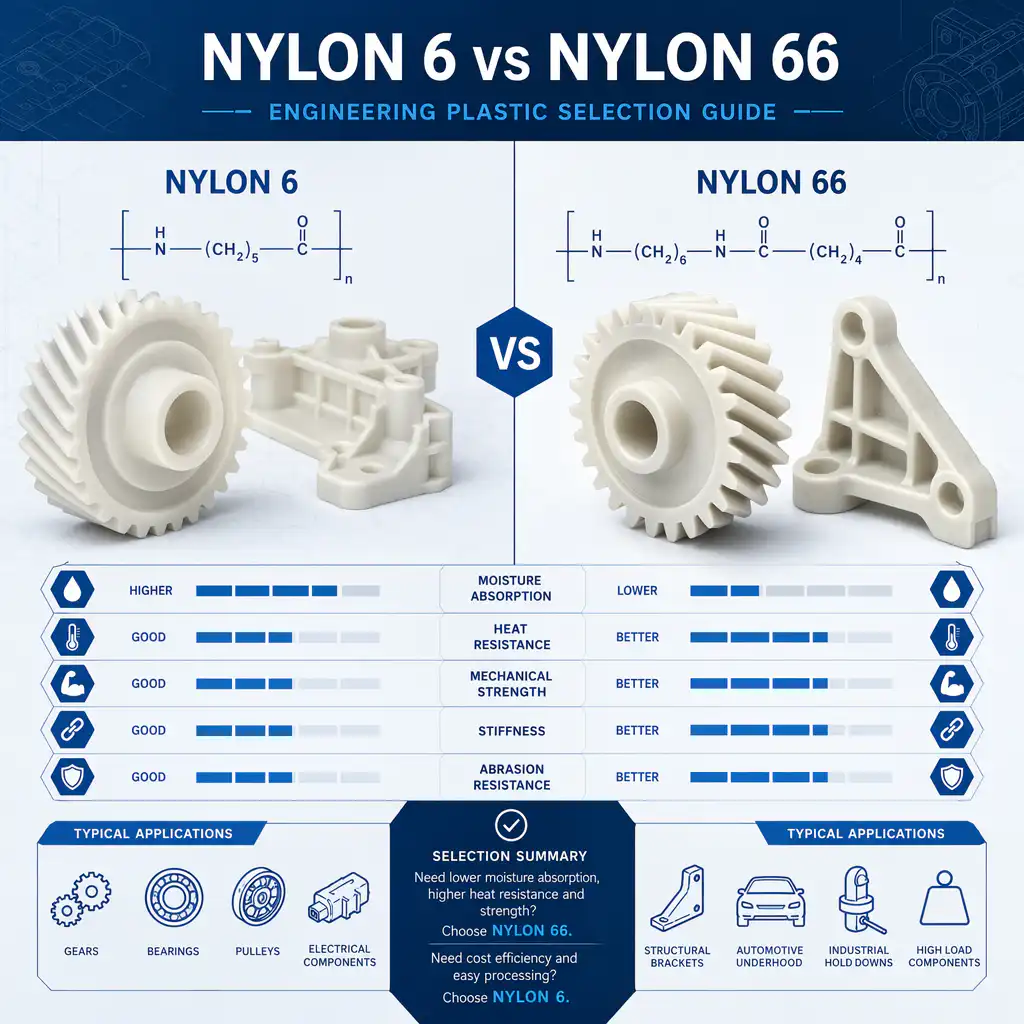
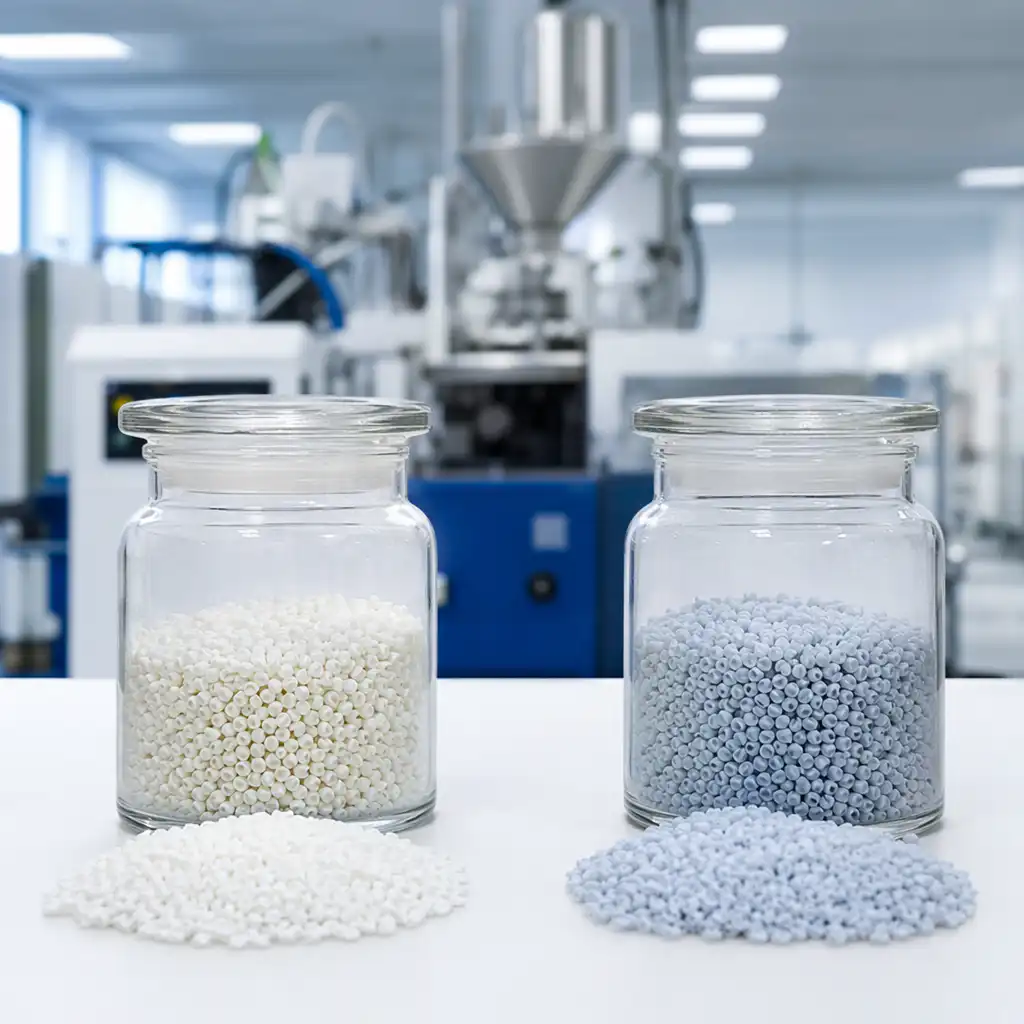
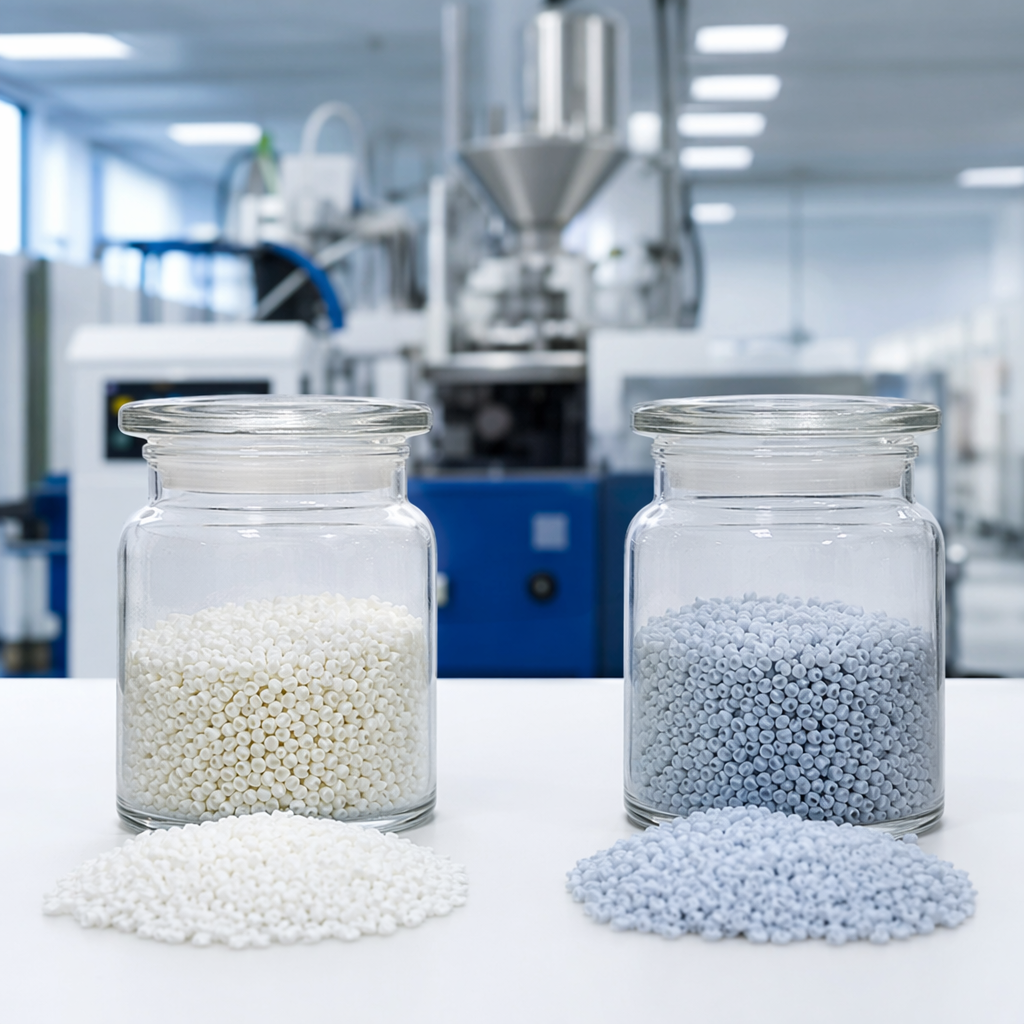
Chemical Structure Differences
The fundamental difference between PA6 (Nylon 6) và PA66 (Nylon 66) lies in their molecular structure:
- Nylon 6: Made from caprolactam, has 6 carbon atoms in each repeating unit. Less crystalline structure.
- Nylon 66: Made from hexamethylenediamine and adipic acid, has two 6-carbon chains. More crystalline structure.
Mechanical Properties Comparison
| Tài sản | PA6 | PA66 |
|---|---|---|
| Độ bền kéo | 70-85 MPa | 80-100 MPa |
| Hệ số uốn | 2.5-3.0 GPa | 2.8-3.5 GPa |
| Độ giãn dài khi đứt | 30-100% | 15-60% |
| Notched Izod Impact | 50-100 J/m | 40-80 J/m |
| Điểm nóng chảy | 220°C | 260°C |
| HDT at 1.8 MPa | 70°C | 90°C |
Khả năng hấp thụ độ ẩm
Moisture absorption is critical for nylon applications:
| Condition | PA6 | PA66 |
|---|---|---|
| At 50% RH | 2.5-3.0% | 2.0-2.5% |
| Saturation | 8-10% | 6-8% |
Processing Characteristics
Nylon 6 Processing
- Melting Point: 220°C
- Processing Range: 240-280°C
- Nhiệt độ khuôn: 40-80°C
Nylon 66 Processing
- Melting Point: 260°C
- Processing Range: 280-320°C
- Nhiệt độ khuôn: 60-90°C
Applications by Material
Nylon 6 Applications
- Gears and sprockets
- Industrial monofilament
- Film and packaging
- Consumer products
Nylon 66 Applications
- Automotive under-hood components
- Electrical connectors
- High-temperature bearings
- Precision mechanical components
Reinforced Grades
Both materials are commonly reinforced with glass fiber:
| Hạng | PA6 + GF30 | PA66 + GF30 |
|---|---|---|
| Độ bền kéo | 140-160 MPa | 170-200 MPa |
| HDT (1.8 MPa) | 205°C+ | 250°C+ |
| Khả năng hấp thụ độ ẩm | 1.0-1.5% | 0.8-1.2% |
Selection Summary
Choose Nylon 6 when:
- Impact resistance is critical
- Cost sensitivity is high
- Operating temperatures are moderate
Choose Nylon 66 when:
- Higher mechanical strength is required
- Elevated temperatures are expected
- Dimensional stability is critical
Câu hỏi thường gặp
When is Nylon 6 vs Nylon 66 — Engineering Plastic Selection Guide a good option?
Nylon 6 vs Nylon 66 — Engineering Plastic Selection Guide is a good option when fast iteration, complex geometry, low tooling cost, or low-volume production is more important than molded-part unit cost.
What should be checked before choosing Nylon 6 vs Nylon 66 — Engineering Plastic Selection Guide?
Kiểm tra kích thước chi tiết, tính chất vật liệu, độ nhám bề mặt, dung sai kích thước, mức độ tiếp xúc với nhiệt, hướng tải trọng và xem có cần xử lý sau gia công hay không.
How does Nylon 6 vs Nylon 66 — Engineering Plastic Selection Guide compare with CNC machining?
In 3D có thể tạo ra các hình dạng phức tạp một cách nhanh chóng, trong khi gia công CNC thường mang lại độ bền cao hơn cho các bề mặt chính xác, dung sai chặt chẽ hơn và sử dụng vật liệu đạt tiêu chuẩn sản xuất.
What affects the cost of Nylon 6 vs Nylon 66 — Engineering Plastic Selection Guide?
Chi phí phụ thuộc vào vật liệu, thể tích in, thời gian in, độ dày lớp, việc tháo khung đỡ, hoàn thiện, kiểm tra và số lượng chi tiết trong mô hình.
Nylon 6 vs Nylon 66 — Frequently Asked Questions
Is Nylon 66 stronger than Nylon 6?
Yes. Nylon 66 typically offers 15-25% higher tensile strength (80-100 MPa vs 70-85 MPa) due to more crystalline structure.
Which nylon is better for gears?
Both work well. PA6 is preferred for impact-loaded gears due to higher toughness. PA66 is better for high-load, high-temperature applications.
Where can I source quality PA6 and PA66 granules?
Nylonplastic supplies both grades in natural, colored, and reinforced versions. Contact us for samples.

 English
 Dutch
Dutch German
 French
 Korean
 Russian
 Japanese
 Spanish
 Vietnamese
 Chinese
 Portuguese
 Arabic