What Is Polyacetal Material? Understanding POM Homopolymer and Copolymer
Polyacetal material, chemically known as polyoxymethylene and commonly abbreviated as POM, is a high-performance engineering thermoplastic characterized by exceptional dimensional stability, low friction, and high stiffness. It ranks alongside nylon and polycarbonate as one of the most widely specified engineering plastics for precision mechanical components. POM is produced in two primary forms: homopolymer and copolymer, each with distinct properties that make them suitable for different applications.
The chemical backbone of polyacetal material consists of repeating methylene oxide units. POM homopolymer is polymerized from formaldehyde, forming a linear chain of -CH2-O- repeating units with acetate end groups for thermal stabilization. POM copolymer incorporates a small percentage of comonomer units, typically oxyethylene linkages, which interrupt the regular chain structure. These comonomer units serve as thermal degradation stops, providing the copolymer with superior thermal stability and chemical resistance compared to the homopolymer.
This structural difference has practical implications for buyers and engineers. Homopolymer POM offers slightly higher crystallinity, translating to marginally better strength and stiffness. Copolymer POM provides better resistance to hot water, alkaline solutions, and thermal-oxidative degradation. For most injection molding applications, both grades deliver excellent performance, though copolymer is often preferred for parts exposed to hot water or aggressive cleaning chemicals.

About Our Engineering Plastics Supply
As an ISO 9001 certified engineering plastics manufacturer and exporter based in China, we specialize in providing high-quality nylon (PA6, PA66, PA12), polyacetal (POM), thermoplastic polyurethane (TPU), polypropylene (PP), and specialty engineering compounds to B2B buyers worldwide. Our products include glass fiber reinforced, carbon fiber filled, flame retardant, and custom-modified grades tailored to your application requirements. With in-house testing laboratories and a dedicated R&D team, we ensure consistent quality across every batch. Whether you need standard grades or custom formulations, we deliver reliable material solutions for automotive, electronics, industrial, and consumer goods applications.
Key Mechanical and Thermal Properties of Polyacetal Material
Polyacetal material delivers a balanced profile of mechanical and thermal properties that make it a go-to choice for precision engineering components. Its tensile strength ranges from 60 to 70 MPa for unfilled grades, with a tensile modulus of 2,600 to 3,200 MPa. These values approach those of die-cast metals while maintaining the processing advantages of a thermoplastic.
Stiffness and Dimensional Stability
POM stands out for its rigidity: the flexural modulus typically ranges from 2,500 to 3,000 MPa, making it one of the stiffest unfilled thermoplastics available. Combined with a low coefficient of linear thermal expansion (approximately 110 x 10 to the power of negative 6 per degree Kelvin), this stiffness ensures that POM parts maintain tight tolerances across temperature variations. This predictability is essential for gear meshing, snap-fit assemblies, and bearing applications where clearance must be tightly controlled.
Low Friction and Wear Resistance
The lubricious surface of polyacetal material provides a low coefficient of friction, typically 0.2 to 0.35 against steel in dynamic applications. This self-lubricating behavior eliminates the need for external lubrication in many applications, reducing maintenance requirements and preventing contamination. The wear resistance is further enhanced in modified grades containing PTFE, silicone, or MoS2 additives, which can reduce the wear factor by 50% or more in high-load bearing applications.
Thermal Performance
Unfilled POM has a heat deflection temperature (HDT) of approximately 110 degrees Celsius at 1.82 MPa and a melting point of 165 degrees Celsius for homopolymer and 175 degrees Celsius for copolymer. The continuous service temperature is typically 90 to 105 degrees Celsius, with short-term peaks allowable to 140 degrees Celsius. For applications requiring higher thermal resistance, glass fiber reinforced POM grades push HDT values to approximately 160 degrees Celsius.
Advantages Over Metals in Precision Parts
Polyacetal material increasingly replaces metals in precision components for several compelling reasons. First, POM parts are significantly lighter, with a density of approximately 1.41 grams per cubic centimeter compared to 2.7 for aluminum or 7.8 for steel. This weight reduction is particularly valuable in automotive and aerospace applications where every gram of mass saved translates to improved fuel efficiency.
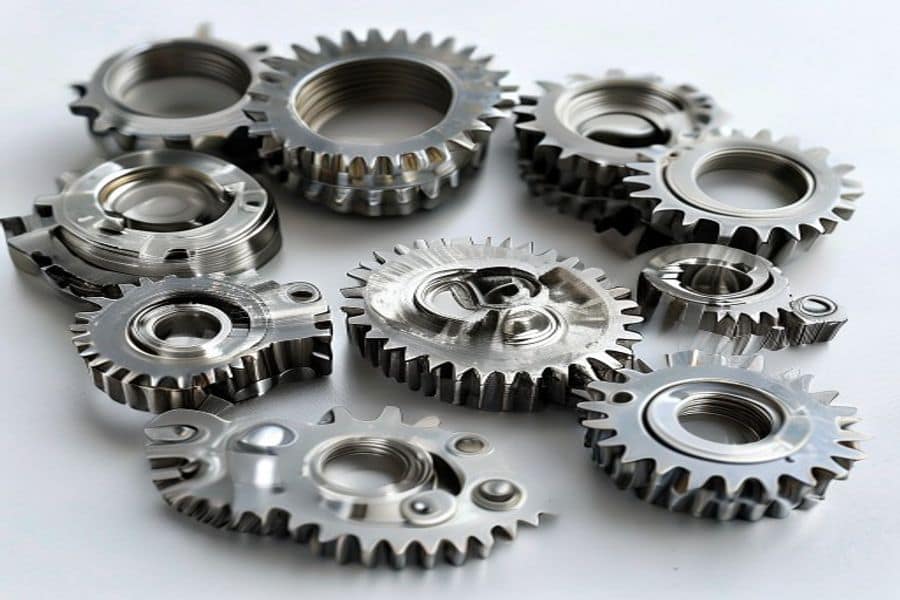
Second, injection molding allows POM to be formed into complex geometries in a single processing step, eliminating multiple machining operations, assembly, and finishing required for metal parts. A POM gear, for example, can be molded with integrated bearing surfaces, snap features, and mounting bosses in one shot, while a metal equivalent requires separate manufacturing steps for the gear teeth, bore, keyway, and retention features.
Third, POM provides inherent noise and vibration damping. Metal gears and bearings transmit vibration efficiently, leading to audible noise in consumer products and industrial machinery. POM parts absorb vibration energy, resulting in quieter operation. They also provide electrical insulation, eliminating ground loops and galvanic corrosion concerns that arise with metal components in electronic assemblies.
Processing Guidelines for Injection Molding POM
Successful injection molding of polyacetal material requires attention to several processing parameters that differ from those of commodity thermoplastics. POM is a semi-crystalline polymer with a sharp melting point and relatively low melt viscosity, which impacts both mold filling behavior and shrinkage characteristics.
Material Preparation
POM absorbs minimal moisture compared to nylons, typically reaching equilibrium at 0.2 to 0.3% moisture content. While pre-drying is generally not required for standard processing, stored material should be kept sealed to prevent surface moisture condensation. If moisture-related defects appear, drying at 80 degrees Celsius for 2 to 3 hours resolves the issue.
Melt and Mold Temperature
Melt temperatures for POM homopolymer range from 180 to 210 degrees Celsius, while copolymer requires 190 to 215 degrees Celsius. Temperatures exceeding 230 degrees Celsius risk thermal degradation, which releases formaldehyde gas. Adequate ventilation and careful temperature control are essential. Mold temperatures of 60 to 120 degrees Celsius are recommended, with higher temperatures producing better crystallinity, improved dimensional stability, and enhanced surface finish. For high-precision parts, mold temperature control within a 5-degree Celsius range is recommended.
Shrinkage and Warpage
POM exhibits relatively high mold shrinkage, typically 1.8 to 2.5% for unfilled grades. This shrinkage is anisotropic, differing between flow and transverse directions. Proper mold design accounting for directional shrinkage is critical for achieving dimensional accuracy in precision components like gears, where tooth profile and pitch diameter must be held to tight tolerances.
Industry Applications Across Automotive, Plumbing, Consumer, and Industrial
Automotive Sector
Polyacetal material is ubiquitous in automotive manufacturing. Fuel-system components, including fuel sender housings, pump impellers, and filler necks, rely on POM for its fuel resistance and dimensional stability. Seat-belt mechanisms, including buckle housings, retractor gears, and D-ring guides, use POM for its strength and predictable wear behavior under millions of engagement cycles. Steering column components, window regulator brackets, and door lock assemblies also favor POM for its combination of stiffness, low friction, and fatigue resistance.
Plumbing and Fluid Handling
In plumbing, POM is the material of choice for shower heads, ballcocks, faucet cartridges, and valve components. Its hot water resistance, dimensional stability, and resistance to scaling and mineral deposits ensure reliable performance over years of service. Copolymer POM is particularly suited to these applications because of its superior resistance to hot water degradation and chemical attack from water treatment additives.
Sản phẩm tiêu dùng
Polyacetal material appears in countless everyday items that consumers rarely notice but depend on. Zippers use POM teeth for smooth operation and long-term durability. Lighter bodies leverage POM’s combination of chemical resistance to lighter fluid and dimensional stability. Toys, garden sprayers, stereo components, and kitchen appliance mechanisms all benefit from POM’s balance of toughness, lubricity, and moldability. The material’s ability to be colored during molding also enhances product aesthetics without secondary finishing.
Ứng dụng công nghiệp
Industrial machinery depends heavily on POM components. Couplings, pump impellers, conveyor plates, and material handling components use the material for wear resistance and dimensional accuracy. Gears, sprockets, and springs in power transmission systems leverage fatigue resistance and predictable elastic recovery. Tool holders, jigs, and fixtures benefit from POM’s machinability and stiffness when metal alternatives would be cost-prohibitive or electrically unsuitable.
Design Considerations for POM Parts
Designing with polyacetal material requires attention to several factors that influence part quality and long-term performance. Wall thickness should be as uniform as possible to minimize differential shrinkage and warpage. Recommended wall thickness ranges from 0.8 mm for small components to 4 mm for larger structural parts, with the optimum being 1.5 to 3 mm. Sharp corners should be avoided in favor of generous radii, typically 0.3 times the nominal wall thickness at internal corners and 1.5 times at external corners.
Gate location is particularly important for POM because of its anisotropic shrinkage. For gears and round parts, center gating is preferred to promote radial flow and consistent shrinkage. Ribbing should be 50 to 60% of the nominal wall thickness to avoid sink marks while providing adequate reinforcement. Snap-fit features must account for strain rate sensitivity: POM has excellent spring-back for press-fit and snap-fit designs, but repeated deflection beyond 2% strain can cause permanent deformation.
Post-molding annealing can improve dimensional stability for high-tolerance parts. Annealing at a temperature 10 to 20 degrees Celsius below the heat deflection temperature for 30 to 60 minutes per millimeter of wall thickness relieves molding stresses and stabilizes crystallinity.
Comparison with Nylon and Other Engineering Plastics
POM vs. Nylon (PA6 and PA66)
POM and nylon serve overlapping but distinct roles in engineering applications. POM offers lower moisture absorption (0.2% vs. 2.5 to 3.5% for unfilled nylon), resulting in far better dimensional stability in humid environments. POM also provides superior creep resistance, lower friction, and better fatigue endurance. Nylon, however, offers higher impact resistance, better resistance to hydrocarbons and aromatic solvents, and higher continuous use temperature. For bearing and sliding applications where dimensional stability is critical, POM often outperforms nylon. For structural components exposed to impact loads or aggressive chemical environments, nylon may be the better choice.
POM vs. Polycarbonate
Polycarbonate provides better impact strength and optical clarity compared to POM, but it is more susceptible to chemical stress cracking and cannot match the wear resistance or lubricity of polyacetal material. For transparent applications or parts requiring high impact resistance, polycarbonate is preferred. For wear surfaces, precision mechanical components, and applications exposed to oils and greases, POM is superior.
POM vs. Die-Cast Metals
When replacing die-cast zinc or aluminum with POM, engineers must account for differences in modulus (POM is lower), thermal expansion (POM is higher), and creep behavior under sustained load. Design reinforcements, including ribbing and gussets, compensate for lower modulus. Thermal expansion differences require careful analysis of clearance fits in assemblies containing both metal and POM components. The trade-off delivers significant weight savings, cost reduction through part consolidation, and elimination of secondary machining.
Frequently Asked Questions About Polyacetal Material
Which is better for wet environments, POM homopolymer or copolymer?
POM copolymer is generally preferred for wet environments and applications involving exposure to hot water or alkaline solutions. The oxyethylene comonomer units in the copolymer chain provide thermal degradation stops that prevent chain unzipping, giving it superior resistance to hydrolytic degradation. For shower heads, plumbing fixtures, and food service equipment, copolymer POM is the recommended choice and widely specified by manufacturers.
Can polyacetal material be bonded or welded?
POM is one of the more difficult thermoplastics to bond because of its low surface energy and chemical resistance. Conventional adhesives often fail to form strong bonds with untreated POM surfaces. However, surface pretreatment methods including plasma treatment, corona discharge, chromic acid etching, and flame treatment can significantly improve bond strength. Ultrasonic and friction welding are more commonly used for joining POM parts to themselves, as the molten material fuses readily when the interface reaches melt temperature.
Is POM FDA-approved for food contact?
Certain grades of POM copolymer are compliant with FDA regulations for food contact applications, specifically 21 CFR 177.2470 for repeated-use food contact surfaces. These grades are formulated without prohibited additives and meet extractive limits defined in the regulation. Buyers should verify certification with their supplier and ensure that any colorants, fillers, or processing aids used during molding also carry FDA compliance for food contact use.
What causes formaldehyde odor during POM processing, and is it dangerous?
Formaldehyde is released when POM thermally degrades during processing, particularly if the melt temperature exceeds 230 degrees Celsius or if the material is held at elevated temperatures for too long. While the concentration in a properly ventilated injection molding environment is typically below occupational exposure limits, adequate local exhaust ventilation is essential. If a persistent formaldehyde odor is detected, processing temperatures should be reduced, residence time minimized, and ventilation systems inspected. The odor serves as a useful warning indicator of thermal degradation before it causes visible defects in molded parts.