

When engineers compare pla+ vs pla for real-world applications, they need more than anecdotal experience. They need quantified data on strength, thermal behavior, and print quality. This article provides a detailed, data-driven comparison of the mechanical and thermal properties that matter most for functional 3D printed parts.
PLA+ vs PLA: Tensile Strength Comparison
Tensile strength measures how much pulling force a material can withstand before breaking. In the pla+ vs pla comparison, this is where the most consistent difference appears:
| Test Specimen | Standard PLA | PLA+ (Brand A) | PLA+ (Brand B) |
|---|---|---|---|
| Tensile at Yield | 48-52 MPa | 52-58 MPa | 55-62 MPa |
| Tensile at Break | 42-48 MPa | 48-55 MPa | 50-58 MPa |
| Young’s Modulus | 3.0-3.5 GPa | 2.8-3.3 GPa | 2.9-3.4 GPa |
| Dehnung beim Bruch | 3-5% | 7-15% | 10-18% |
Heat Resistance: The Overlooked Differentiator
Heat resistance is measured by the Heat Deflection Temperature (HDT), which indicates the temperature at which a material begins to soften under load. When comparing pla+ vs pla in thermal performance, the differences are modest but can be significant in specific applications.
Standard PLA begins softening noticeably around 50-55°C. PLA+ typically adds 3-5°C to this threshold, reaching 55-60°C. While this seems minor, it can mean the difference between a part surviving in a hot car in summer (interior temperatures can reach 55-65°C in direct sunlight) or deforming within minutes. For parts intended for indoor use or temperature-controlled environments, this difference is irrelevant. For automotive interiors, kitchen appliances, or outdoor installations, it becomes critical.
Impact Resistance and Toughness
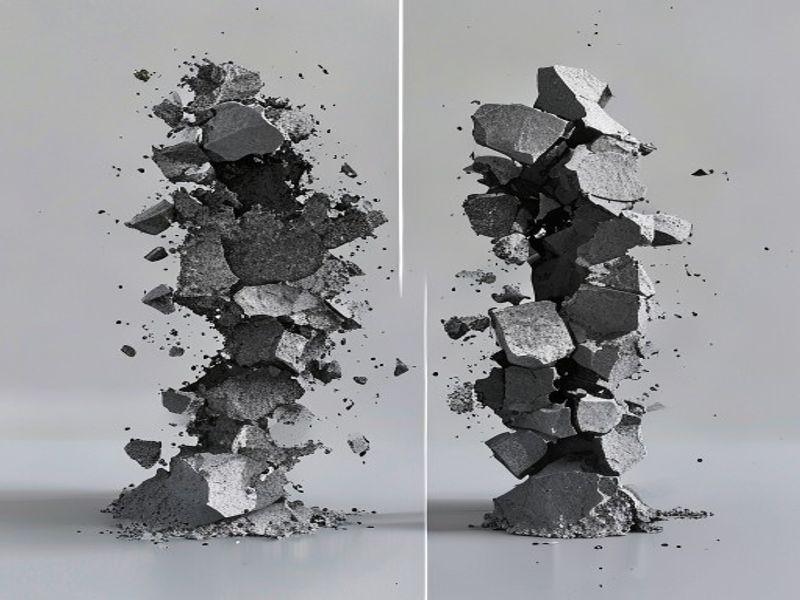
Impact resistance is the property that most dramatically separates pla+ vs pla. Standard PLA absorbs approximately 4-6 kJ/m² of impact energy before fracturing—roughly comparable to polystyrene. PLA+ absorbs 8-14 kJ/m², placing it closer to ABS in impact performance.
This 100-150% improvement transforms the practical utility of PLA-based parts. A gear printed in standard PLA will shatter if dropped onto a concrete floor from waist height. The same gear printed in PLA+ will typically survive multiple identical drops. For products shipped to customers, this shock-absorption capability significantly reduces damage during transit.
Layer Adhesion and Interlaminar Strength
Interlayer bonding strength is the Achilles heel of FDM printing, but it is an area where PLA+ excels. Standard PLA achieves 50-60% of its bulk strength across layer boundaries, creating natural fracture planes. PLA+ typically achieves 65-80% interlayer strength—a significant improvement that makes printed parts behave more like homogenous, injection-molded components.
Print Quality: PLA+ vs PLA Surface Finish
At optimized temperatures, PLA+ tends to produce a slightly glossier surface finish than standard PLA. The plasticizers and modifiers in PLA+ promote smoother melt flow, which fills minor gaps between extrusion lines more effectively. However, printing PLA+ at the wrong temperature (too low) magnifies surface defects because the modifiers interfere with proper melt behavior. Always perform temperature tower calibration when switching between PLA and PLA+ brands.
Why Choose Nylon Plastic for Your 3D Printing and Engineering Plastic Needs
With over 10 years of experience in engineering plastics, Nylon Plastic supplies high-performance materials to B2B clients worldwide. Our product range covers nylon (PA6, PA66, PA12), POM, PEEK, and 3D printing filaments including PLA, PLA+, and PETG. Every batch is tested for diameter tolerance (±0.03mm), moisture content, and mechanical properties before shipping.
- ISO 9001 certified manufacturing facilities
- Bulk supply with competitive B2B pricing
- Technical support for material selection and printing parameters
- Fast global shipping from multiple warehouses
- Custom material formulation available for OEM projects
FAQ
When is PLA+ vs PLA: Strength, Heat Resistance and Print Quality Compared a good option?
PLA+ vs PLA: Strength, Heat Resistance and Print Quality Compared is a good option when fast iteration, complex geometry, low tooling cost, or low-volume production is more important than molded-part unit cost.
What should be checked before choosing PLA+ vs PLA: Strength, Heat Resistance and Print Quality Compared?
Prüfen Sie die Größe des Teils, die Materialeigenschaften, die Oberflächenbeschaffenheit, die Maßtoleranz, die Wärmeeinwirkung, die Belastungsrichtung und ob eine Nachbearbeitung erforderlich ist.
How does PLA+ vs PLA: Strength, Heat Resistance and Print Quality Compared compare with CNC machining?
Mit dem 3D-Druck lassen sich komplexe Formen schnell erstellen, während die CNC-Bearbeitung für präzise Oberflächen, engere Toleranzen und serienreife Materialien oft besser geeignet ist.
What affects the cost of PLA+ vs PLA: Strength, Heat Resistance and Print Quality Compared?
Die Kosten hängen vom Material, dem Bauvolumen, der Druckzeit, der Schichthöhe, der Entfernung von Stützen, der Endbearbeitung, der Prüfung und der Anzahl der Teile im Bau ab.
 English
 Dutch
Dutch German
 French
 Korean
 Russian
 Japanese
 Spanish
 Vietnamese
 Chinese
 Portuguese
 Arabic