
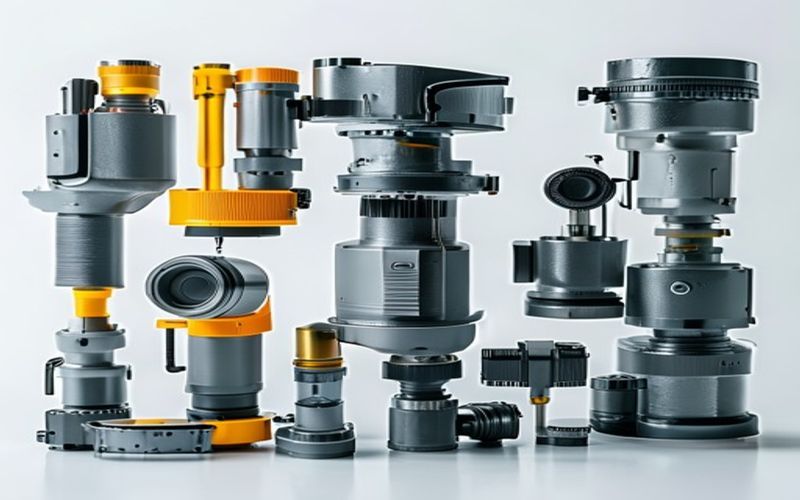
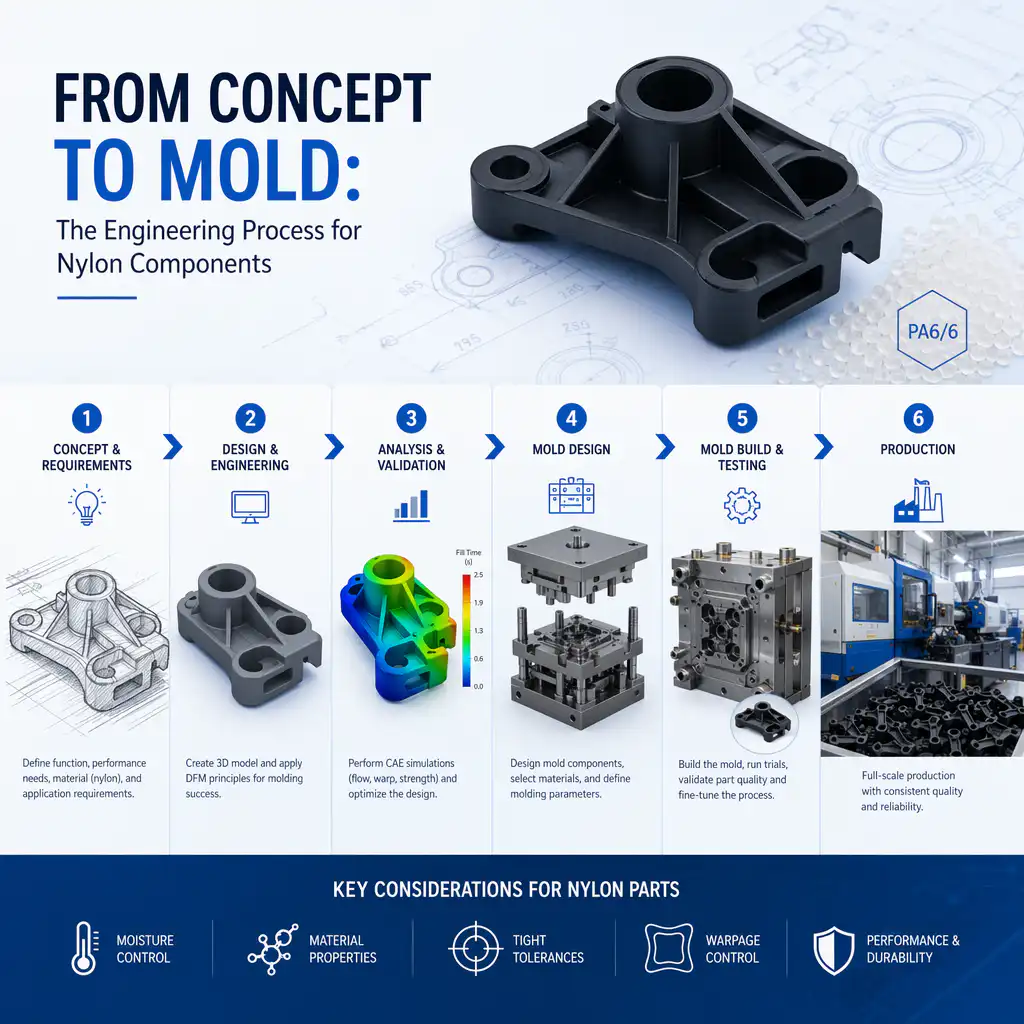
Transforming a product concept into a production-ready injection molded nylon component requires a systematic engineering process. Each stage builds on the previous one, with opportunities to identify and resolve issues before they become costly problems. Understanding this journey helps you plan effectively and set realistic timelines.
Stage 1: Design Development
Initial Concept
Everything begins with your vision—sketches, specifications, or a 3D CAD model. At this stage, we focus on understanding functional requirements, aesthetic expectations, and application environment. For nylon parts, key questions include:
- Will the part be exposed to chemicals, UV, or temperature extremes?
- What mechanical loads will it experience?
- Are there regulatory requirements (FDA, UL, automotive)?
- What annual volumes are anticipated?
Selección de materiales
Nylon selection dramatically affects both part performance and mold design. Options include:
| Material | Propiedades clave | Aplicaciones típicas |
|---|---|---|
| PA6 | Good toughness, easy processing | General purpose, consumer goods |
| PA66 | Higher temperature rating, stiffer | Automotive, industrial |
| PA6+30%GF | High strength, dimensional stability | Structural components, gears |
| PA12 | Low moisture absorption, flexible | Tubing, fuel lines, sports equipment |
Stage 2: DFM and Design Optimization
Design for Manufacturing analysis identifies potential issues before tooling investment:
- Wall thickness review: Ensuring uniformity and appropriate thickness for nylon flow
- Draft analysis: Verifying adequate angles for nylon’s shrinkage characteristics
- Rib and boss design: Optimizing for strength without sink marks
- Gate location planning: Positioning for optimal flow and minimal visible weld lines
We provide detailed feedback with recommended modifications. Most designs benefit from 2-3 iteration cycles to optimize for both function and manufacturability.
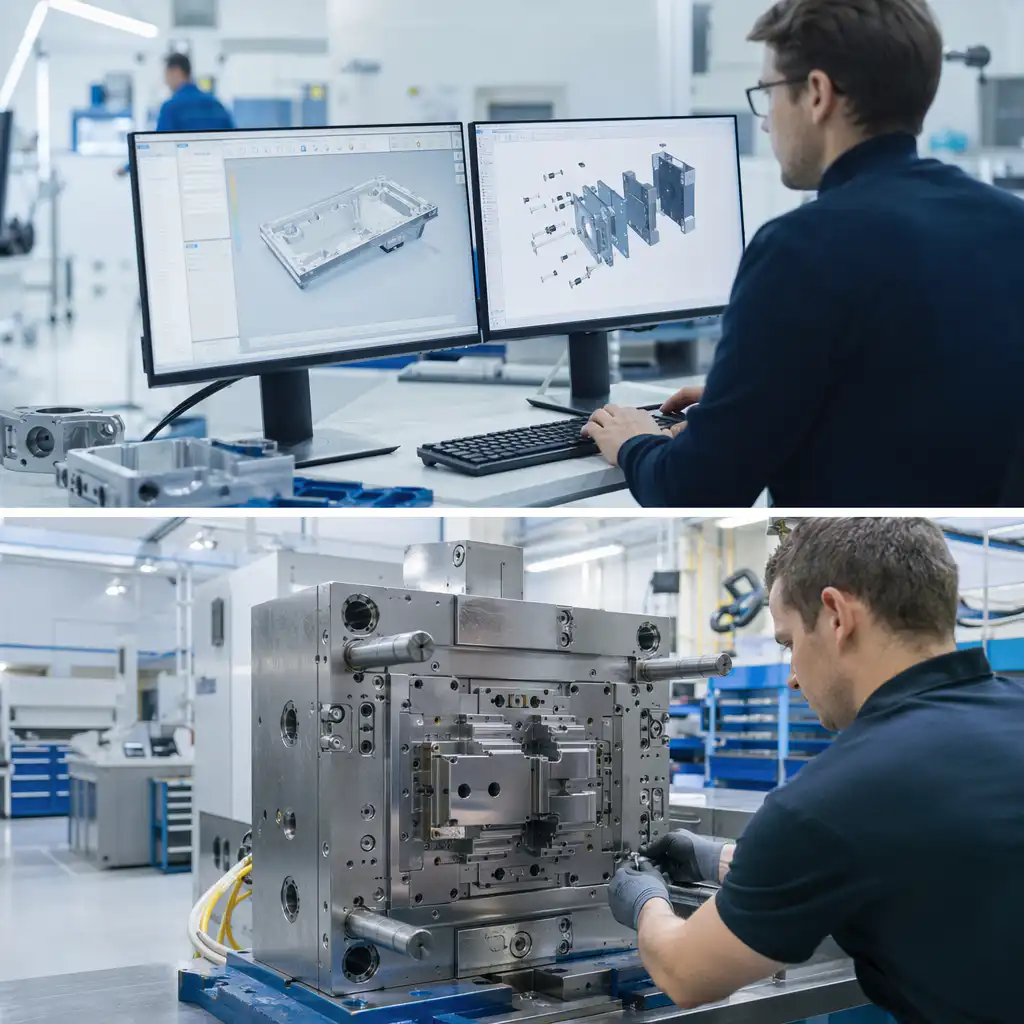
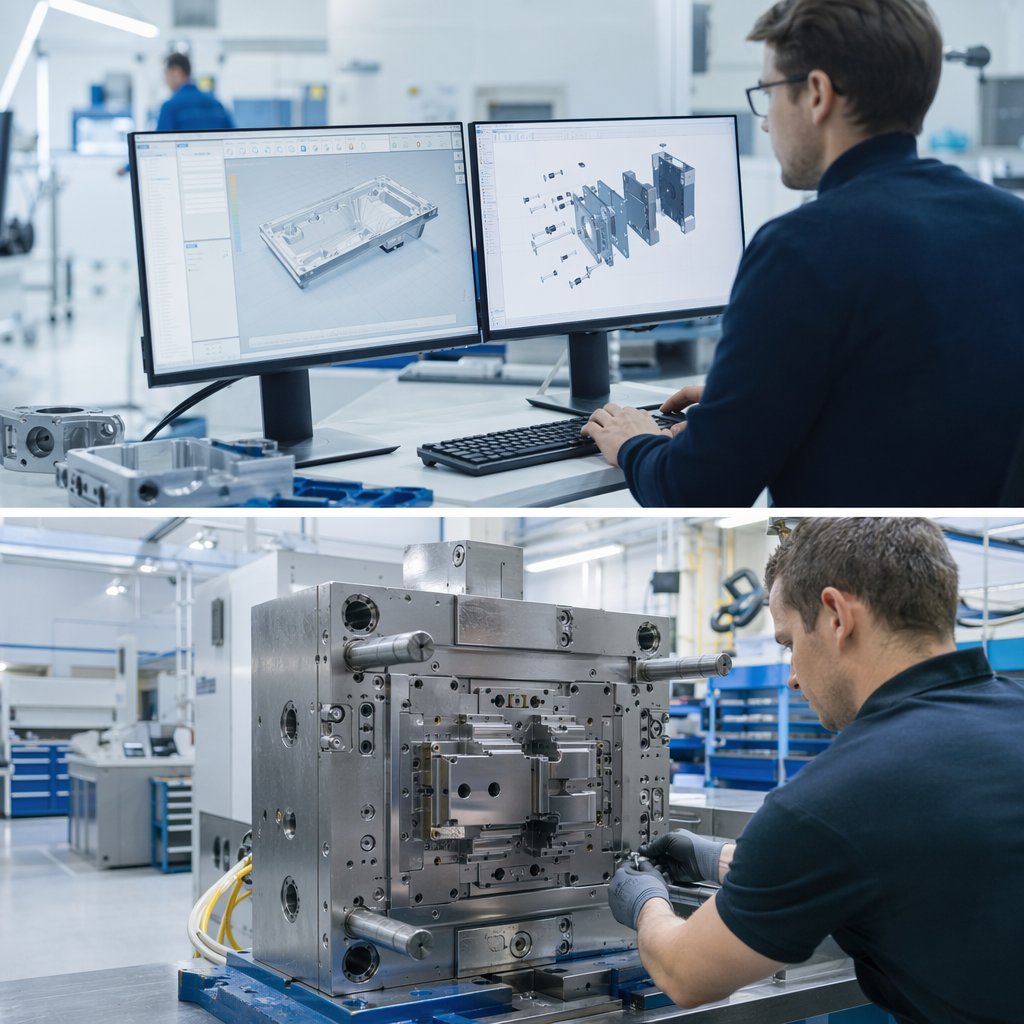
Stage 3: Mold Design
With approved part design, mold design begins:
- Cavity layout: Single vs. multi-cavity, parting line determination
- Cooling system: Channel placement for uniform temperature control
- Ejection design: Pin locations, stripper plates, or air ejection
- Runner system: Hot vs. cold runner, gate types and locations
- Mold flow simulation: Validating fill patterns and identifying potential issues
For nylon, mold temperature control is critical. We design heating systems to maintain 60-90°C mold temperatures required for proper crystallinity development.
Stage 4: Mold Construction
Physical mold building involves:
- CNC machining of cavities and cores
- EDM for fine details and sharp corners
- Polishing and surface texturing
- Assembly and fitting of moving components
- Installation of cooling and heating systems
Quality checks throughout ensure dimensional accuracy. Mold components are inspected against design specifications before assembly.
Stage 5: Sampling and Validation
First shots from the mold reveal the reality of design choices:
- Visual : Surface quality, gate appearance, weld lines
- Dimensional check: Critical features measured against specifications
- Process optimization: Finding optimal parameters for consistent quality
- Functional testing: Assembly trials, fit checks, performance validation
Minor adjustments are common at this stage. For complex parts, 2-3 sampling iterations may be needed to achieve optimal results.
PREGUNTAS FRECUENTES
When does From Concept to Mold: The Engineering Process for Nylon Components make sense?
From Concept to Mold: The Engineering Process for Nylon Components makes sense when the part volume, material choice, geometry, and repeatability needs justify mold design and tooling investment.
What design factors matter most for From Concept to Mold: The Engineering Process for Nylon Components?
Wall thickness, ribs, bosses, draft angle, gate location, shrinkage, parting line, and ejection all affect molded part quality.
What information is needed before mold production?
The supplier should confirm the 3D model, material, expected annual volume, appearance requirements, tolerance needs, and any assembly or functional testing requirements.
What is the biggest risk in From Concept to Mold: The Engineering Process for Nylon Components?
The biggest risk is approving tooling before material behavior, shrinkage, flow, and part function are fully checked against the real application.


 English
  Dutch
Dutch  German
  French
  Korean
  Russian
  Japanese
  Spanish
  Vietnamese
  Chinese
  Portuguese
  Arabic