
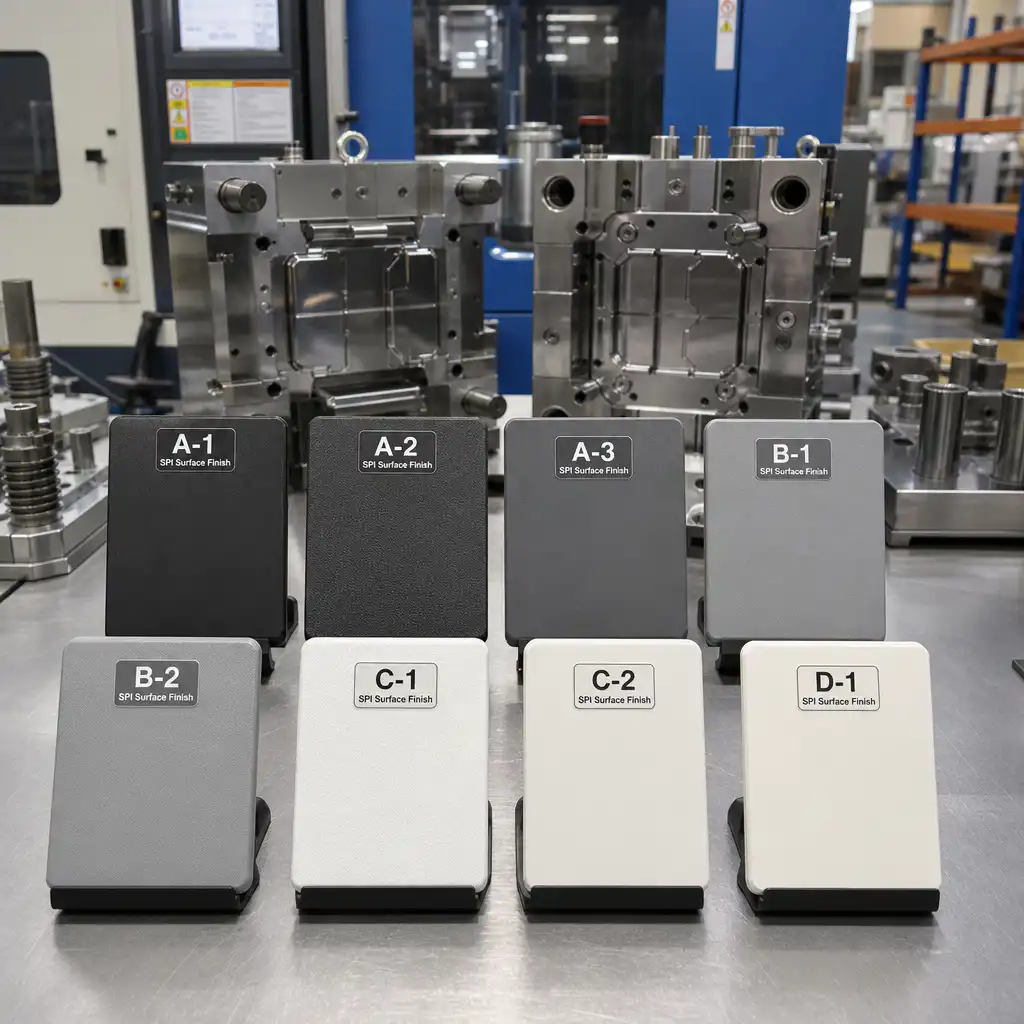
SPI (Society of the Plastics Industry) surface finish standards define 12 grades of mold polish — from mirror-gloss A-1 to rough blasted D-3. Specifying the right SPI finish on your injection mold drawing directly controls part appearance, mold release, and even part strength for engineering plastics like nylon.
SPI Finish Grades at a Glance
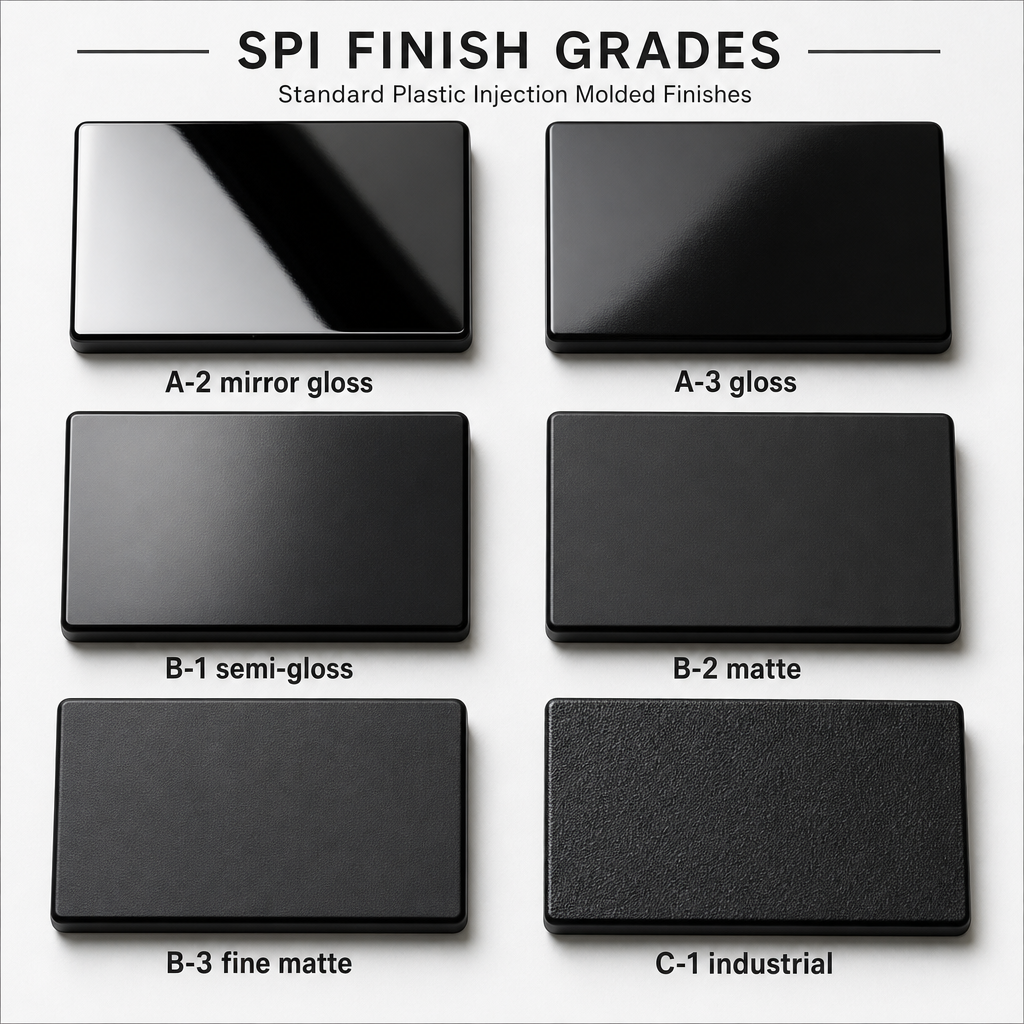
| SPI Grade | Method | Ra (μin) | Typical Use |
|---|---|---|---|
| A-1 | Grade #3 Diamond Buff | 0-1 | Optical lenses, mirrors |
| A-2 | Grade #6 Diamond Buff | 1-2 | High-gloss consumer products |
| A-3 | Grade #15 Diamond Buff | 2-3 | Glossy housings, automotive interior |
| B-1 | 600 Grit Paper | 2-4 | Semi-gloss parts, good release |
| B-2 | 400 Grit Paper | 4-6 | Matte finish, most engineering parts |
| B-3 | 320 Grit Paper | 7-10 | Functional matte, good hiding of flow lines |
| C-1 | 600 Stone | 10-12 | Industrial, non-cosmetic |
| C-2 | 400 Stone | 12-16 | General purpose, EDM surfaces |
| D-1 / D-2 / D-3 | Blast (various media) | 12-30+ | Texture, grip surfaces, hiding defects |
Nylon-Specific Finish Considerations
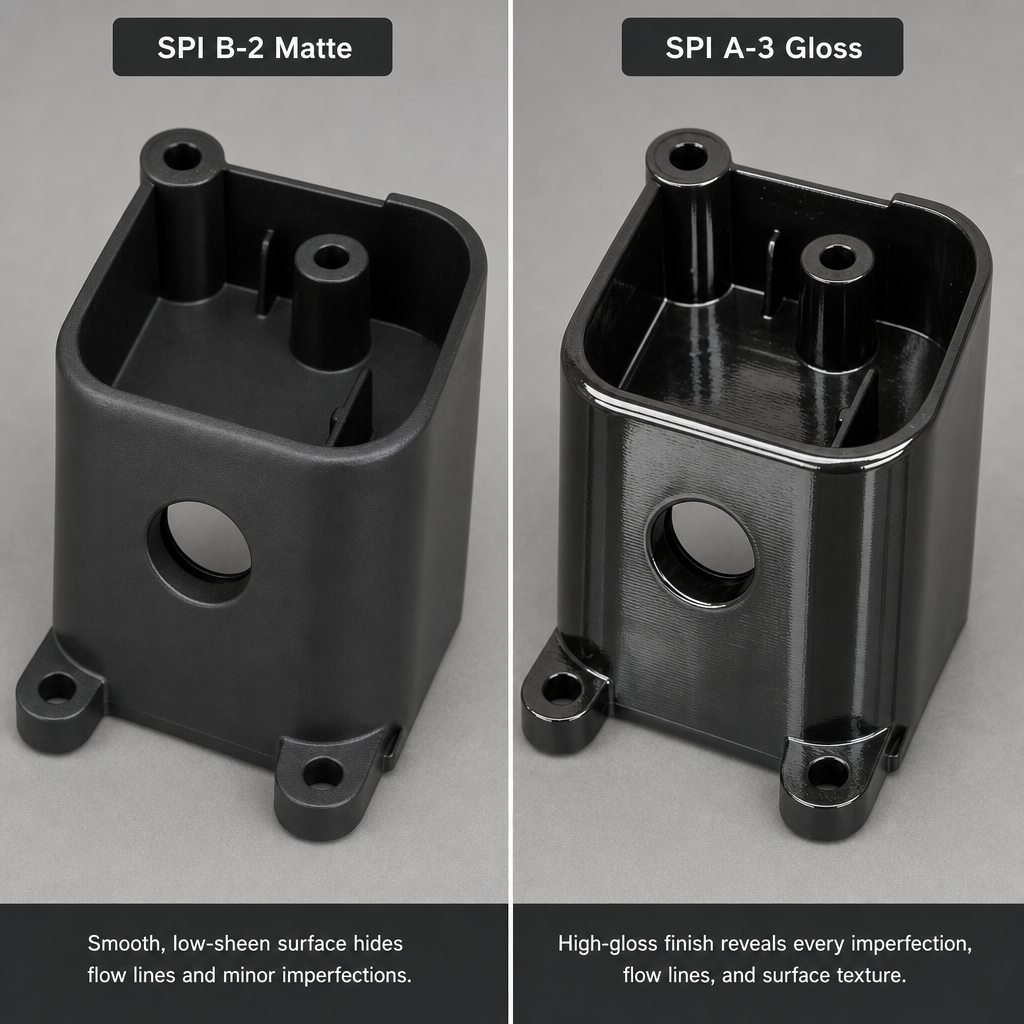
Nylon (PA6/PA66) has excellent mold surface replication — it copies the cavity finish almost exactly. SPI B-2 or B-1 is our recommended default for engineering nylon parts: matte enough to hide minor flow lines and knit lines, but smooth enough for clean release. Mirror-gloss A-grade finishes on nylon require impeccably dry material and a hot mold (80-100°C) to achieve full replication. Cold mold + glossy cavity = dull, hazy part surface.
Cost Impact of Higher Polish
Every SPI grade jump roughly doubles the polishing labor. A-1 diamond polish on a complex cavity can add $500-1,500 per cavity vs a standard B-2 finish. For multi-cavity production molds, the cost multiplies. Unless your part is a visible consumer product, SPI B-2 or B-3 produces perfectly functional parts at the lowest mold cost.
よくある質問
Which SPI finish gives the best mold release for nylon?
SPI B-1 or B-2 with 1-2° draft works best. Mirror finishes (A-grade) can actually increase sticking because the ultra-smooth surface creates more contact area. A slight texture (B-3 or C-1) disrupts the vacuum-like stick between smooth plastic and smooth steel.
Will the mold finish affect my part’s mechanical strength?
Not directly, but rough blasted surfaces (D-grade) create micro stress concentrators that can reduce fatigue life in cyclic-loading applications. For structural nylon parts under repeated load, specify B-1 or B-2 on critical surfaces.
How do I specify SPI finish on a mold drawing?
Call out “SPI B-2 all over unless noted” on the cavity drawing and use separate callouts for specific surfaces that need different finishes. Always specify finish on the cavity side — the core can be coarser since internal surfaces aren’t cosmetic.
Can textured finishes help hide sink marks?
Yes. SPI D-2 or D-3 blast textures effectively camouflage minor sink marks over ribs and bosses. For parts with unavoidable wall thickness variations, a textured finish is the most practical aesthetic solution without redesigning the part.
Need injection molded parts with specific surface finishes?
We provide mold polishing to any SPI grade and can recommend the right finish for your material and application.


 English
 Dutch
Dutch German
 French
 Korean
 Russian
 Japanese
 Spanish
 Vietnamese
 Chinese
 Portuguese
 Arabic