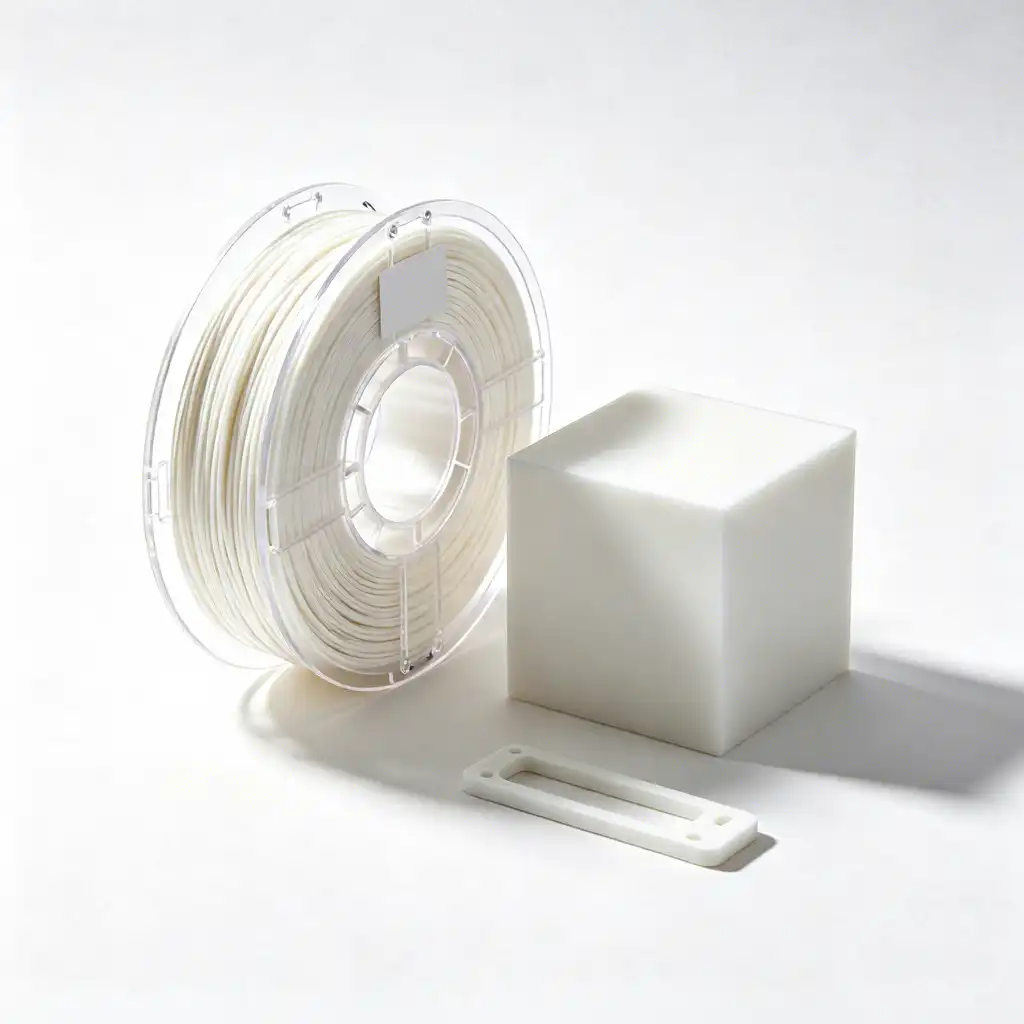

Why Moisture Absorption is the Defining Characteristic of Nylon
No other engineering thermoplastic absorbs moisture as dramatically as nylon. PA6 can absorb up to 9.5% by weight at saturation — more than any other common engineering plastic. Even PA66, with its tighter molecular packing, reaches 8.5%. PA12 reaches only 1.5%, making it the nylon of choice for wet environments.
This moisture absorption is not a defect — it is a fundamental property arising from the hydrogen-bonding amide groups in the polyamide chain. Water molecules penetrate the amorphous regions of the polymer and plasticize it, fundamentally altering mechanical, thermal, and dimensional properties.
For buyers and engineers specifying nylon, understanding moisture effects is not optional. Every nylon datasheet value — tensile strength, modulus, impact resistance — is measured on conditioned specimens. The same part, tested dry-as-molded, can show tensile strength 40% higher but impact resistance 70% lower than conditioned values.
How Nylon Absorbs Moisture: The Science
Moisture absorption in nylon follows a classic Fickian diffusion process with two phases:

- Phase 1 (rapid): Surface saturation within hours — parts appear “wet” but interior is still dry. This is the most dangerous phase for dimensional instability and surface blistering.
- Phase 2 (slow): True equilibrium through bulk diffusion — can take weeks or months for thick sections (>10mm wall thickness)
At 50% relative humidity (23°C), PA6 reaches approximately 2.5% moisture content within 24 hours. Full saturation at 95% RH can take 2-4 weeks. The actual equilibrium moisture content depends on:
| Nylon Grade | Max Moisture Absorption (%) | Equilibrium at 50% RH | Equilibrium at 95% RH |
|---|---|---|---|
| PA6 | 9.0-9.5% | 2.5-3.0% | 8.5-9.0% |
| PA66 | 8.0-8.5% | 2.0-2.5% | 7.5-8.0% |
| PA12 | 1.4-1.6% | 0.7-0.9% | 1.3-1.5% |
| PA6-GF30 | 6.0-7.0% | 1.5-2.0% | 5.5-6.5% |
| PA66-GF30 | 5.0-6.0% | 1.3-1.8% | 4.5-5.5% |
| PA46 | 7.0-7.5% | 2.0-2.3% | 6.5-7.0% |
Effects on Mechanical Properties
Moisture absorption simultaneously improves some properties while degrading others — a trade-off that must be understood for accurate part design.

| Eigendom | Dry As Molded | Conditioned (50% RH) | Change |
|---|---|---|---|
| Treksterkte (MPa) | 80-90 | 55-65 | -28% |
| Tensile Modulus (MPa) | 3000-3300 | 1800-2100 | -35% |
| Rek bij breuk | 40-60% | 150-250% | +250% |
| Izod Impact (kJ/m²) | 3-5 | 6-10 | +100% |
| Flexural Modulus (MPa) | 2800-3100 | 1500-1800 | -40% |
| HDT (1.82 MPa, °C) | 65-75 | 55-65 | -15°C |
Effects on Dimensional Stability
Moisture absorption causes dimensional changes that can be significant for precision parts. The dimensional change is not linear — it follows a differential swelling pattern between skin (which equilibrates first) and core (which remains dry).

- Linear expansion: PA6 expands approximately 0.15-0.20% per 1% moisture absorbed in the flow direction, and 0.40-0.50% in the transverse direction
- Anisotropic swelling: Similar to shrinkage anisotropy, moisture swelling is greater perpendicular to the mold flow direction
- Warpage from differential drying: Parts dried unevenly after conditioning can warp as surface and core dry at different rates
- Threaded inserts: Metal inserts in nylon do not change dimension with humidity — dimensional changes occur only in the nylon surrounding the insert, creating stress on the interface
Measurement Methods: How to Measure Nylon Moisture Content
Accurate moisture measurement is essential for quality control in nylon processing and for verifying material condition before use.

| Method | Principle | Accuracy | Time | Best Use |
|---|---|---|---|---|
| Loss on Drying (LOD) | Weigh before/after oven drying at 103°C | ±0.1% | 2-4 hours | Quick production QC |
| Karl Fischer Titration | Chemical reaction with water molecules | ±0.01% | 10-20 min | Precision verification |
| Coulometric KF | Electrolytic Karl Fischer | ±0.001% | 15-30 min | R&D, spec testing |
| Moisture Analyzer | Automated LOD with integrated balance | ±0.05% | 20-40 min | Inline production QC |
| Dew Point Hygrometer | Equilibrium with desiccant | ±0.3% | 30-60 min | Dryer monitoring |
Control Strategies: Drying and Storage Best Practices
Effective moisture control requires a systematic approach from material storage through processing:

- Desiccant dryer: The standard for nylon drying. Use desiccant with dew point below -40°C (ideally -70°C). Maintain air dew point of -40°C throughout the drying cycle. Target 0.1-0.2% residual moisture for PA66, 0.2% for PA6.
- Drying temperatures: 80°C for PA6 and PA66 (higher temperatures risk oxidative degradation), 70-75°C for PA12
- Drying time: 4-6 hours minimum for properly sealed material; 8-12 hours for material exposed to humid air or with wall thickness >15mm
- Hopper design: Use sealed hoppers with nitrogen purge to prevent re-absorption during production runs
- Material shelf life after drying: Once dried, nylon re-absorbs moisture at approximately 0.1% per hour at 23°C/50% RH — dried material must be used within 2-4 hours or re-dried
FAQs
Q1: How can I tell if my nylon is too wet for molding without a moisture analyzer?
A: Wet nylon produces splay (silver streaks) on molded parts, surface roughness, a dull or frosted surface finish, and reduced mechanical properties (parts feel brittle when broken). A simple visual inspection of trial shots is often sufficient to detect moisture-related problems.
Q2: Is it possible to over-dry nylon, and what happens?
A: Drying above 100°C with inadequate desiccant regeneration can cause surface oxidation, darkening the material. However, at recommended drying temperatures (80-85°C), nylon cannot be over-dried. Running at 0.05% moisture content is fine — the lower the better within the recommended temperature range.
Q3: How doesmoisture absorption differ between virgin and recycled nylon?
A: Recycled nylon (especially from post-industrial sources) may have different moisture absorption rates depending on contamination, prior drying history, and the presence of fillers or additives. Always test recycled material from each lot before production use.
Q4: What is the effect of humidity aging on long-term nylon performance?
A: Long-term humidity aging above 85% RH can cause hydrolysis — chain scission that gradually reduces molecular weight and mechanical properties. PA6 stored at 95% RH/50°C loses approximately 15% of tensile strength after 1,000 hours. Heat-stabilized grades and glass fiber reinforcement significantly slow hydrolysis.