
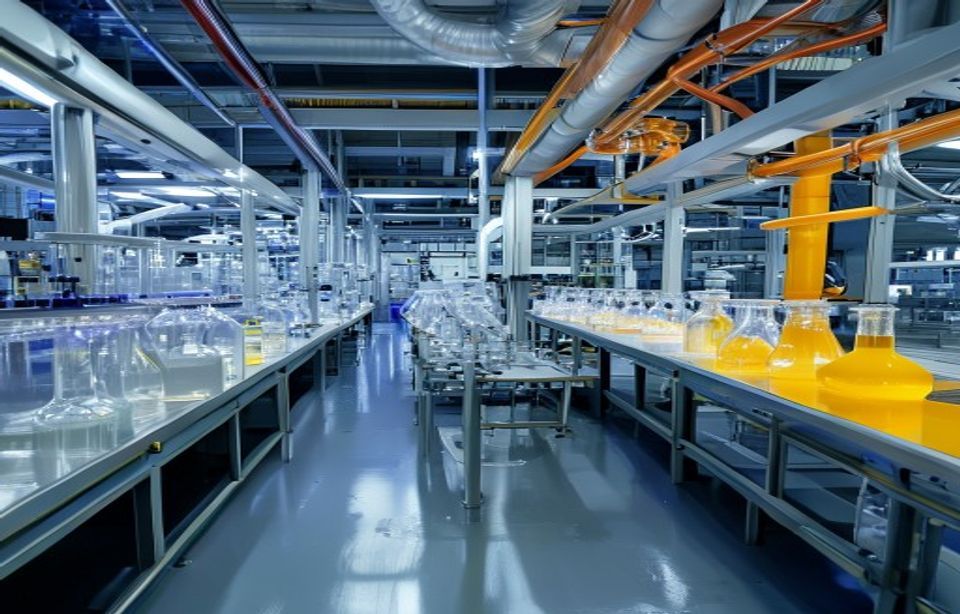
Nylon Chemical Resistance: Acids, Bases, Solvents, Automotive Fluids, and Food Contact
Chemical resistance is the single most misunderstood property of nylon in engineering procurement. Most engineers treat “nylon” as a single material when assessing chemical compatibility, then are surprised when PA6 and PA12 behave dramatically differently in the same environment.
This guide provides systematic chemical resistance data for PA6, PA66, and PA12 across all major chemical classes, with clear guidance on when nylon is appropriate and when alternative materials should be specified.

Understanding Nylon Chemical Resistance Mechanisms
Nylon resistance to chemicals operates through three distinct mechanisms. Understanding which mechanism applies to your environment determines whether the material will perform reliably.
Physical resistance: The polymer matrix physically blocks chemical penetration. This is the dominant mechanism for non-polar solvents like gasoline and oils — nylon has excellent resistance because hydrocarbon molecules cannot penetrate the crystalline domains.
Chemical resistance: The polymer chain does not react with the chemical. This is why nylon is attacked by strong acids and bases — they hydrolyze the amide bonds in the polyamide chain.
Plasticization and swelling: Water and polar solvents penetrate the amorphous regions, swelling the polymer without breaking chemical bonds. This increases flexibility but reduces stiffness and dimensional accuracy.
| Chemical Class | PA6 | PA66 | PA12 | Primary Mechanism | Application Notes |
|---|---|---|---|---|---|
| Motor oils (mineral) | Excelente | Excelente | Excelente | Physical barrier | Under-hood auto applications |
| Motor oils (synthetic) | Excelente | Excelente | Excelente | Physical barrier | ATS, DCT fluids |
| Gasoline (aromatic) | Good (60°C) | Good (100°C) | Excelente | Physical barrier | Fuel rails: PA66-GF30 |
| Ethanol blends (E85) | Limited | Limited (80°C) | Excelente | Physical + swelling | Fuel lines: PA12 preferred |
| Diesel, Biodiesel | Bom | Bom | Excelente | Physical barrier | Fuel system components |
| ATF / Transmission fluid | Good (120°C) | Excellent (150°C) | Bom | Physical barrier | Transmission oil pans |
| Glycol coolant (50/50) | Good (100°C) | Good (130°C) | Excelente | Swelling (limited) | Coolant reservoirs |
| Brake fluids (DOT 3/4/5) | Poor | Poor | Bom | Chemical attack | Use PA12 for brake components |
| Weak acids (<10%) | Limited (elev T) | Limited (elev T) | Bom | Chemical hydrolysis | PA12 or PP for acid contact |
| Strong acids (>10%) | Not recommended | Not recommended | Limited | Rapid hydrolysis | PVDF or PTFE for acid |
Water Absorption and Its Effect on Chemical Resistance
Moisture absorption fundamentally changes nylon’s chemical resistance profile. Dry nylon is more chemically resistant to polar solvents (the plasticized, wet state actually resists further polar penetration) but is more susceptible to oxidative degradation. This creates a critical design consideration: parts in wet service should be tested in the conditioned (wet) state, not dry-as-molded.
| Conditioning State | PA6 Tensile Strength | PA6 Modulus | Chemical Resistance to Water | Chemical Resistance to Acids |
|---|---|---|---|---|
| Dry as molded (0%) | 85 MPa | 3,200 MPa | N/A | Poor (brittle failure) |
| Conditioned 50% RH (2.5%) | 65 MPa | 2,000 MPa | Moderate | Moderate (ductile) |
| Saturated (9.0%) | 45-50 MPa | 1,200 MPa | Swells significantly | Moderate (ductile) |
| After drying (0.1%) | 80+ MPa | 3,000 MPa | Excelente | Poor (brittle failure) |
Industrial and Laboratory Chemical Environments
For chemical processing and industrial equipment, verify compatibility under actual operating conditions with immersion testing. The following table provides baseline guidance for common industrial chemicals.
| Chemical | PA6 | PA66 | PA12 | Max Service Temp (°C) | Alternative Material |
|---|---|---|---|---|---|
| Sulfuric acid (10%) | Limited | Not recommended | Limited | 40°C | PVDF, HDPE |
| Hydrochloric acid (10%) | Not recommended | Not recommended | Limited | 40°C | PVDF, PTFE |
| Sodium hydroxide (50%) | Limited (>60°C) | Not recommended | Bom | 80°C | PP, HDPE |
| Acetone | Limited | Not recommended | Bom | 60°C | PTFE |
| Ethanol | Bom | Bom | Excelente | 100°C | PA12 preferred |
| Phenol (5%) | Not recommended | Not recommended | Not recommended | N/A | PTFE only |
| Formic acid (10%) | Not recommended | Not recommended | Limited | 40°C | PTFE, PVDF |
| Calcium chloride | Limited | Limited | Bom | 80°C | PA12 for salt contact |
| Steam (continuous) | Not recommended | Not recommended | Limited | 120°C | PPS, PTFE |
Automotive Fluids: The Most Common Real-World Exposure
Automotive under-hood applications define the largest volume of nylon use globally. The following data reflects ASTM D543 immersion testing results at specified temperatures and exposure durations (typically 1,000 hours = approximately 6 weeks of continuous exposure).
| Fluid | PA6 | PA66 | PA12 | Weight Change | Tensile Retention | Application Confidence |
|---|---|---|---|---|---|---|
| Engine oil SAE 5W-30 (150°C) | Excelente | Excelente | Excelente | <1% | >95% | Full production use |
| Transmission fluid ATF (130°C) | Bom | Excelente | Bom | <2% | >90% | Full production use |
| Power steering fluid (120°C) | Bom | Bom | Excelente | <2% | >90% | Full production use |
| Coolant 50/50 EG (130°C) | Bom | Bom | Excelente | <3% | >85% | Full production use |
| Brake fluid DOT 4 (120°C) | Poor | Poor | Bom | >10% | <60% | PA12 only |
| Windshield washer (60°C) | Excelente | Excelente | Excelente | <0.5% | >99% | Full production use |
| Battery acid (25°C) | Not recommended | Not recommended | Not recommended | N/A | N/A | PP or PE only |
| AdBlue / DEF (urea) | Bom | Bom | Excelente | <1% | >95% | SCR system components |
FAQ
How do you know whether Nylon Chemical Resistance: Acids, Bases, Solvents, and More fits a part?
Nylon Chemical Resistance: Acids, Bases, Solvents, and More fits a part when its load capacity, temperature range, moisture exposure, wear behavior, and processing method match the real service conditions.
What properties should be checked for Nylon Chemical Resistance: Acids, Bases, Solvents, and More?
Verificar a resistência, a rigidez, a resistência ao impacto, a resistência ao calor, a absorção de humidade, a estabilidade dimensional, a fricção, o desgaste e a compatibilidade química.
What is the biggest selection risk for Nylon Chemical Resistance: Acids, Bases, Solvents, and More?
O maior risco é escolher a partir de um valor da folha de dados sem considerar o ambiente real, o método de processamento, a geometria da peça e a utilização a longo prazo.
When should Nylon Chemical Resistance: Acids, Bases, Solvents, and More be tested before production?
Recomenda-se a realização de ensaios quando a peça é sujeita a carga, calor, produtos químicos, humidade, tolerâncias apertadas, requisitos regulamentares ou um novo ambiente de funcionamento.


 English
  Dutch
Dutch  German
  French
  Korean
  Russian
  Japanese
  Spanish
  Vietnamese
  Chinese
  Portuguese
  Arabic