

Chemical Structure Differences
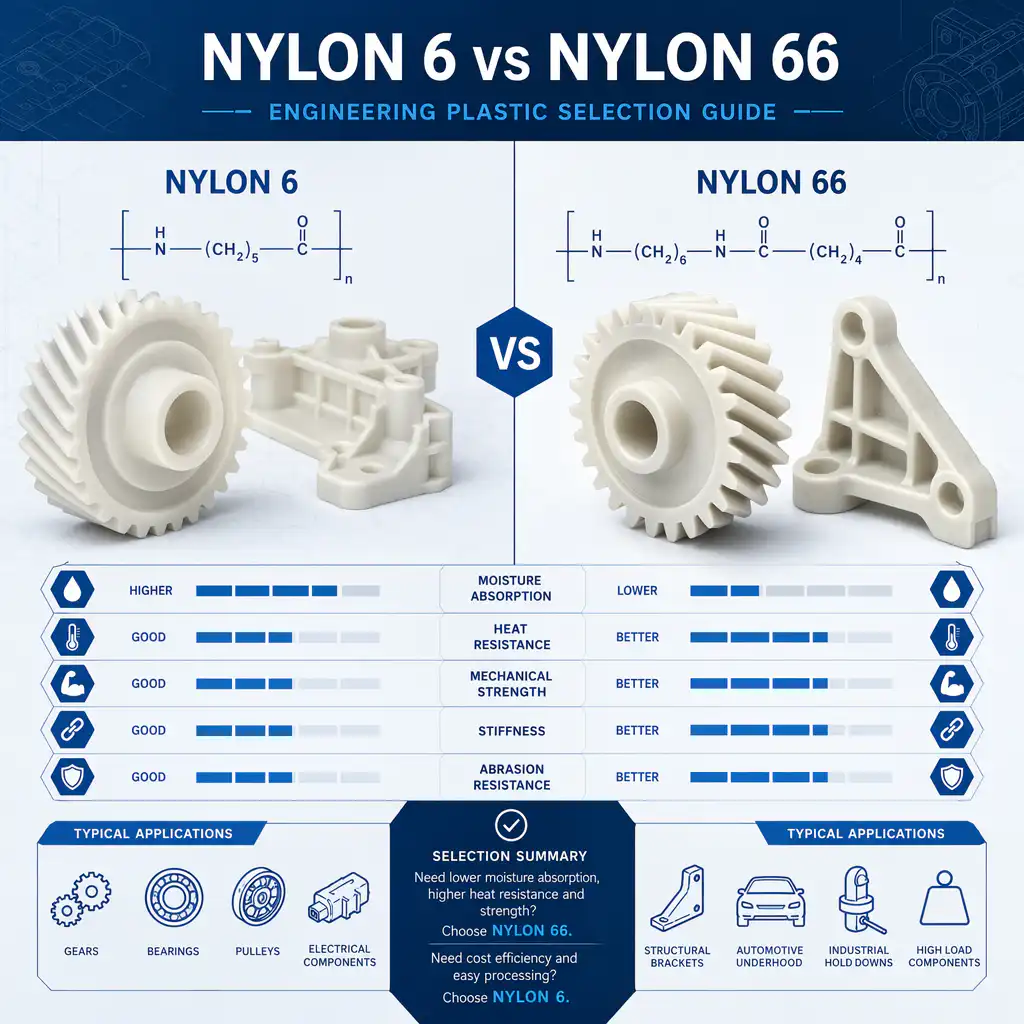
The fundamental difference between PA6 (Nylon 6) e PA66 (Nylon 66) lies in their molecular structure:
- Nylon 6: Made from caprolactam, has 6 carbon atoms in each repeating unit. Less crystalline structure.
- Nylon 66: Made from hexamethylenediamine and adipic acid, has two 6-carbon chains. More crystalline structure.
Mechanical Properties Comparison
| Imóveis | PA6 | PA66 |
|---|---|---|
| Resistência à tração | 70-85 MPa | 80-100 MPa |
| Módulo de flexão | 2.5-3.0 GPa | 2.8-3.5 GPa |
| Alongamento na rutura | 30-100% | 15-60% |
| Notched Izod Impact | 50-100 J/m | 40-80 J/m |
| Ponto de fusão | 220°C | 260°C |
| HDT at 1.8 MPa | 70°C | 90°C |
Absorção de humidade
Moisture absorption is critical for nylon applications:
| Condition | PA6 | PA66 |
|---|---|---|
| At 50% RH | 2.5-3.0% | 2.0-2.5% |
| Saturation | 8-10% | 6-8% |
Processing Characteristics
Nylon 6 Processing
- Melting Point: 220°C
- Processing Range: 240-280°C
- Temperatura do molde: 40-80°C
Nylon 66 Processing
- Melting Point: 260°C
- Processing Range: 280-320°C
- Temperatura do molde: 60-90°C
Applications by Material
Nylon 6 Applications
- Gears and sprockets
- Industrial monofilament
- Film and packaging
- Consumer products
Nylon 66 Applications
- Automotive under-hood components
- Electrical connectors
- High-temperature bearings
- Precision mechanical components
Reinforced Grades
Both materials are commonly reinforced with glass fiber:
| Grau | PA6 + GF30 | PA66 + GF30 |
|---|---|---|
| Resistência à tração | 140-160 MPa | 170-200 MPa |
| HDT (1.8 MPa) | 205°C+ | 250°C+ |
| Absorção de humidade | 1.0-1.5% | 0.8-1.2% |
Selection Summary
Choose Nylon 6 when:
- Impact resistance is critical
- Cost sensitivity is high
- Operating temperatures are moderate
Choose Nylon 66 when:
- Higher mechanical strength is required
- Elevated temperatures are expected
- Dimensional stability is critical
FAQ
When is Nylon 6 vs Nylon 66 — Engineering Plastic Selection Guide a good option?
Nylon 6 vs Nylon 66 — Engineering Plastic Selection Guide is a good option when fast iteration, complex geometry, low tooling cost, or low-volume production is more important than molded-part unit cost.
What should be checked before choosing Nylon 6 vs Nylon 66 — Engineering Plastic Selection Guide?
Verificar o tamanho da peça, as propriedades do material, o acabamento da superfície, a tolerância dimensional, a exposição ao calor, a direção da carga e se é necessário pós-processamento.
How does Nylon 6 vs Nylon 66 — Engineering Plastic Selection Guide compare with CNC machining?
A impressão 3D pode criar formas complexas rapidamente, enquanto a maquinagem CNC é frequentemente mais forte para superfícies precisas, tolerâncias mais apertadas e materiais de qualidade de produção.
What affects the cost of Nylon 6 vs Nylon 66 — Engineering Plastic Selection Guide?
O custo depende do material, do volume de construção, do tempo de impressão, da altura da camada, da remoção do suporte, do acabamento, da inspeção e do número de peças na construção.

 English
  Dutch
Dutch  German
  French
  Korean
  Russian
  Japanese
  Spanish
  Vietnamese
  Chinese
  Portuguese
  Arabic