
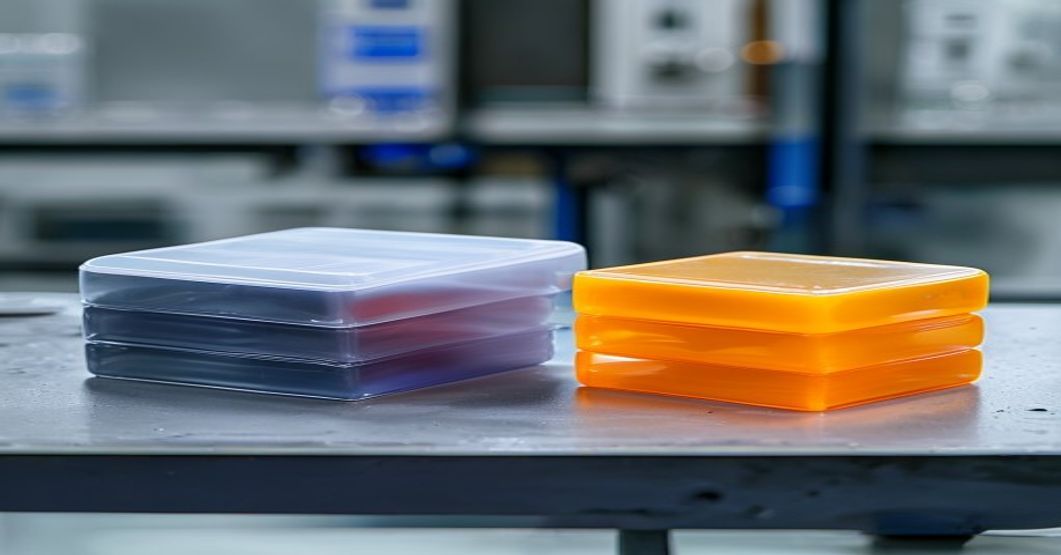
When selecting nylon materials for engineering applications, PA6 and PA66 are the two most common choices. While both belong to the polyamide family, their different molecular structures lead to distinct property profiles that can significantly impact your product’s performance.
Molecular Structure: The Key Difference
The fundamental difference between PA6 and PA66 lies in their chemical structure. PA6 (Polycaprolactam) is made from a single monomer—caprolactam—with six carbon atoms per repeat unit. PA66 (Polyhexamethylene adipamide) is made from two monomers—hexamethylene diamine and adipic acid—each contributing six carbons to the repeat unit.
This structural difference affects crystallinity, melting point, and ultimately the material’s mechanical and thermal properties.
Mechanical Properties Comparison
| Imóveis | PA6 | PA66 |
|---|---|---|
| Resistência à tração (MPa) | 70-85 | 80-95 |
| Alongamento na rutura (%) | 50-150 | 30-60 |
| Módulo de flexão (GPa) | 2.5-3.0 | 2.8-3.3 |
| Notched Izod Impact (kJ/m²) | 5-15 | 4-8 |

Thermal Properties
PA66 has a higher melting point (approximately 260°C vs 220°C for PA6) and better heat deflection temperature.
Temperatura de utilização contínua
- PA6: 80-100°C
- PA66: 100-120°C
Absorção de humidade
Both PA6 and PA66 are hygroscopic materials, meaning they absorb moisture from the environment. However, PA6 typically absorbs moisture faster due to its lower crystallinity.

Processing Differences
PA6 has a wider processing window and lower processing temperature requirements, making it easier to mold. PA66 requires more precise temperature control and higher processing temperatures.
Processing Parameters
- PA6 Melt Temperature: 230-280°C
- PA66 Melt Temperature: 270-300°C
- PA6 Mold Temperature: 40-80°C
- PA66 Mold Temperature: 60-100°C
Cost Considerations

PA6 is typically 10-20% less expensive than PA66 on a per-kilogram basis.
Application Recommendations
Choose PA6 When:
- Impact resistance is critical
- Cost sensitivity is high
- Processability and cycle time matter
- Parts will not be exposed to high temperatures
Choose PA66 When:
- High temperature resistance is required
- Stiffness and strength are priorities
- Dimensional stability under load matters
- Parts will be used in demanding environments
As nossas capacidades
Com mais de 300 máquinas CNC, produzimos mais de 10.000 peças por dia com tolerâncias tão apertadas como ±0,005mm. Aceitamos MOQ a partir de 1 peça, com prazos de entrega que variam entre 24 horas a 15 dias. Obter um orçamento no prazo de 24 horas.
FAQ
How do you know whether PA6 vs PA66: Which Nylon Grade Is Right for Your Application? fits a part?
PA6 vs PA66: Which Nylon Grade Is Right for Your Application? fits a part when its load capacity, temperature range, moisture exposure, wear behavior, and processing method match the real service conditions.
What properties should be checked for PA6 vs PA66: Which Nylon Grade Is Right for Your Application??
Verificar a resistência, a rigidez, a resistência ao impacto, a resistência ao calor, a absorção de humidade, a estabilidade dimensional, a fricção, o desgaste e a compatibilidade química.
What is the biggest selection risk for PA6 vs PA66: Which Nylon Grade Is Right for Your Application??
O maior risco é escolher a partir de um valor da folha de dados sem considerar o ambiente real, o método de processamento, a geometria da peça e a utilização a longo prazo.
When should PA6 vs PA66: Which Nylon Grade Is Right for Your Application? be tested before production?
Recomenda-se a realização de ensaios quando a peça é sujeita a carga, calor, produtos químicos, humidade, tolerâncias apertadas, requisitos regulamentares ou um novo ambiente de funcionamento.

 English
 Dutch
Dutch German
 French
 Korean
 Russian
 Japanese
 Spanish
 Vietnamese
 Chinese
 Portuguese
 Arabic