
Overmolding bonds a soft thermoplastic elastomer (TPE) onto a rigid plastic substrate in a single manufacturing process — creating ergonomic grips, waterproof seals, and vibration-dampening interfaces without adhesives or assembly labor. The soft TPE chemically bonds to the rigid substrate during the second injection shot, forming a permanent, inseparable component.
Two-Shot vs Insert Overmolding
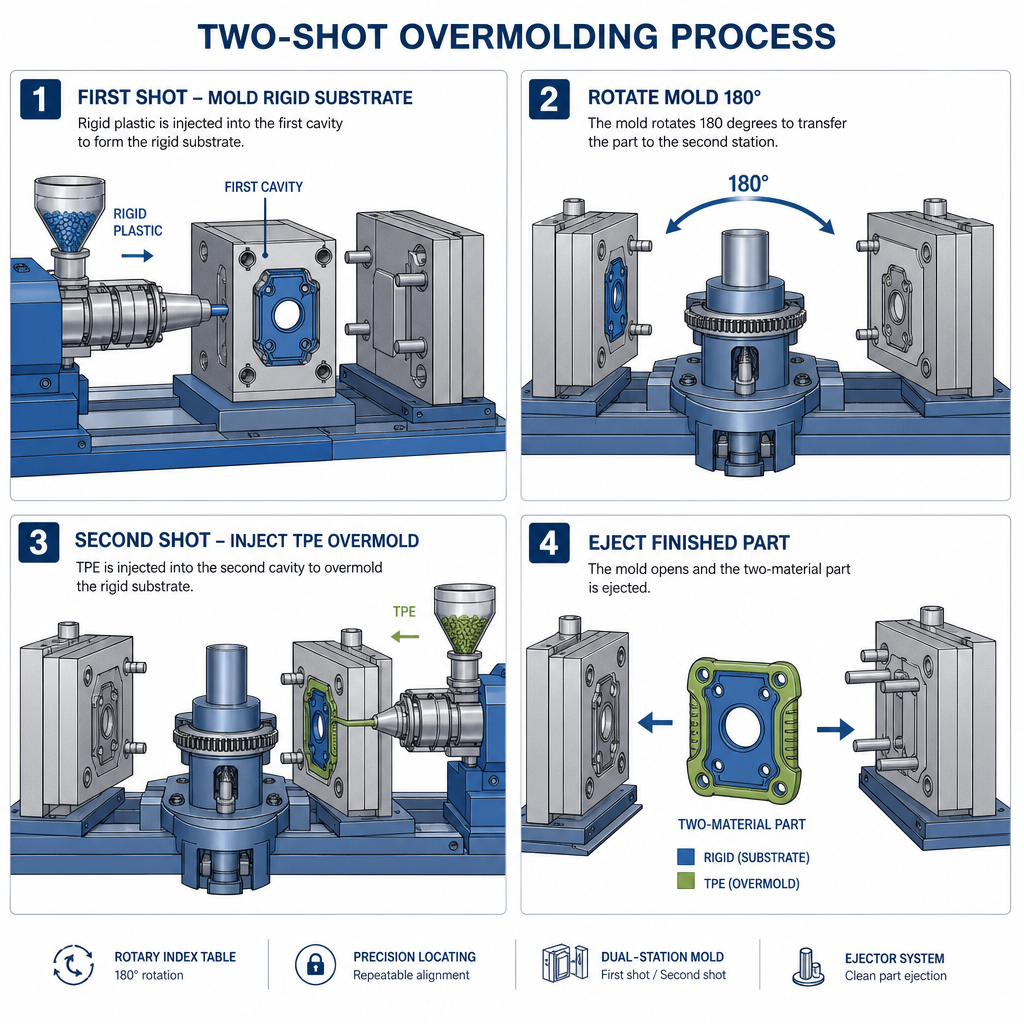
Two-shot (2K) molding uses a rotating mold or core-back mechanism — the rigid substrate is molded in the first shot, the mold rotates to a second station, and the TPE is injected over the substrate while it’s still warm. This maximizes the chemical bond and produces the strongest overmold. Insert overmolding uses pre-molded rigid parts loaded into a separate mold for the TPE shot — suitable for lower volumes but the bond is weaker because the rigid part has cooled and partially crystallized before the TPE is applied.
Material Compatibility
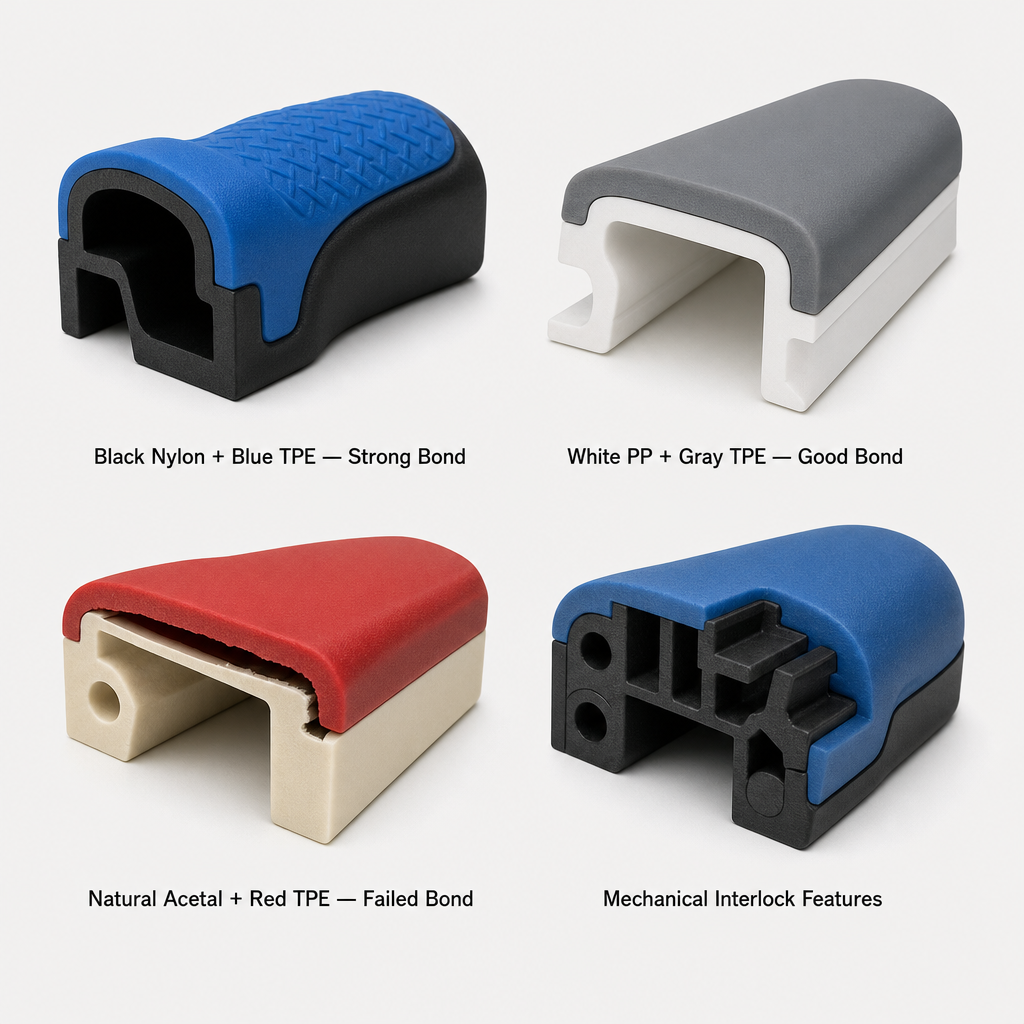
TPE over nylon (PA6, PA66) and TPE over polypropylene achieve the strongest chemical bonds — the TPE’s chemistry is engineered to fuse with these substrates during the overmolding shot. TPE does not bond to acetal (POM) or polyethylene without mechanical interlocking features (holes, undercuts). For applications requiring a mechanical bond, design dovetail grooves or through-holes into the rigid substrate to physically lock the TPE in place.
Часто задаваемые вопросы
How strong is the TPE-to-nylon bond in overmolding?
With proper material pairing and process temperature, the peel strength exceeds the tear strength of the TPE itself — the TPE tears before the bond fails. We specify TPE grades specifically formulated for nylon bonding (e.g., Kraiburg TPE, Teknor Apex, or similar approved grades).
What’s the cost premium for overmolding vs single-material molding?
Two-shot molds cost 40-60% more than single-material molds due to the rotating mechanism, dual injection units, and more complex cooling. For volumes under 5,000 parts/year, manual insert overmolding (mold rigid parts first, load into second mold for TPE) is more cost-effective despite higher labor cost.
Can overmolding replace gaskets and O-rings?
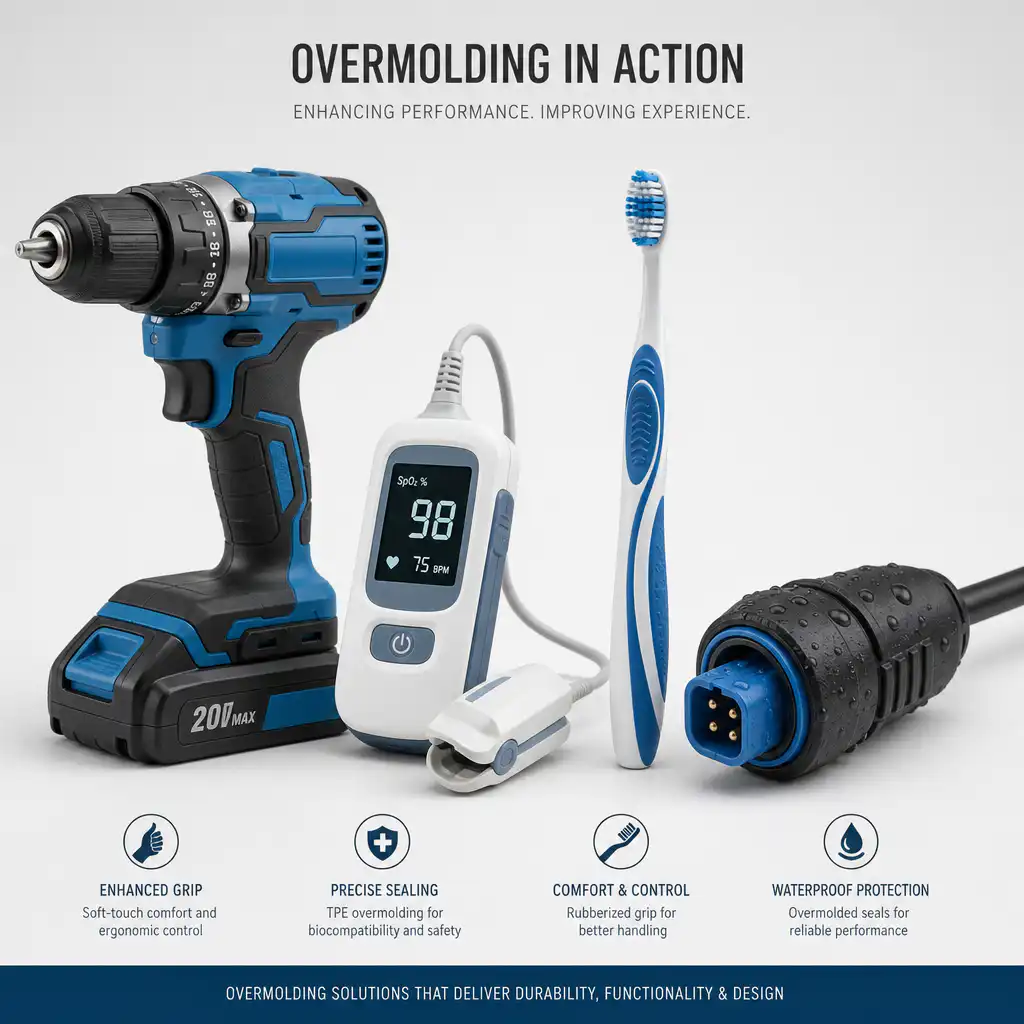
Yes — and it often does. Overmolded TPE seals eliminate separate gasket assembly, reduce part count, and cannot be misaligned during assembly. Medical devices, waterproof consumer electronics, and automotive connectors extensively use overmolded TPE seals for these reasons.
What wall thickness is needed for the TPE layer?
Minimum 0.5mm for a functional overmold, 1.0-2.0mm for soft-touch grips and seals. Below 0.3mm, the TPE cools too quickly during injection and won’t fill thin sections completely. Use generous gate placement and multiple gates for large-area overmolds.
Need overmolded parts?
We provide two-shot and insert overmolding for nylon/TPE, PP/TPE, and other material combinations. Send your design for a feasibility review.


 English
 Dutch
Dutch German
 French
 Korean
 Russian
 Japanese
 Spanish
 Vietnamese
 Chinese
 Portuguese
 Arabic