

POM (Polyoxymethylene), also known as acetal or Delrin, and nylon are the two most widely used engineering plastics for precision mechanical components. Both offer excellent mechanical properties, good wear resistance, and proven reliability in demanding applications.

Key Property Differences
POM has a coefficient of friction of 0.15-0.35 vs nylon’s 0.3-0.5, with moisture absorption of only 0.2-0.3% vs nylon PA66’s 8-9%. POM’s tensile strength is 60-70 MPa while nylon PA66 offers 80-85 MPa. Maximum continuous temperature is 100°C for POM vs 200°C for nylon. For high-load applications, consider our PA66-CF30.
When to Choose POM/Acetal
POM is preferred for precision gears and bearings (lower friction), applications requiring dimensional stability, food contact applications (FDA-compliant grades), and high-speed rotating parts.
When to Choose Nylon
Nylon is better for high-load applications, elevated temperatures, noise reduction requirements, and impact resistance applications.
Source Engineering Materials
As a specialized source manufacturer, we supply both POM and nylon materials in rod, sheet, and tube forms. 聯絡我們 for material selection assistance and pricing.
常見問題
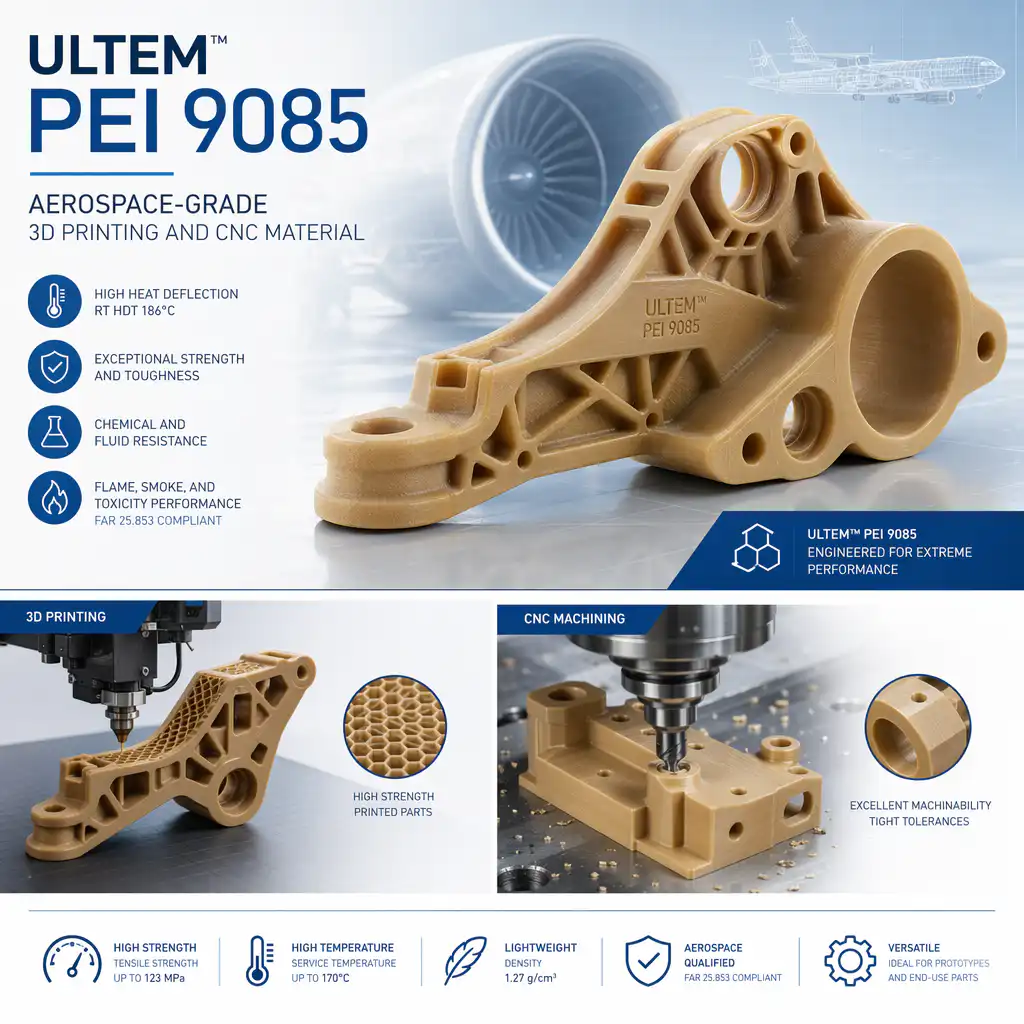
When is Ultem PEI 9085 — Aerospace-Grade 3D Printing and CNC Material a good option?
Ultem PEI 9085 — Aerospace-Grade 3D Printing and CNC Material is a good option when fast iteration, complex geometry, low tooling cost, or low-volume production is more important than molded-part unit cost.
What should be checked before choosing Ultem PEI 9085 — Aerospace-Grade 3D Printing and CNC Material?
檢查零件尺寸、材料特性、表面光潔度、尺寸公差、受熱情況、負載方向,以及是否需要後加工。.
How does Ultem PEI 9085 — Aerospace-Grade 3D Printing and CNC Material compare with CNC machining?
3D 列印可以快速製造複雜的形狀,而 CNC 加工通常在精密表面、更小的公差和生產級材料方面更強。.
What affects the cost of Ultem PEI 9085 — Aerospace-Grade 3D Printing and CNC Material?
成本取決於材料、建置量、列印時間、層高、支撐移除、精加工、檢查以及建置中的零件數量。.
POM vs Nylon — Frequently Asked Questions
Which material is better for precision gears: POM or Nylon?
POM (Acetal/Delrin) is preferred for precision gears due to its lower coefficient of friction (0.15-0.35 vs 0.3-0.5 for nylon), excellent dimensional stability with low moisture absorption (0.2-0.3%), and good wear resistance. POM gears operate quietly and maintain precise dimensions.
When should I choose nylon over POM?
Choose nylon (PA66) when your application requires higher load capacity (80-85 MPa vs 60-70 MPa for POM), elevated temperature resistance (200C continuous vs 100C for POM), superior impact resistance, or noise reduction.
Where can I source POM and nylon materials?
Nylonplastic is a specialized manufacturer established in 2005 with ISO9001/14001/45001/IATF16949 certifications. We supply POM homopolymer, POM copolymer, PA6, PA66, and PA12 in rod, sheet, and tube forms. Our 300+ CNC machines can machine these to 0.02mm tolerance. Contact us for free samples.
 English
 Dutch
Dutch German
 French
 Korean
 Russian
 Japanese
 Spanish
 Vietnamese
 Chinese
 Portuguese
 Arabic