

Automotive Fire Safety Standards
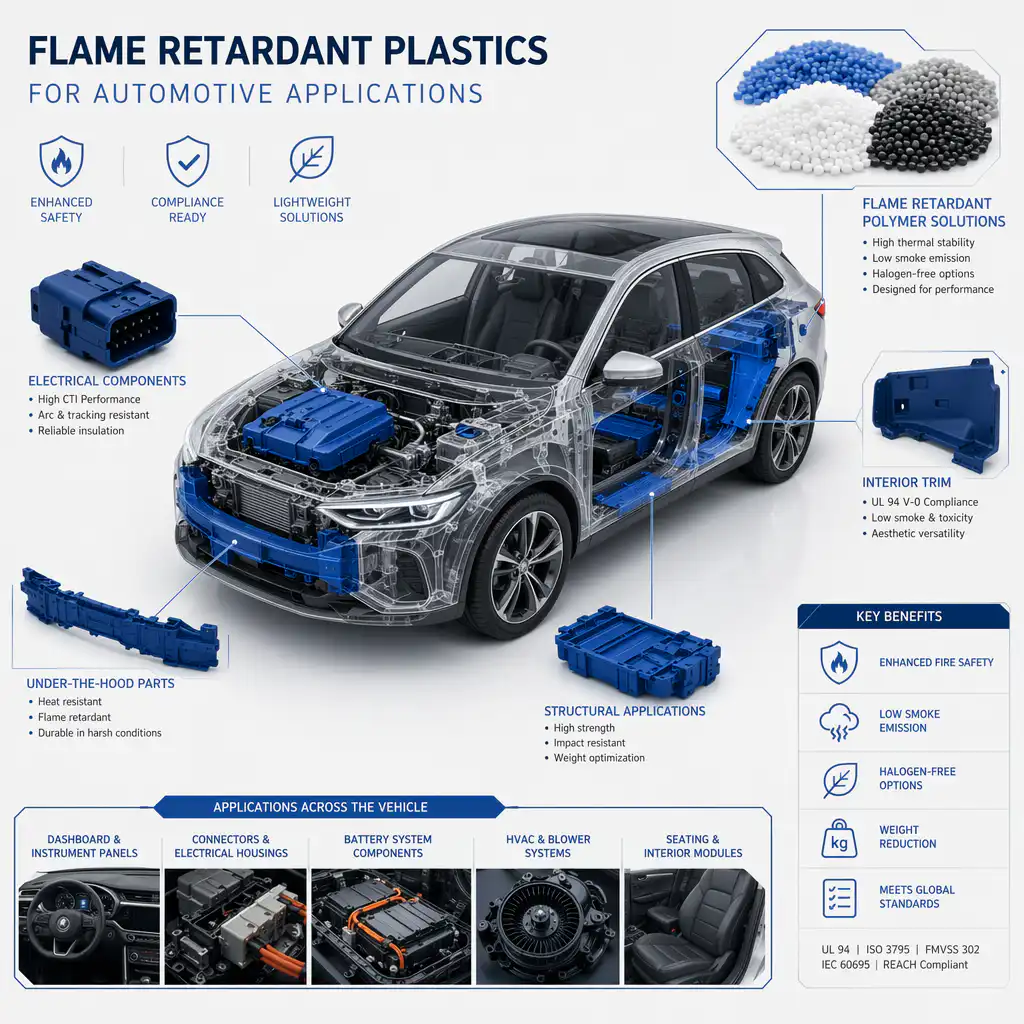
Vehicle interior components must meet strict flame retardant standards to protect passengers.
Key Standards
- FMVSS 302: US federal standard
- UL94 V-0/V-1/V-2: Vertical burn ratings
- ISO 3795: European equivalent
Common FR Materials
- PA66-FR: V-0 rated, halogen-free available
- PP-FR: FMVSS 302 compliant
- ABS-FR: V-0 rated interior grades
FAQ
When is Flame Retardant Plastics for Automotive Applications a good option?
Flame Retardant Plastics for Automotive Applications is a good option when fast iteration, complex geometry, low tooling cost, or low-volume production is more important than molded-part unit cost.
What should be checked before choosing Flame Retardant Plastics for Automotive Applications?
Prüfen Sie die Größe des Teils, die Materialeigenschaften, die Oberflächenbeschaffenheit, die Maßtoleranz, die Wärmeeinwirkung, die Belastungsrichtung und ob eine Nachbearbeitung erforderlich ist.
How does Flame Retardant Plastics for Automotive Applications compare with CNC machining?
Mit dem 3D-Druck lassen sich komplexe Formen schnell erstellen, während die CNC-Bearbeitung für präzise Oberflächen, engere Toleranzen und serienreife Materialien oft besser geeignet ist.
What affects the cost of Flame Retardant Plastics for Automotive Applications?
Die Kosten hängen vom Material, dem Bauvolumen, der Druckzeit, der Schichthöhe, der Entfernung von Stützen, der Endbearbeitung, der Prüfung und der Anzahl der Teile im Bau ab.
Flame Retardant Plastics — Frequently Asked Questions
What's the difference between V-0 and V-2?
V-0 is highest rating, flames self-extinguish within 10 seconds. V-2 allows flaming drips.
Where can I source flame retardant plastics?
Nylonplastic supplies halogen and halogen-free FR grades with full certifications.


 English
 Dutch
Dutch German
 French
 Korean
 Russian
 Japanese
 Spanish
 Vietnamese
 Chinese
 Portuguese
 Arabic