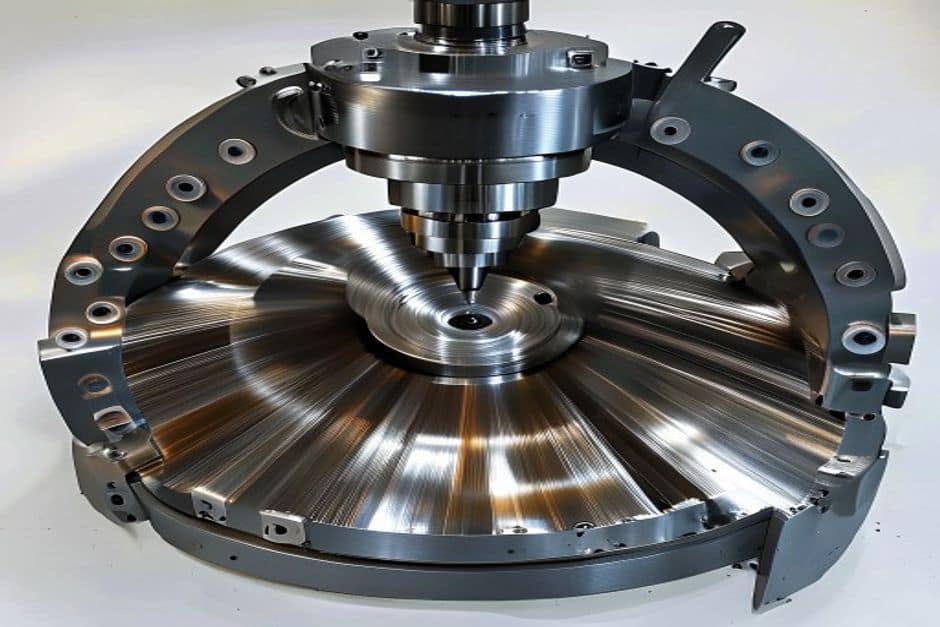
The axis count of a CNC machine determines how many directions the cutting tool can approach the workpiece from — and this fundamentally shapes the geometry, accuracy, and economics of the parts you can produce. From simple 3-axis prismatic parts to complex 5-axis contoured surfaces, each axis configuration serves distinct manufacturing niches.
3-Axis CNC Machining: The Industry Workhorse
3-axis CNC machines move the cutting tool along three perpendicular axes — X (left-right), Y (front-back), and Z (up-down). The workpiece remains stationary on the machine table. This is the most common CNC configuration, used for the majority of manufacturing applications worldwide.
Capabilities
- Face milling, pocket milling, drilling, tapping, and boring
- Producing prismatic parts with vertical walls, flat bottoms, and features accessible from one direction
- Tolerances of ±0.001 inches achievable with proper setup
Limitations
- Features on multiple faces require re-fixturing — operator removes part, repositions, re-aligns, re-secures
- Each re-fixture introduces positioning error (cumulative: 0.001-0.003 inches per setup)
- Undercuts, angled holes, and compound-angle features require modified tools or are simply impossible
- Increased setup time for multi-face parts, especially in low-volume production
Coût
3-axis machines are the most affordable CNC equipment — $20,000-$150,000 for professional machines. Operating costs are correspondingly low. The primary cost penalty appears in multi-setup parts where labor for repositioning dominates cycle cost.
4-Axis CNC Machining: Adding Rotation
4-axis CNC machines add a rotary axis (typically A-axis rotating around X, or C-axis rotating around Z) to the standard XYZ configuration. This allows the workpiece to rotate while the tool approaches, enabling access to multiple faces without re-fixturing.
Capabilities
- Machining features on a cylinder or shaft face without re-fixturing (circumferential drilling, slotting, engraving)
- Rotary tool positioning for angled face machining
- Continuous rotary contouring — producing cams, turbine blades, and helical gears
- Wrapping 2D toolpaths onto cylindrical surfaces (engraving text on a shaft circumference)
Limitations
- Rotary axis typically has lower stiffness than linear axes, limiting heavy cutting on angled faces
- Workpiece size limited by rotary table capacity
- Still cannot approach all compound angles — some undercuts remain impossible
Coût
4-axis machines range from $40,000-$200,000 — roughly 50-100% more than equivalent 3-axis machines. The premium pays for itself in reduced setup time when parts require access to multiple faces.
5-Axis CNC Machining: Maximum Flexibility
5-axis CNC machines add two rotary axes (commonly A + C, or A + B) to the XYZ linear axes, enabling the cutting tool — or the workpiece, depending on the machine design — to orient at any compound angle relative to the part. This is the most capable CNC configuration and increasingly the standard for precision manufacturing.
5-Axis Machine Architectures
- 5-Axis Simultaneous: All five axes move concurrently during cutting — essential for complex 3D contoured surfaces like turbine blades and medical implants
- 3+2 (Positional 5-Axis): Rotary axes position the workpiece at a specific angle, then lock; remaining operations use 3-axis motion. Simpler CAM programming, adequate for angled flat face machining.
Principaux avantages
- Single Setup Machining: All five faces of a cube and many undercut features accessible without re-fixturing — eliminates positioning error from multiple setups
- Shorter Tools: Angled tool approach allows shorter, stiffer cutting tools — reduces deflection, improves surface finish, extends tool life
- Complex Contoured Surfaces: Turbine blades, impellers, medical implant geometries, mold cavities — impossible on 3-axis machines
- Improved Surface Finish: Tool position relative to surface can be optimized continuously, eliminating witness marks
Coût
5-axis machines start at $150,000 and can exceed $1 million for large-format aerospace machines. CAM software and programming expertise add significant cost. However, reduced setup time, improved accuracy, and higher throughput justify the investment for complex parts.
Axis Configuration Selection Guide
| Part Characteristic | Recommended Configuration |
|---|---|
| All features accessible from one face | 3-axis |
| Features on multiple faces, no compound angles | 3+2 or 4-axis |
| Cylindrical parts with circumferential features | 4-axis |
| Complex contoured surfaces (aerospace, medical) | 5-axis simultaneous |
| Undercuts and compound-angle features | 5-axis simultaneous |
Articles connexes
Explore our complete guide to engineering plastics and precision manufacturing. For detailed technical guidance, review our articles on CNC machining processes, material selection, and manufacturing optimization.
Questions fréquemment posées
What determines the best manufacturing process for my project?
The optimal process depends on production volume, material, tolerances, geometry complexity, and budget. Low-volume precision parts suit CNC machining. High-volume identical parts favor injection molding. Hardened materials with sharp corners benefit from EDM. Cold-cutting requirements point to water jet.
How important is material selection in the manufacturing outcome?
Material choice is arguably the most important decision. It determines cutting parameters, tool selection, achievable tolerances, surface finish, and ultimately part performance. Engineering plastics like Nylon and POM behave very differently from metals — requiring specific feeds, speeds, and cooling strategies.
What certifications should I look for when choosing a manufacturer?
ISO 9001:2015 is the baseline. Industry-specific certifications include AS9100 (aerospace), ISO 13485 (medical), IATF 16949 (automotive), and NADCAP (special processes). Verify the certification scope covers your specific component type.
How can I reduce manufacturing costs?
Optimize designs for manufacturability: relax tolerances where functionally acceptable, minimize setups by designing features accessible from one orientation, use standard tool sizes, and order larger quantities to amortize setup time. Early supplier engagement during the design phase is the most effective cost-reduction strategy.