
Mold Material Customization for Precision Tooling
Compare tool steels, aluminum alloys, beryllium copper, tungsten carbide, and additively manufactured mold materials by hardness, thermal conductivity, polishability, tool life, and cost — so every mold starts with the right substrate for its production volume and part requirements.
The mold material is the foundation — everything else builds on it
A mold is only as good as the steel (or aluminum, or carbide) it is cut from. Cycle time, part consistency, tool maintenance interval, and per-piece cost all trace back to this single decision. The wrong material choice cannot be fixed by better machining or tighter process control.
This page organizes every mold and tooling material available through our supply chain — from standard pre-hardened P20 for general-purpose molds to maraging steel for 3D-printed conformal cooling inserts — with practical guidance on when each one earns its cost. Use it to align your mold specification with production volume, resin type, surface finish requirements, and budget.
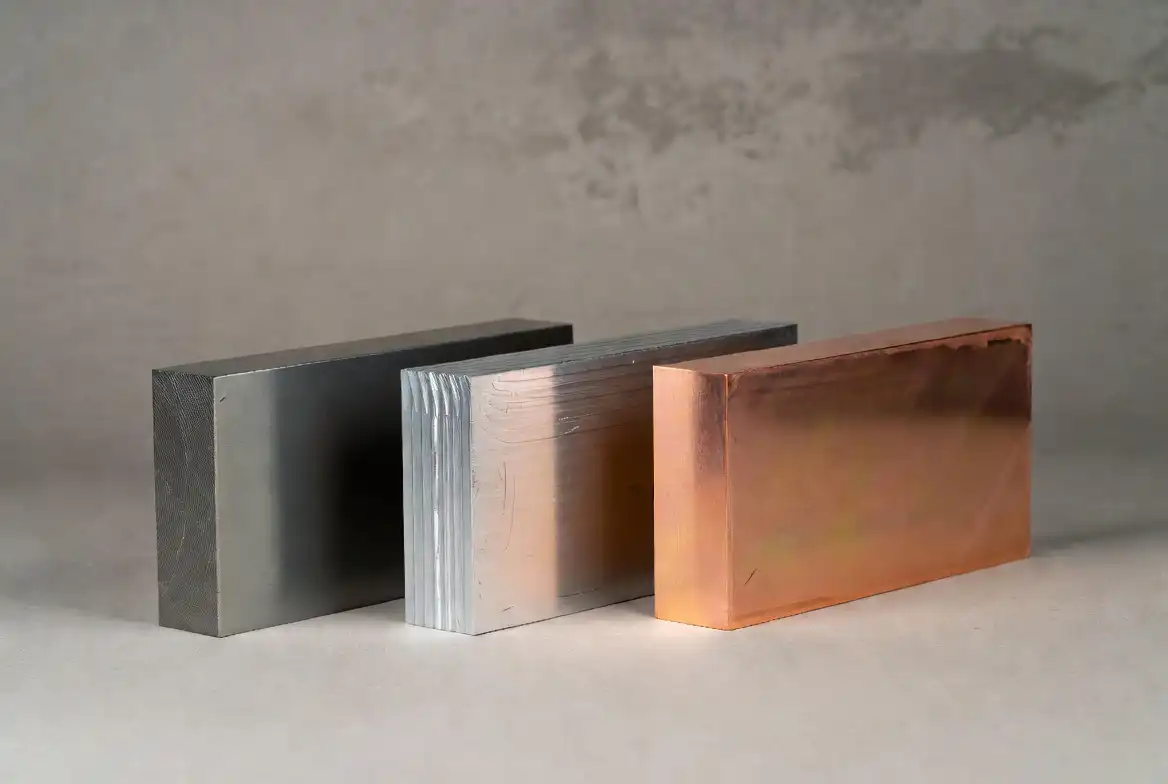
Complete Mold Material Comparison
Technical specifications for standard, hardened, and specialty mold materials. Select by hardness, wear resistance, thermal conductivity, polishability, and relative tool cost.
| Matériau | Hardness (HRC) | Thermal Cond. | Polishability | Typical Tool Life | Coût relatif | Meilleur pour |
|---|---|---|---|---|---|---|
| P20 (1.2311) | 28–32 (pre-hard) | Moderate | Good (B-1+) | 200k–500k shots | $$ | General injection molds, medium volume |
| H13 (1.2344) | 48–52 (hardened) | Moderate | Bon | 500k–1M+ shots | $$$ | High-wear, high-temp, die casting |
| 420 SS (1.2083) | 48–52 (hardened) | Plus bas | Excellent (A-1) | 500k–1M+ shots | $$$ | Transparent parts, PVC, corrosive resins |
| 718H | 33–38 (pre-hard) | Bon | Very good (A-2) | 300k–600k shots | $$$ | High-polish, large molds, automotive |
| NAK80 | 37–43 (pre-hard) | Bon | Excellent (A-1+) | 300k–500k shots | $$$ | Mirror-finish, optical, cosmetic |
| 7075-T6 Aluminum | ~150 HB (Brinell) | Excellent | Good (B-1) | 5k–50k shots | $ | Prototypes, low volume, fast turnaround |
| AlMg3 (Aimonte) | ~80 HB | Excellent | Bon | 3k–20k shots | $ | Transparent prototypes, concept models |
| Béryllium Cuivre | 36–42 (aged) | 3–4x steel | Bon | 200k+ (as inserts) | $$$$ | High-heat inserts, rapid cooling zones |
| Carbure de tungstène | 88–92 HRA | Haut | Limited | 2M+ shots | $$$$$ | Abrasive resins, glass-filled, long runs |
| Maraging Steel (1.2709) | 50–54 (aged) | Moderate | Very good | 200k–500k shots | $$$$ | 3D-printed conformal cooling molds |
| Revêtement DLC | >80 HRC (surface) | N/A | Smooth (low COF) | Extends base 2–5x | $$$ | Sticky resins (TPE/TPU), release aid |
Tool Steel: The Workhorse Materials
Tool steels account for over 80% of production injection molds. Each grade is optimized for a different balance of hardness, toughness, machinability, and polishability.
P20 — Pre-Hardened Generalist
Supplied at 28–32 HRC, machines directly without heat treatment. Ideal for medium-volume molds (200k–500k shots) for PE, PP, ABS, and unfilled nylon. Accepts SPI B-1 polish and standard textures.
No heat treat neededGood machinability
H13 — Hot Work Champion
Hardened to 48–52 HRC after rough machining. Exceptional hot hardness and thermal fatigue resistance. The standard for die casting, high-temp engineering resins (PEEK, PPS), and abrasive filled compounds.
High temp ratedWear resistant
420 Stainless — Corrosion Fighter
Hardened to 48–52 HRC with excellent polishability to SPI A-1. Resists corrosion from PVC outgassing, flame-retardant additives, and humid operating environments. Standard for medical and optical molds.
Mirror polishCorrosion proof
Aluminum Molds: Speed Economics
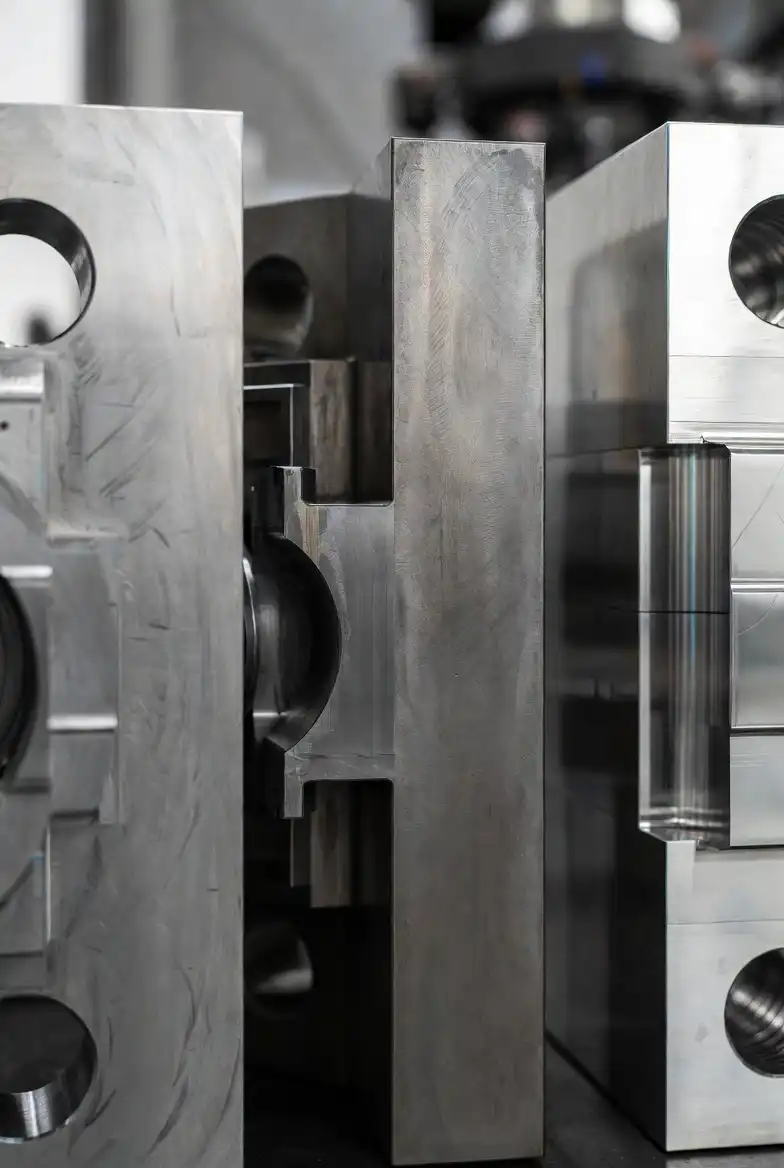
Aluminum tooling trades longevity for speed. A 7075-T6 mold machines up to 70% faster than P20, and its 3–4x higher thermal conductivity can cut cycle times by 15–25%. The economics favor prototyping, bridge tooling, and low-volume production.
| Propriété | Aluminum 7075-T6 | P20 Tool Steel | Winner |
|---|---|---|---|
| Machining time | 1x (baseline) | 2.5–4x longer | Aluminum — 60–75% faster |
| Thermal conductivity | 130–160 W/m·K | 28–34 W/m·K | Aluminum — 3–5x better cooling |
| Typical tool life | 5,000–50,000 shots | 200,000–500,000 shots | Steel — 10–40x longer |
| Polish ceiling | SPI B-1 (fine semi-gloss) | SPI A-2 (high polish) | Steel — higher gloss possible |
| Repair & welding | More difficult, lower strength | Standard weld repair | Steel — easier to maintain |
| Tool cost (same geometry) | $5,000–$15,000 | $15,000–$40,000 | Aluminum — 50–70% lower |
| Cycle time reduction | 15–25% faster cooling | Baseline | Aluminum — lower per-part cost |
Tool Life by Material and Production Volume
Expected shot counts under normal operating conditions with standard maintenance. Aggressive resins (glass-filled, mineral-filled, flame-retardant) reduce these figures by 30–50%.
Specialty Materials: When Standard Won’t Do
For extreme thermal loads, abrasive compounds, complex cooling geometries, and sticky release problems — these materials solve problems that P20 and H13 cannot.
Beryllium Copper Inserts
Thermal conductivity of 105–130 W/m·K — 3 to 4 times that of tool steel. Installed as cavity inserts in hot spots where cycle time is bottlenecked by cooling. Typical payback: 15–30% cycle time reduction on thick-walled parts.
Fastest coolingInsert strategy
Tungsten Carbide Cavities
Hardness of 88–92 HRA with exceptional wear resistance. Used for gate inserts, runner blocks, and full cavities when molding 30%+ glass-filled nylon, PPS, or PEEK. Tool life exceeds 2 million shots even with abrasive compounds.
Maximum wear resistanceUltra-long life
3D-Printed Maraging Steel (1.2709)
Laser powder bed fusion (LPBF) enables conformal cooling channels that follow the cavity contour — impossible with conventional drilling. Reduces cycle time by 20–30% and improves part quality by eliminating hot spots and reducing warpage.
Conformal coolingGéométrie complexe
How to select the right mold material
Three factors that should be locked before the mold design begins.
Determine production volume
Under 10,000 total shots? Aluminum is almost certainly the right answer. 50,000 to 300,000? P20 or 718H pre-hardened steel. Over 500,000? H13 or 420 stainless with hardened inserts for wear zones. The material cost difference is small compared to the cost of a mold that wears out mid-production.
Analyze the resin
Each resin family stresses the mold differently. PVC outgasses corrosive HCl — needs 420 stainless or chrome plating. Glass-filled nylon is abrasive — needs hardened steel or carbide at gates. TPE/TPU sticks — DLC coating pays for itself in reduced release-agent cycles alone. Unfilled PP/PE is forgiving — P20 is sufficient.
Define surface finish requirements
If the part needs SPI A-2 or better, the mold material must be capable of achieving that polish. 420 stainless and NAK80 are the gold standards for mirror finish. P20 tops out around B-1. Aluminum cannot reach SPI A grades. Texture (VDI, leather grain, geometric patterns) can be applied to any steel mold but may have shorter life on aluminum.
Mold Materials by Industry Application
Questions fréquemment posées
How much more does a hardened steel mold cost vs. aluminum?
For the same part geometry, an aluminum (7075-T6) mold typically costs 50–70% less than a P20 steel mold and 65–80% less than a hardened H13 or 420 SS mold. However, per-part tool amortization flips this at volume: an aluminum mold at 10,000 shots costs $0.50–$1.50 per part in tool amortization, while a steel mold at 300,000 shots costs $0.05–$0.13 per part. The crossover point where steel becomes cheaper per part is typically between 8,000 and 20,000 shots, depending on geometry complexity.
Can I start with aluminum and switch to steel later?
Yes — this is a common and recommended strategy called bridge tooling. Use an aluminum mold to produce the first 5,000–10,000 parts for design validation, market testing, and regulatory approval. Once the design is locked, cut a steel production mold. The aluminum mold cost is treated as a de-risking investment. One caveat: aluminum molds wear differently than steel, so gate vestige, parting line flash, and texture degradation will be visible earlier — plan the switch before quality becomes an issue, not after.
What mold material should I use for glass-filled nylon (PA6-GF30)?
Glass-filled nylon is one of the most abrasive common molding resins. For production volumes above 50,000 shots, specify hardened H13 (48–52 HRC) for core and cavity, with tungsten carbide or hardened D2 inserts at the gate and runner areas where wear is concentrated. Nitriding the H13 cavity surface adds 15–25 µm of case hardness (to ~900 HV) and extends life by 40–60%. For prototype volumes under 5,000 shots, P20 can survive if you accept some gate wear and dimensional drift toward the end of the run.
Is 3D-printed mold tooling (maraging steel) ready for production?
Maraging steel (1.2709) produced by laser powder bed fusion is production-ready for conformal cooling inserts and complex cores where traditional machining cannot achieve the cooling channel geometry. It is not yet a full-cavity replacement for conventionally machined H13 or 420 SS — the as-printed surface requires post-machining to achieve SPI finish grades, and the cost per cubic centimeter is 3–5x conventional steel. Its ROI is strongest when conformal cooling reduces cycle time by 20–30% on complex, high-volume parts, where the tool cost premium is recovered within months through increased throughput.
Need a mold material recommendation?
Tell us your part material, production volume, and surface finish target. We will recommend the optimal mold substrate and provide a tooling cost estimate with material options at different price points.
We do not sell, trade, or rent your personal data. You can contact us at any time to request, update, or delete your information.