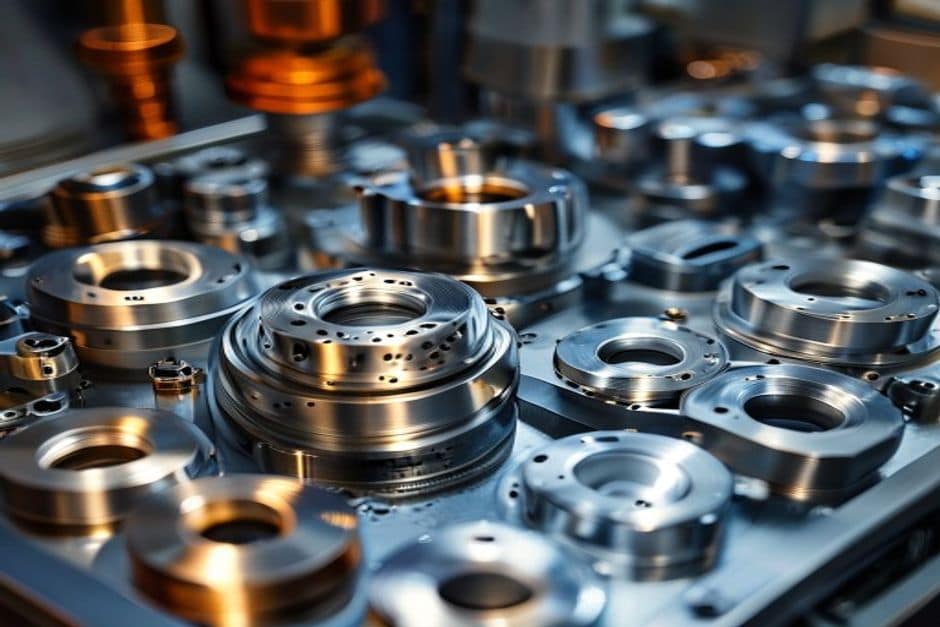
Precision machining is CNC manufacturing performed to tolerances significantly tighter than standard practice — typically ±0.001 to ±0.0001 inch (±25 to ±2.5 microns). At this level, every variable matters: machine temperature stability, tool runout, cutting forces, coolant temperature, operator expertise, and measurement uncertainty. Precision machining is the domain of aerospace, medical devices, optics, instrumentation, and other industries where part-to-part interchangeability must function at the limits of conventional manufacturing.
What Defines “Precision” Machining?
Standard CNC machining routinely achieves ±0.002 to ±0.005 inch (50-125 microns) across typical production runs. Precision machining pushes this to ±0.0005 inch (12 microns) and below — tolerances where:
- A 1°C temperature change in the workpiece of 6 inches expands it by approximately 0.0001 inch — exceeding the tolerance band
- Cutting tool runout of 0.0001 inch translates directly to part diameter variation
- Coolant temperature fluctuations of 2°C measurably affect part dimensions
- Ball screw pitch error that was acceptable at ±0.002 inch becomes the dominant error source at ±0.0005 inch
Key Enablers of Precision Machining
1. Machine Tool Quality
Precision machining requires machine tools with:
- Hydrostatic or high-grade linear roller guide ways with sub-micron straightness
- Glass scale linear encoders directly on each axis (not just rotary encoders on motors)
- Ball screws with < 2 µm pitch error over 300 mm travel
- Machine mass (weight) approximately 10× the expected cutting force to dampen vibration
- Temperature-controlled spindle bearings (oil mist or chilled coolant circulation)
2. Environmental Control
The machine shop environment directly determines which tolerances are achievable:
- Température: Controlled to ±1°C (68°F ±2°) for precision work; uncontrolled shops can fluctuate 10°C+ between morning and afternoon
- Foundation Stability: Precision machines require isolated concrete foundations to prevent transmission of vibration from adjacent equipment or building systems
- Cleanliness: Airborne dust and chips can interfere with coolant nozzles, tool setting, and workpiece positioning at the micron level
3. Metrology and Inspection
You cannot manufacture what you cannot measure. Precision machining requires:
- Coordinate Measuring Machines (CMM): Accuracy of ±0.0002 inch or better
- In-Process Probing: On-machine Renishaw probes that verify dimensions before the part leaves the fixture — eliminating measurement errors from re-fixturing
- Laser Interferometers: Calibrate machine positioning accuracy to < 1 µm
- Ballbar Circularity Testing: Quantifies servo tuning quality, backlash, and axis squareness

Tolerance Achievability by Process
| Processus | Standard Tol (±in) | Precision Tol (±in) |
|---|---|---|
| CNC Milling | 0.002-0.005 | 0.0005-0.001 |
| CNC Turning | 0.001-0.003 | 0.0002-0.0005 |
| Wire EDM | 0.0005-0.001 | 0.0001-0.0002 |
| Grinding (cylindrical) | 0.0002-0.0005 | 0.00005-0.0001 |
| Honing | 0.0002-0.0005 | 0.00005-0.0001 |
Precision Machining of Engineering Plastics
Engineering plastics present unique challenges in precision machining:
- Thermal Expansion: Nylon has a coefficient of thermal expansion approximately 10× higher than steel. A part machined at 30°C and inspected at 20°C will measure undersized. Achievable precision tolerances on plastic components are typically ±0.002 inch (50 microns) — double that of equivalent metal parts — due to thermal effects and material compliance.
- Absorption de l'humidité: Nylon 6 absorbs 2-3% moisture by weight, expanding 0.2-0.5% in the process. Parts measured immediately after machining will change dimension as moisture stabilizes.
- Tool Deflection: Sharp tools and reduced cutting forces are essential — plastic compliance causes dimensional variation if tools deflect due to aggressive feed rates.
Articles connexes
Explore our complete guide to engineering plastics and precision manufacturing. For detailed technical guidance, review our articles on CNC machining processes, material selection, and manufacturing optimization.
Questions fréquemment posées
What determines the best manufacturing process for my project?
The optimal process depends on production volume, material, tolerances, geometry complexity, and budget. Low-volume precision parts suit CNC machining. High-volume identical parts favor injection molding. Hardened materials with sharp corners benefit from EDM. Cold-cutting requirements point to water jet.
How important is material selection in the manufacturing outcome?
Material choice is arguably the most important decision. It determines cutting parameters, tool selection, achievable tolerances, surface finish, and ultimately part performance. Engineering plastics like Nylon and POM behave very differently from metals — requiring specific feeds, speeds, and cooling strategies.
What certifications should I look for when choosing a manufacturer?
ISO 9001:2015 is the baseline. Industry-specific certifications include AS9100 (aerospace), ISO 13485 (medical), IATF 16949 (automotive), and NADCAP (special processes). Verify the certification scope covers your specific component type.
How can I reduce manufacturing costs?
Optimize designs for manufacturability: relax tolerances where functionally acceptable, minimize setups by designing features accessible from one orientation, use standard tool sizes, and order larger quantities to amortize setup time. Early supplier engagement during the design phase is the most effective cost-reduction strategy.