
Importance of Mold Maintenance
Injection molds are significant investments. Proper maintenance extends tool life, ensures part quality, and prevents costly production interruptions.
Preventive Maintenance Schedule
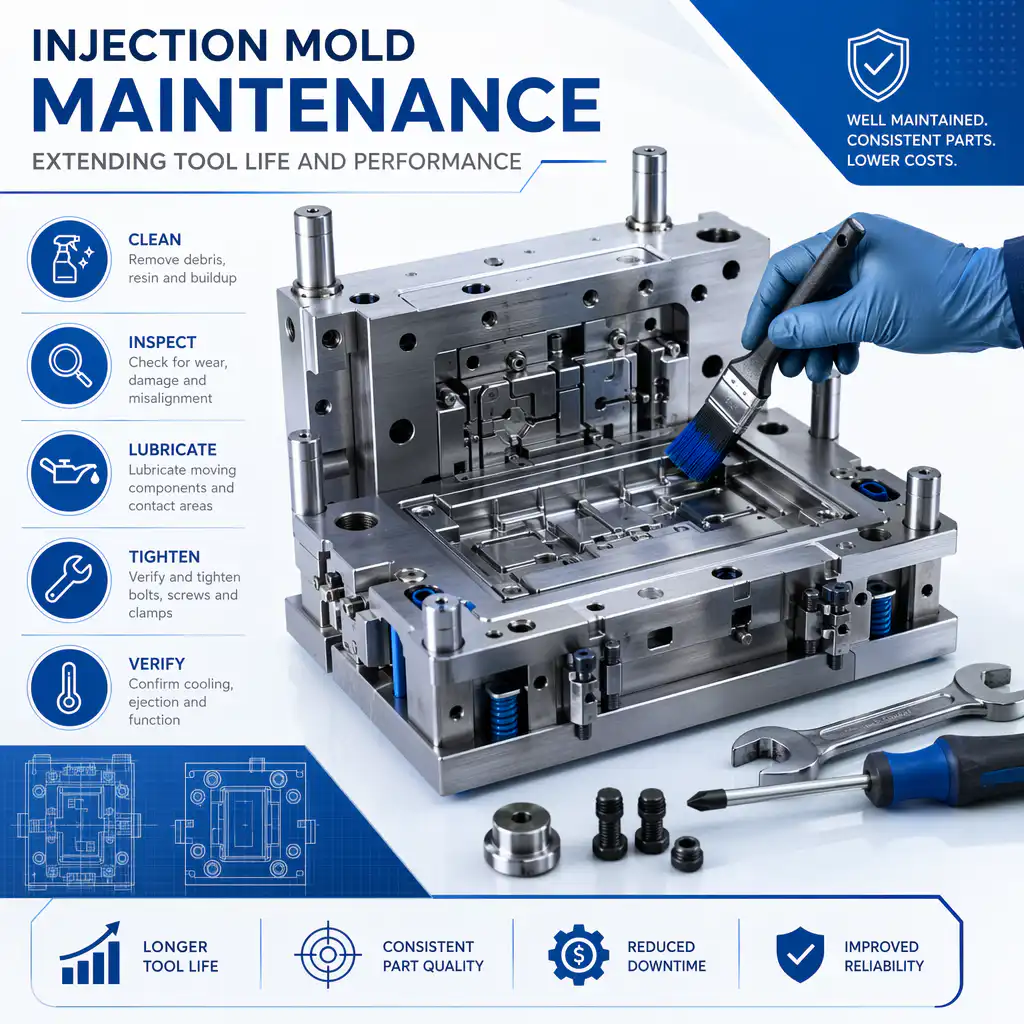
Daily Maintenance
- Clean cavity surfaces with approved solvents
- Check ejector pins for wear or sticking
- Inspect parting line for flash or damage
- Verify cooling water flow
- Lubricate moving components
Weekly Maintenance
- Deep clean all mold surfaces
- Check and clean vents
- Inspect hot runner system (if applicable)
- Check water channels for scale buildup
- Verify sensor functionality
Monthly Maintenance
- Measure critical dimensions
- Check for wear on sliding components
- Replace worn ejector pins
- Document condition with photos
Annual Maintenance
- Replace all wearable components
- Check mold base alignment
- Update maintenance records
- Plan major repairs or refurbishment
Common Maintenance Issues
Ejector Pin Wear
Ejector pins are subject to constant friction. Signs of wear include:
- Part marking or scratching
- Sticking or binding
- Flash around pin holes
Solution: Replace pins at scheduled intervals or when wear exceeds tolerance.
Vent Blockage
Vents allow air and gas to escape during injection. Blocked vents cause:
- Short shots
- Burning or discoloration
- Weak weld lines
Solution: Clean vents regularly with appropriate tools.
Cooling Channel Scale
Water scale reduces cooling efficiency:
- Longer cycle times
- Uneven cooling
- Higher energy consumption
Solution: Descale channels periodically or use treated water.
Mold Storage Best Practices
Documentation and Records
Maintain detailed records for each mold:
- Mold identification number
- Total shot count
- Maintenance history
- Repair records with photos
Cost of Neglect
Poor maintenance leads to:
- Unexpected production stoppages
- Poor part quality and rejects
- Shortened mold life
- Higher repair costs
Conclusie
Verwante bronnen
- Selectiegids voor kunststof materialen
- Technische plastic kostenfactoren
- Vergelijking PEEK vs PEI
- Flame Retardant Plastics
- Food Grade Plastics Guide
FAQ
When does Injection Mold Maintenance — Extending Tool Life and Performance make sense?
Injection Mold Maintenance — Extending Tool Life and Performance makes sense when the part volume, material choice, geometry, and repeatability needs justify mold design and tooling investment.
What design factors matter most for Injection Mold Maintenance — Extending Tool Life and Performance?
Wall thickness, ribs, bosses, draft angle, gate location, shrinkage, parting line, and ejection all affect molded part quality.
What information is needed before mold production?
The supplier should confirm the 3D model, material, expected annual volume, appearance requirements, tolerance needs, and any assembly or functional testing requirements.
What is the biggest risk in Injection Mold Maintenance — Extending Tool Life and Performance?
The biggest risk is approving tooling before material behavior, shrinkage, flow, and part function are fully checked against the real application.

 English
 Dutch
Dutch German
 French
 Korean
 Russian
 Japanese
 Spanish
 Vietnamese
 Chinese
 Portuguese
 Arabic