
What is ABS?
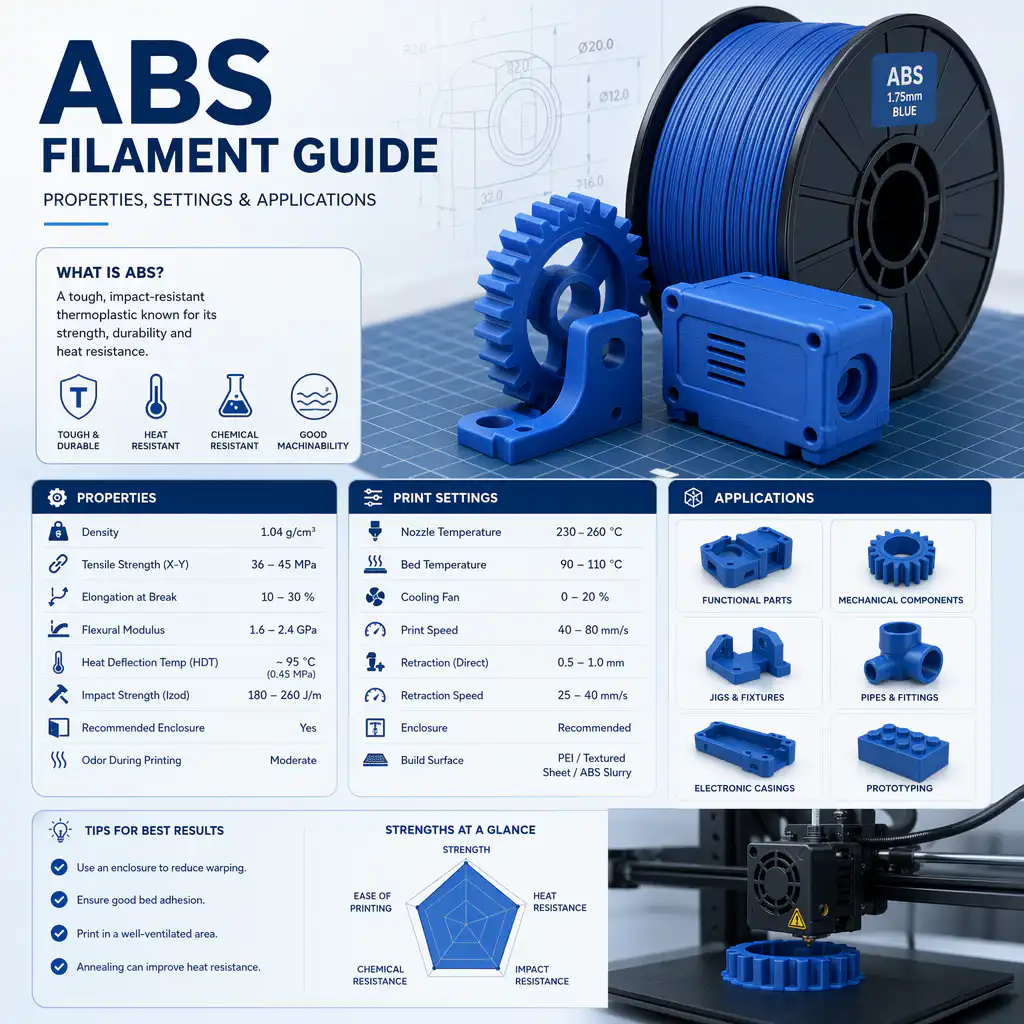
ABS (acrylonitril-butadieenstyreen) is a terpolymer combining three monomers for a balanced property profile:
- Acrylonitrile: Chemical resistance and thermal stability
- Butadiene: Toughness and impact resistance
- Styrene: Rigidity and ease of processing
Essentiële eigenschappen
| Eigendom | Waarde |
|---|---|
| Treksterkte | 40-50 MPa |
| Flexural Modulus | 2.0-2.5 GPa |
| Heat Deflection Temp | 85-95°C at 1.8 MPa |
| Glass Transition | 105°C |
| Dichtheid | 1.04 g/cm³ |
ABS Print Settings
Recommended Parameters
- Nozzle Temperature: 230-260°C
- Bed Temperature: 90-110°C
- Print Speed: 40-80 mm/s
- Cooling Fan: 0-30%
- Layer Height: 0.1-0.3mm
Troubleshooting Guide
Scheeftrekken
Cause: Uneven cooling
Solutions:
- Use enclosed chamber
- Increase bed temperature
- Apply ABS slurry or glue
Layer Separation
Cause: Insufficient adhesion
Solutions:
- Increase nozzle temperature
- Reduce cooling fan
- Slow print speed
Post-Processing ABS
Acetone Smoothing
Acetone vapor smooths ABS surfaces, eliminating layer lines:
- Place part in sealed container
- Add acetone on paper towel
- Allow 10-60 minutes
- Remove and let dry
FAQ
When is ABS Filament Guide — Properties, Settings & Applications a good option?
ABS Filament Guide — Properties, Settings & Applications is a good option when fast iteration, complex geometry, low tooling cost, or low-volume production is more important than molded-part unit cost.
What should be checked before choosing ABS Filament Guide — Properties, Settings & Applications?
Controleer de onderdeelgrootte, materiaaleigenschappen, oppervlakteafwerking, maattolerantie, blootstelling aan hitte, belastingsrichting en of nabewerking nodig is.
How does ABS Filament Guide — Properties, Settings & Applications compare with CNC machining?
Met 3D-printen kunnen complexe vormen snel worden gemaakt, terwijl CNC-bewerking vaak sterker is voor precieze oppervlakken, nauwere toleranties en productiematerialen.
What affects the cost of ABS Filament Guide — Properties, Settings & Applications?
De kosten zijn afhankelijk van het materiaal, het bouwvolume, de printtijd, de laaghoogte, het verwijderen van de ondersteuning, de afwerking, de inspectie en het aantal onderdelen in de bouw.
ABS Filament Guide — Frequently Asked Questions
Is ABS harder to print than PLA?
Yes. ABS requires higher temperatures, enclosed chamber, and careful attention to bed adhesion and cooling.
Can I smooth ABS with acetone?
Yes. Acetone vapor smoothing is a popular technique for ABS, eliminating layer lines.
Where can I buy quality ABS filament?
Nylonplastic supplies ABS in 1.75mm and 2.85mm. Free samples available.
 English
 Dutch
Dutch German
 French
 Korean
 Russian
 Japanese
 Spanish
 Vietnamese
 Chinese
 Portuguese
 Arabic