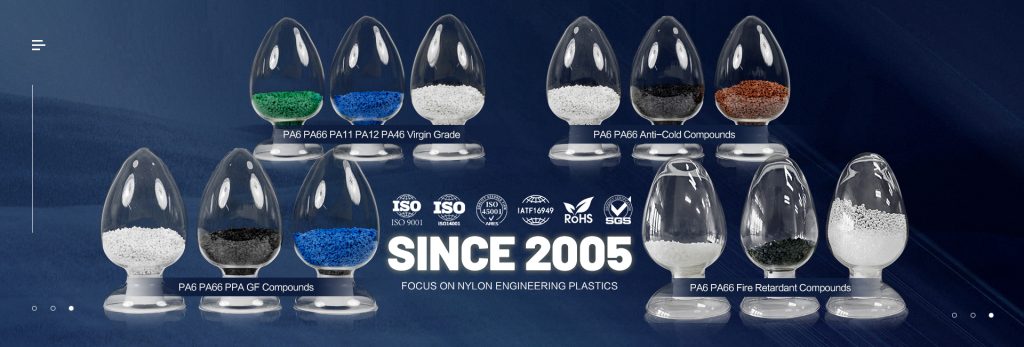

Adding glass fibers to nylon dramatically changes its performance characteristics. While unfilled nylon offers excellent toughness and processability, glass-filled grades deliver substantially higher strength, stiffness, and thermal stability.
What Is Glass-Filled Nylon?
Glass-filled nylon is a composite material consisting of nylon resin reinforced with short glass fibers. The most common grades contain 15%, 25%, 30%, or 50% glass fiber by weight.
Mechanical Properties Comparison
| Imóveis | PA6 Unfilled | PA6 GF15 | PA6 GF30 | PA6 GF50 |
|---|---|---|---|---|
| Resistência à tração (MPa) | 75 | 120 | 170 | 210 |
| Módulo de flexão (GPa) | 2.7 | 5.5 | 8.5 | 14.0 |
| HDT at 1.8 MPa (°C) | 65 | 180 | 195 | 210 |
Estabilidade dimensional
Glass fibers reduce the material’s coefficient of linear thermal expansion (CLTE) by 50-70%, bringing it closer to metals like aluminum.
Considerações sobre o processamento
Glass-filled nylon requires: higher melt temperatures, higher injection pressures, hardened molds due to abrasive wear, and careful gate design for fiber orientation.
Cost Considerations
GF30 provides the best balance of cost and performance for most applications. It’s the most widely used glass-filled grade.
Application Guide
Choose Unfilled Nylon When:
- Impact resistance and toughness are critical
- Parts need good surface finish
- Snap-fits or living hinges are required
- Cost is the primary concern
Choose Glass-Filled Nylon When:
- High strength and stiffness are needed
- Dimensional stability under heat is critical
- Metal replacement is the goal
- Precision tolerances must be maintained
As nossas capacidades
Com mais de 300 máquinas CNC, produzimos mais de 10.000 peças por dia com tolerâncias tão apertadas como ±0,005mm. Aceitamos MOQ a partir de 1 peça, com prazos de entrega que variam entre 24 horas a 15 dias. We supply nylon in all grades—unfilled, GF15, GF30, and GF50. Obter um orçamento no prazo de 24 horas.
FAQ
How do you know whether Glass-Filled vs Unfilled Nylon: Complete Performance Comparison fits a part?
Glass-Filled vs Unfilled Nylon: Complete Performance Comparison fits a part when its load capacity, temperature range, moisture exposure, wear behavior, and processing method match the real service conditions.
What properties should be checked for Glass-Filled vs Unfilled Nylon: Complete Performance Comparison?
Verificar a resistência, a rigidez, a resistência ao impacto, a resistência ao calor, a absorção de humidade, a estabilidade dimensional, a fricção, o desgaste e a compatibilidade química.
What is the biggest selection risk for Glass-Filled vs Unfilled Nylon: Complete Performance Comparison?
O maior risco é escolher a partir de um valor da folha de dados sem considerar o ambiente real, o método de processamento, a geometria da peça e a utilização a longo prazo.
When should Glass-Filled vs Unfilled Nylon: Complete Performance Comparison be tested before production?
Recomenda-se a realização de ensaios quando a peça é sujeita a carga, calor, produtos químicos, humidade, tolerâncias apertadas, requisitos regulamentares ou um novo ambiente de funcionamento.