


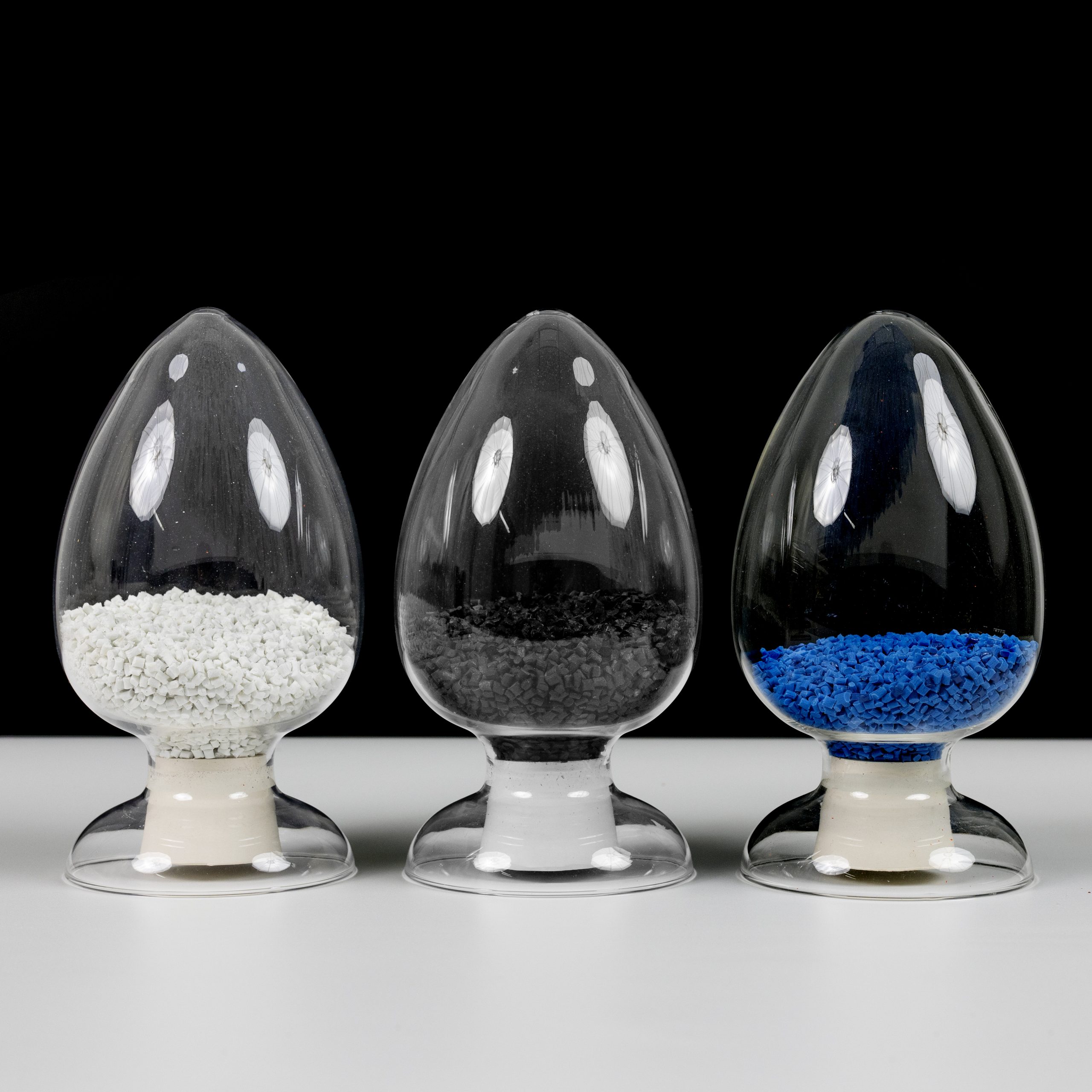
PET GF10 Technical Data (Estimated Typical Values)
| Imóveis | Valor | Norma de ensaio |
|---|---|---|
| Conteúdo de fibra de vidro | 10% | ISO 1172 |
| Resistência à tração | 100 - 120 MPa | ISO 527 |
| Módulo de flexão | 7.000 - 8.500 MPa | ISO 178 |
| Resistência ao impacto entalhado | 6 – 8 kJ/m² | ISO 180 |
| HDT @1,8 MPa | 205 – 215 °C | ISO 75 |
| Comparative Tracking Index (CTI) | 600 V | IEC 60112 |
PET GF Series Performance Comparison Table (Estimated Typical Values)
| Imóveis | PET GF10 | PET GF20 | PET GF30 | PET GF40 | PET GF50 |
|---|---|---|---|---|---|
| Conteúdo de fibra de vidro | 10% | 20% | 30% | 40% | 50% |
| Resistência à tração | 100 - 120 MPa | 125 – 145 MPa | 145 – 165 MPa | 160 - 180 MPa | 175 - 195 MPa |
| Módulo de flexão | 7.000 - 8.500 MPa | 8.500 - 10.000 MPa | 10.000 - 12.000 MPa | 12.000 - 14.000 MPa | 14,000 – 17,000 MPa |
| Resistência ao impacto entalhado | 6 – 8 kJ/m² | 7 – 9 kJ/m² | 8 - 11 kJ/m² | 7 - 10 kJ/m² | 6 - 9 kJ/m² |
| HDT @1,8 MPa | 205 – 215 °C | 215 - 225 °C | 225 – 235 °C | 230 – 240 °C | 235 – 245 °C |
| CTI (Comparative Tracking Index) | 600 V | 575 V | 550 V | 525 V | 500 V |
| Perfil-chave | Cost-effective high-strength upgrade | Precision parts with great surface | Best all-around structural performance | High rigidity & creep resistance | Maximum stiffness for metal replacemen |
PET GF10 Key Advantages
✅ Substantial Performance Leap: Offers a significant and cost-effective increase in tensile strength, stiffness, and heat resistance compared to unreinforced PET, providing a solid foundation for engineering parts.
✅ Maintained Processability & Stability: Retains good flow characteristics for easier molding while introducing excellent dimensional stability with very low shrinkage and moisture absorption.
✅ Reliable Base for Electrical Safety: Preserves the high dielectric strength and Comparative Tracking Index (CTI) of PET, ensuring good electrical insulation for safe components.
Aplicações do sector:

Explore the PET Glass Fiber Series in Detail
Clique nas hiperligações abaixo para ver os dados técnicos completos, as principais vantagens e os detalhes de aplicação para cada tipo específico.
| Grau | Melhor para | Visão geral | Detalhes completos |
|---|---|---|---|
| PET GF10 | Cost-effective upgrade for high-strength, dimensionally stable parts. | The most accessible GF grade, offering a significant boost in strength, stiffness, and heat resistance over unfilled PET. | View PET GF10 Full Data Sheet → |
| PET GF20 | Precision components requiring an excellent surface finish and high mechanical properties. | A balanced performer with superior dimensional stability, good processability, and high surface quality for engineering parts. | View PET GF20 Full Data Sheet → |
| PET GF30 | High-performance structural parts under significant thermal and mechanical stress. | The industry benchmark grade, delivering an optimal balance of very high strength, rigidity, heat resistance, and stability. | View PET GF30 Full Data Sheet → |
| PET GF40 | Ultra-stiff, high-load applications where minimal creep and deflection are critical. | Engineered for maximum rigidity and exceptional long-term dimensional stability under continuous load at high temperatures. | View PET GF40 Full Data Sheet → |
| PET GF50 | Maximum mechanical performance for demanding metal replacement applications. | The pinnacle grade, offering the highest stiffness, strength, and thermal resistance in the series for the most challenging applications. | View PET GF50 Full Data Sheet → |
Potenciar a inovação em todos os sectores
| Indústria | Principais aplicações |
|---|---|
| Automóvel | High-temperature under-the-hood components (sensor housings, connectors, coil bobbins), structural brackets, lamp sockets and reflectors, wiper system parts. Explorar aplicações automóveis → |
| Eletricidade e eletrónica | Miniaturized and high-pin-count connectors, circuit breakers, switch housings, motor components (commutators, end caps), transformer bobbins. Descubra as soluções E&E → |
| Equipamento industrial | High-load gears, bearings, pump housings and impellers, conveyor system components, robotic structural parts requiring stiffness and creep resistance. Ver Usos industriais → |
| Consumer Goods & Appliances | Power tool housings and gears, kitchen appliance components (hand mixer housings, blender bases), high-strength consumer electronics housings. Explorar aplicações de consumo → |
| Packaging & Technical Parts | Reusable industrial containers (totes, pallets), thin-walled but rigid technical packaging, components requiring inherent gas barrier properties. Inquire About Special Uses → |


How to Choose the Right PET GF Grade?
Em termos simples:
For a cost-effective performance upgrade with significantly enhanced strength, stiffness, and heat resistance for structural parts, consider PET GF10.
For the optimal balance of high mechanical properties, excellent surface finish, and dimensional precision em componentes técnicos exigentes, escolha PET GF30. É a referência de desempenho para a maioria das aplicações estruturais.
For the ultimate stiffness, strength, and long-term dimensional stability under extreme load and heat, consider PET GF50.
Não tem a certeza de qual é o ideal para a sua peça? Descreva a sua aplicação aos nossos engenheiros para obter uma recomendação personalizada: https://nylonplastic.com/contact/
Porquê escolher-nos?


PET GF10 FAQ
Q1: What are the main benefits of PET GF10 over unreinforced PET?
The primary benefits are enhanced mechanical properties and thermal resistance. PET GF10 provides significantly higher tensile strength, flexural modulus (stiffness), and Heat Deflection Temperature (HDT), making it suitable for load-bearing and higher-temperature applications where unreinforced PET would fail.
Q2: Is PET GF10 suitable for food contact or packaging applications?
While standard PET is widely used in packaging, glass-reinforced grades like GF10 are typically not used for direct food contact or thin-walled packaging due to the presence of fibers and different additive packages. They are primarily engineered for structural, electrical, and industrial applications.
Q3: How critical is drying for PET GF10, and how should it be done?
Drying is absolutely essential and cannot be overlooked. PET is highly prone to hydrolysis. Material must be dried in a dehumidifying dryer at 120-140°C for 4-6 hours to achieve a moisture content below 0.02% before processing. Improper drying leads to severe molecular degradation, causing brittleness and loss of mechanical properties.
