
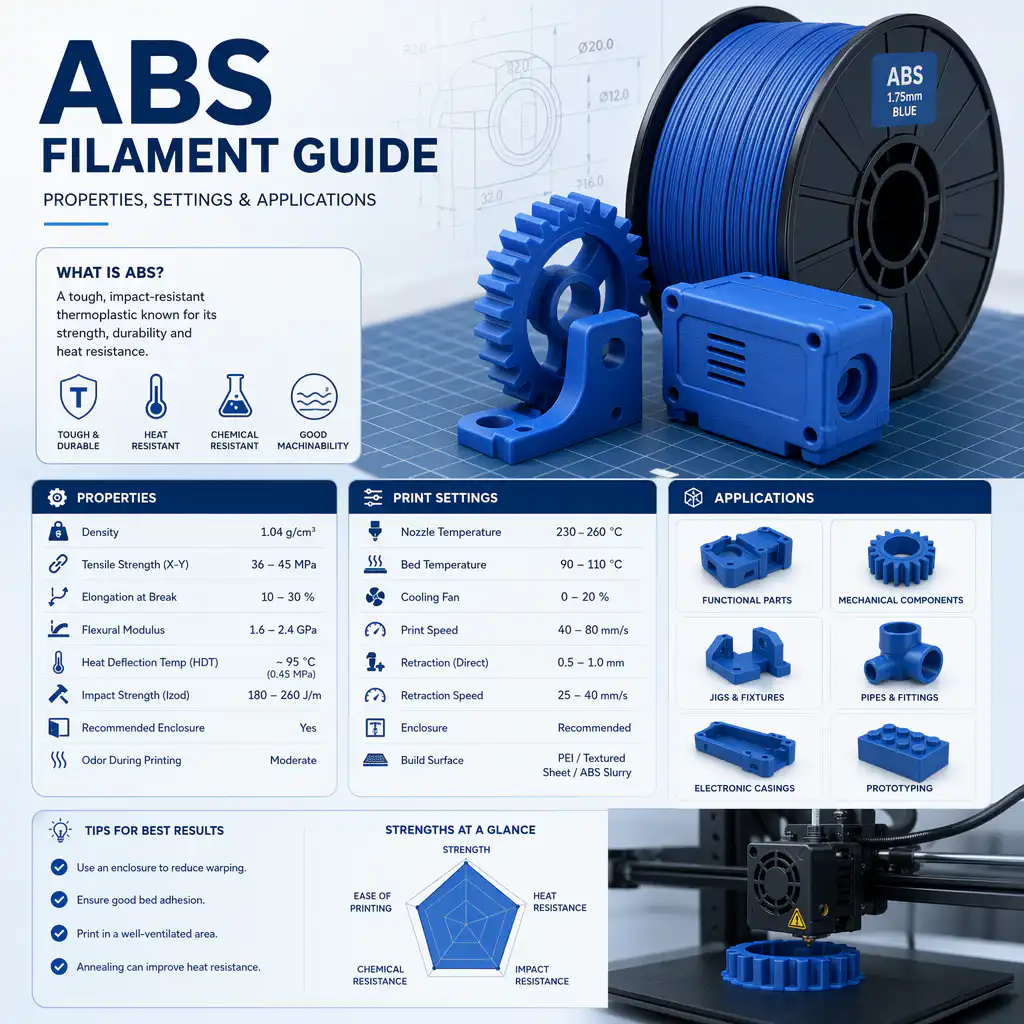
What is ABS?
ABS (Acrylnitril-Butadien-Styrol) is a terpolymer combining three monomers for a balanced property profile:
- Acrylonitrile: Chemical resistance and thermal stability
- Butadiene: Toughness and impact resistance
- Styrene: Rigidity and ease of processing
Wichtige Eigenschaften
| Eigentum | Wert |
|---|---|
| Zugfestigkeit | 40-50 MPa |
| Biegemodus | 2.0-2.5 GPa |
| Heat Deflection Temp | 85-95°C at 1.8 MPa |
| Glass Transition | 105°C |
| Dichte | 1.04 g/cm³ |
ABS Print Settings
Recommended Parameters
- Nozzle Temperature: 230-260°C
- Bed Temperature: 90-110°C
- Print Speed: 40-80 mm/s
- Cooling Fan: 0-30%
- Layer Height: 0.1-0.3mm
Troubleshooting Guide
Verziehen
Cause: Uneven cooling
Solutions:
- Use enclosed chamber
- Increase bed temperature
- Apply ABS slurry or glue
Layer Separation
Cause: Insufficient adhesion
Solutions:
- Increase nozzle temperature
- Reduce cooling fan
- Slow print speed
Post-Processing ABS
Acetone Smoothing
Acetone vapor smooths ABS surfaces, eliminating layer lines:
- Place part in sealed container
- Add acetone on paper towel
- Allow 10-60 minutes
- Remove and let dry
FAQ
When is ABS Filament Guide — Properties, Settings & Applications a good option?
ABS Filament Guide — Properties, Settings & Applications is a good option when fast iteration, complex geometry, low tooling cost, or low-volume production is more important than molded-part unit cost.
What should be checked before choosing ABS Filament Guide — Properties, Settings & Applications?
Prüfen Sie die Größe des Teils, die Materialeigenschaften, die Oberflächenbeschaffenheit, die Maßtoleranz, die Wärmeeinwirkung, die Belastungsrichtung und ob eine Nachbearbeitung erforderlich ist.
How does ABS Filament Guide — Properties, Settings & Applications compare with CNC machining?
Mit dem 3D-Druck lassen sich komplexe Formen schnell erstellen, während die CNC-Bearbeitung für präzise Oberflächen, engere Toleranzen und serienreife Materialien oft besser geeignet ist.
What affects the cost of ABS Filament Guide — Properties, Settings & Applications?
Die Kosten hängen vom Material, dem Bauvolumen, der Druckzeit, der Schichthöhe, der Entfernung von Stützen, der Endbearbeitung, der Prüfung und der Anzahl der Teile im Bau ab.
ABS Filament Guide — Frequently Asked Questions
Is ABS harder to print than PLA?
Yes. ABS requires higher temperatures, enclosed chamber, and careful attention to bed adhesion and cooling.
Can I smooth ABS with acetone?
Yes. Acetone vapor smoothing is a popular technique for ABS, eliminating layer lines.
Where can I buy quality ABS filament?
Nylonplastic supplies ABS in 1.75mm and 2.85mm. Free samples available.
 English
 Dutch
Dutch German
 French
 Korean
 Russian
 Japanese
 Spanish
 Vietnamese
 Chinese
 Portuguese
 Arabic