
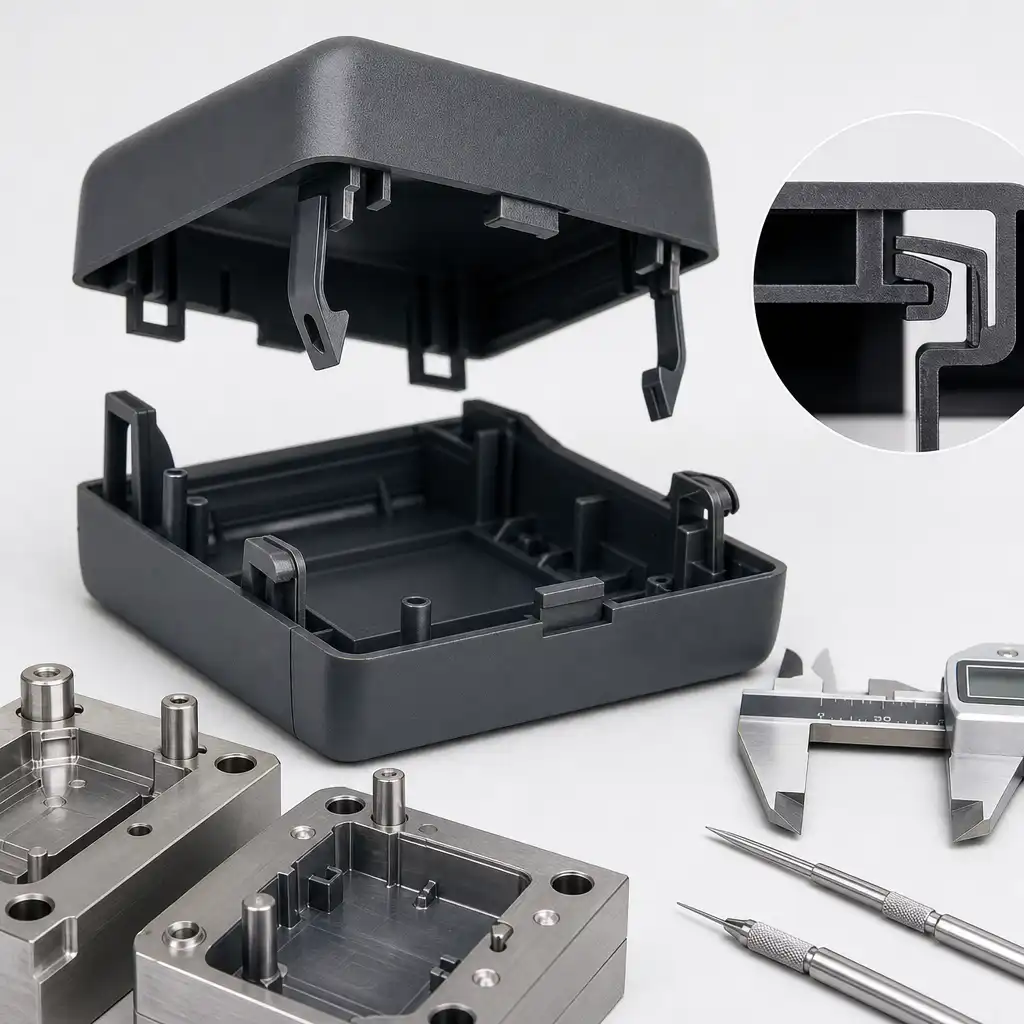
Snap fits are the most cost-effective assembly method in plastic part design — they eliminate screws, adhesives, and assembly tools by using the elastic deformation of the plastic itself to create a permanent or releasable joint. When designed correctly, a snap fit can survive thousands of assembly cycles without failure. When designed poorly, it breaks on the first insertion.
Three Basic Snap Fit Types
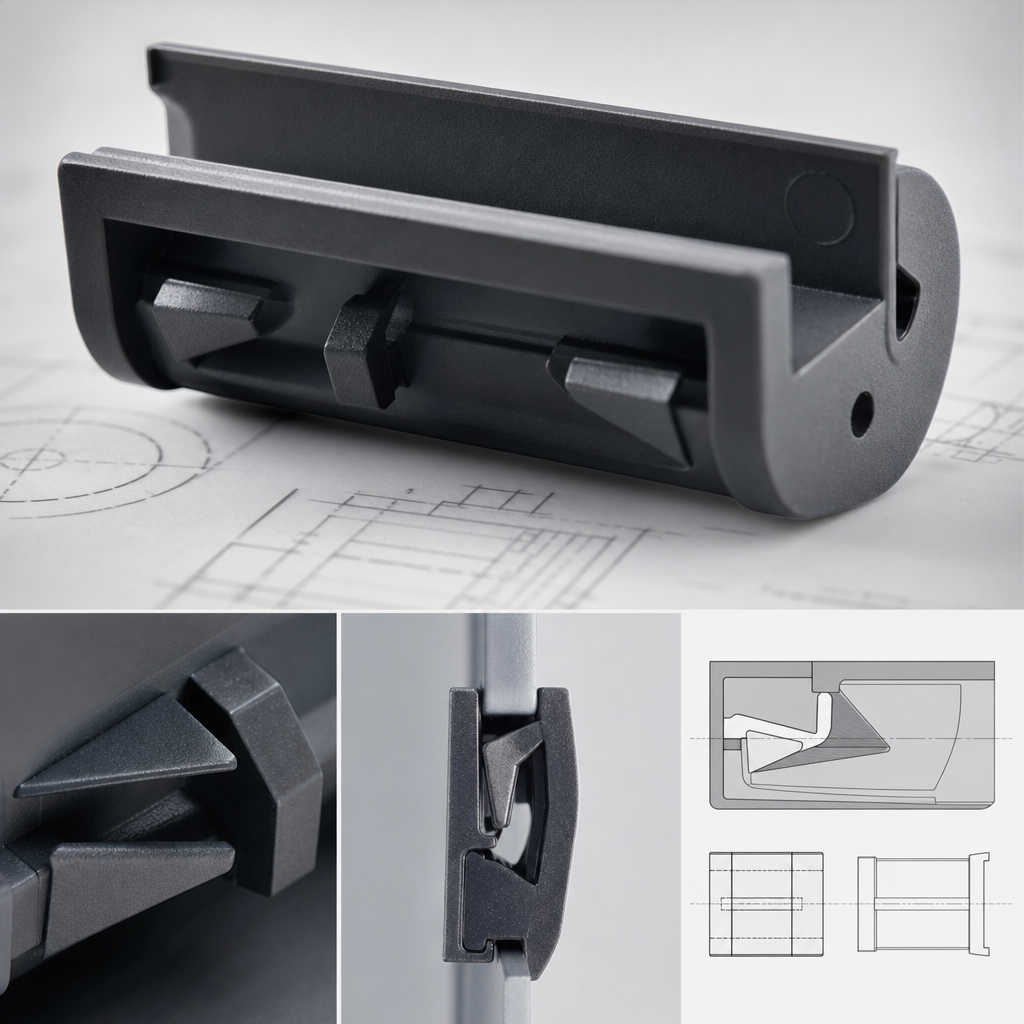
| Typ | Mechanism | Am besten für |
|---|---|---|
| Cantilever Snap Fit | A beam with hook deflects during insertion, snaps back to lock | Most common, housing covers, battery doors, connectors |
| Annular Snap Fit | Circular undercut engages with matching groove — hoop stress does the work | Pen caps, bottle closures, circular connectors |
| Torsional Snap Fit | A rocking beam pivots to release — uses shear deflection rather than bending | Push-to-release mechanisms, living hinges |
Cantilever Snap Fit Design Equations
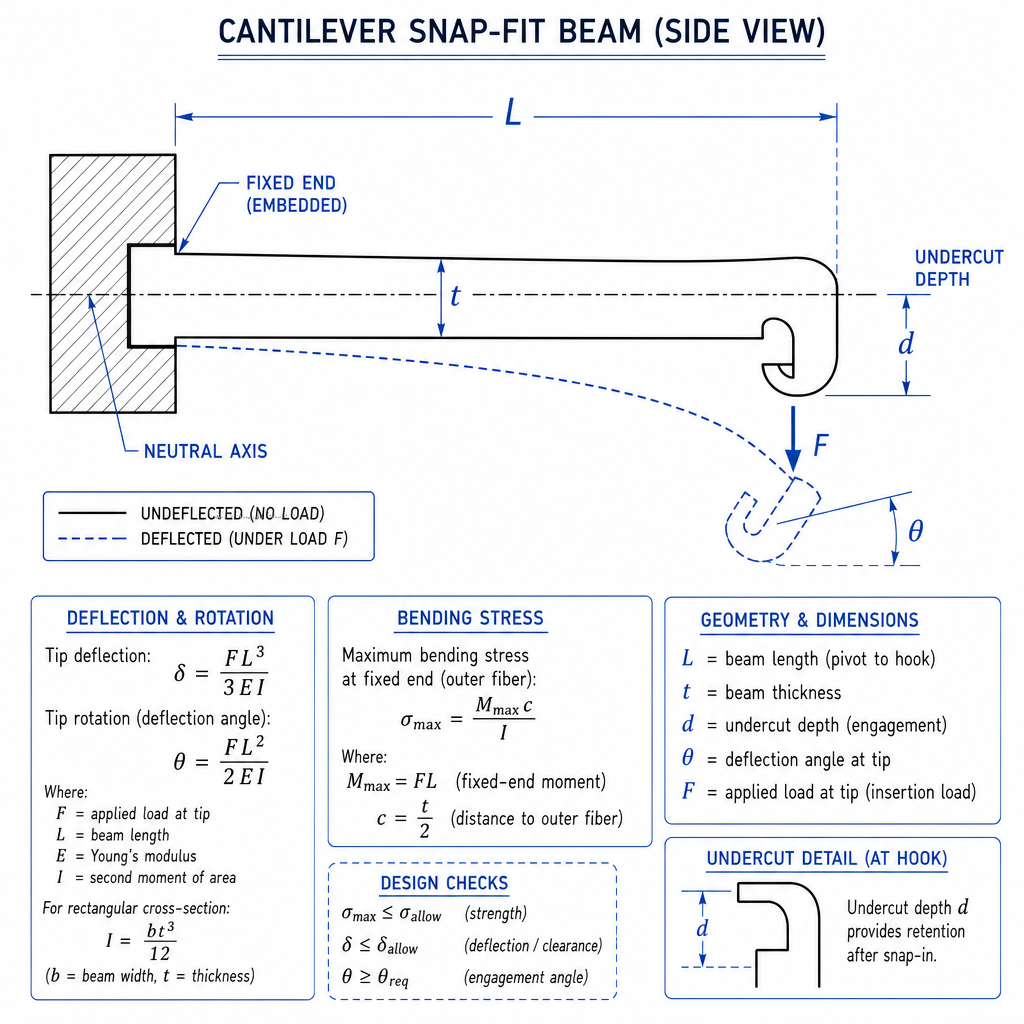
The maximum strain during deflection must stay below the material’s allowable strain. For a rectangular cross-section cantilever with a tapered beam, use: ε = (1.5 × t × y) / L², where t = beam thickness, y = deflection, and L = beam length. Engineering plastics like nylon (PA6, PA66) and acetal (POM) are ideal snap fit materials because they offer high elongation (15-35%) and excellent fatigue resistance.
| Material | Allowable Strain | Snap Fit Suitability |
|---|---|---|
| Nylon 6 (Unfilled) | 4-6% | Ausgezeichnet |
| Nylon 66 (30% GF) | 1.5-2% | Limited — glass reduces flexibility |
| Acetal (POM) | 3-5% | Good — stiff but tolerable elongation |
| ABS | 2-3% | Acceptable |
| Polycarbonat | 2-4% | Good but notch-sensitive |
Mold Design for Snap Fits
The undercut that creates the snap fit hook requires a side action, lifter, or sliding core in the mold — unless you orient the part so the undercut forms parallel to the mold opening direction. Every undercut adds mold complexity and cost. A lifter typically costs $500-1,500 per undercut in a production tool. If your design has four snap fits, orient them radially or along the parting line to minimize undercuts.
Häufig gestellte Fragen
What’s the most common snap fit failure mode?
Creep rupture at the beam root. Over time, the constant stress at the thinnest cross-section causes the polymer chains to slowly realign and fail. Proper taper (2-3° draft) along the beam length distributes stress more evenly and dramatically increases lifetime. Avoid sharp internal corners at the beam root — radius at least 0.5mm.
Can glass-filled nylon be used for snap fits?
Generally not recommended. The glass fibers reduce elongation from 15-25% down to 2-4%, making the beam brittle. The fibers also orient unpredictably during flow, creating weak planes. Use unfilled nylon or a toughened grade instead.
How many cycles can a well-designed snap fit survive?
A properly designed nylon snap fit operating well below its allowable strain can survive 10,000+ cycles. For high-cycle applications like battery doors, design the beam to operate at 25-30% of the material’s allowable strain for maximum fatigue life.
What tolerance should I specify for snap fit engagement?
Allow 0.1-0.3mm interference for the hook engagement. Too tight and assembly force is excessive; too loose and the joint rattles. For nylon, add 0.05mm to account for moisture absorption swelling in service.
Designing parts with snap fits?
We provide injection molding with full DFM (Design for Manufacturing) review — we’ll flag snap fit issues before the mold is cut, saving you time and tooling revisions.


 English
 Dutch
Dutch German
 French
 Korean
 Russian
 Japanese
 Spanish
 Vietnamese
 Chinese
 Portuguese
 Arabic