
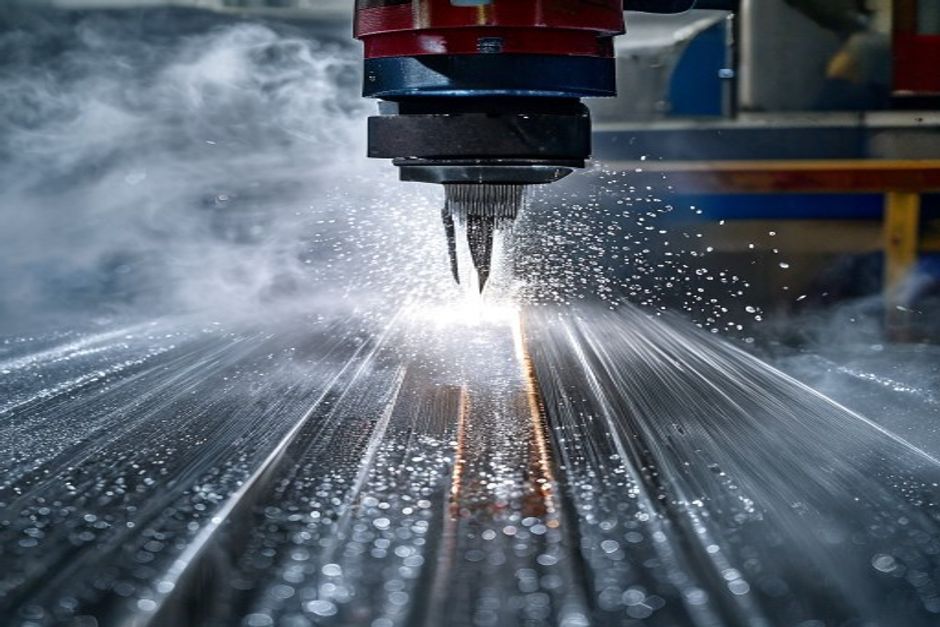
Water jet cutting is a CNC-controlled manufacturing process that uses an extremely high-pressure stream of water – often mixed with abrasive particles – to erode, cut, and shape materials. Unlike thermal cutting processes (laser, plasma) that alter material properties through heat, or mechanical processes (CNC milling) that generate cutting forces, water jet cutting is fundamentally a cold, force-free process. This unique combination of characteristics makes water jet technology indispensable across industries ranging from aerospace to stone fabrication.
How Water Jet Cutting Works
The water jet cutting process begins with a high-pressure pump – typically intensifier or direct-drive type – that pressurizes water to 30,000 to 90,000 PSI (2,000 to 6,200 bar). This ultra-high-pressure water travels through high-pressure tubing to the cutting head, where it passes through a jewel orifice – typically sapphire, ruby, or diamond – with a diameter of 0.003 to 0.020 inches.
Pure Water Jet vs. Abrasive Water Jet
- Pure Water Jet: Uses only pressurized water. Best for soft materials including foam, rubber, textiles, gasket materials, thin plastics, and food products. Produces a very narrow kerf width of 0.003-0.015 inches.
- Abrasive Water Jet: Introduces garnet abrasive particles into the water stream within a mixing tube, dramatically increasing cutting capability. Garnet (80 or 120 mesh) is the most common abrasive, providing the erosive force needed to cut hard materials including tool steel, titanium, stone, glass, ceramics, and thick composites.
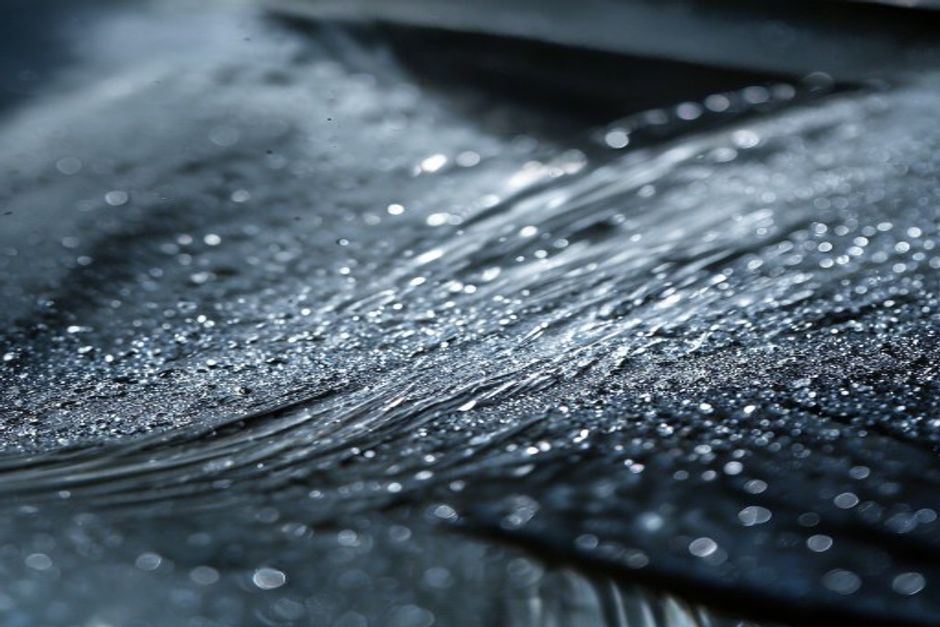
Materials Cut by Water Jet
Water jet cutting works on virtually any material, making it one of the most versatile CNC processes:
- Metalle: Stainless steel up to 8 inches thick, aluminum, titanium, Inconel, brass, copper, tool steel
- Stone and Tile: Granite, marble, ceramic tile, porcelain, engineered stone – a primary application in architectural fabrication
- Verbundwerkstoffe: Carbon fiber, fiberglass, Kevlar laminates – without delamination risks of mechanical cutting
- Glass: Laminated and tempered glass for architectural, automotive, and display applications
- Plastics: Engineering plastics including Nylon, POM, polyethylene, polycarbonate, and acrylic – without melting, discoloration, or toxic fumes
- Rubber and Foam: Gaskets, seals, insulation, and packaging materials
Key Advantages of Water Jet Cutting
Cold Cutting – No Heat-Affected Zone
This is the defining advantage of water jet technology. Unlike laser, plasma, or friction-based cutting that melts material and creates a heat-affected zone (HAZ) with altered metallurgical properties, water jet cutting leaves material properties unchanged. For aerospace alloys, medical-grade materials, and any application requiring fatigue-critical or heat-treated components, this is an essential characteristic.
No Mechanical Cutting Forces
Water jet exerts negligible mechanical force on the workpiece – typically less than 1 pound. This means thin, delicate, or easily deformed materials can be cut without clamping distortion. Honeycomb structures, thin foils, and laminated composites all benefit from this characteristic.
Material Versatility
No other single CNC process can cut the breadth of materials that water jet handles. The same machine can cut 6-inch titanium plate, 2-inch granite countertop, 0.5-inch carbon fiber laminate, and 0.25-inch Nylon sheet without changing tools or process parameters beyond adjusting abrasive flow and traverse speed.
Thick Material Capability
Water jet cutting handles material thicknesses impractical for laser cutting – 6 inches or more in metals, 12 inches or more in stone. While cutting speed decreases with material thickness, the process does not have a fundamental thickness limit like laser beam focusing.
Water Jet Cutting vs. CNC Machining
| Characteristic | Water Jet | CNC-Bearbeitung |
|---|---|---|
| Process Type | Profiling/2D cutting | 3D |
| Thermal Effect | None – cold process | Frictional heating |
| Mechanical Force | Negligible (< 1 lb) | High (100s of lbs) |
| 3D Features | Limited to 5-axis bevel | Full 3D contouring |
| Kerf Width | 0.020-0.060 inches | Tool diameter (0.125+) |
| Operating Cost | Abrasive + pump maintenance | Tool replacement + coolant |
Industrielle Anwendungen
- Luft- und Raumfahrt: Titanium structural components, composite wing skins, engine brackets – no HAZ in fatigue-critical alloys
- Automobilindustrie: Gaskets, interior trim panels, headliner substrates, sound-dampening materials
- Architecture: Granite countertops, decorative metal panels, ceramic floor medallions, glass partitions
- Elektronik: Circuit board substrates, thermal insulation, EMI shielding gaskets
- Industrielle Ausrüstung: Thick steel plate profiles, heavy equipment brackets, mining machinery components
FAQ

When is Water Jet Cutting Guide: How High-Pressure Water Cutting Works the right choice?
Water Jet Cutting Guide: How High-Pressure Water Cutting Works is the right choice when the part requires machined accuracy, controlled surfaces, repeatable features, and a material that can be cut reliably.
What should be confirmed before ordering Water Jet Cutting Guide: How High-Pressure Water Cutting Works?
Bestätigen Sie die Zeichnungsversion, die Materialqualität, die Toleranzen, die Menge, die kritischen Maße, die Oberflächenbeschaffenheit und die Prüfanforderungen, bevor Sie mit der Produktion beginnen.
What usually drives cost in Water Jet Cutting Guide: How High-Pressure Water Cutting Works?
Die Kosten werden in der Regel durch Material, Rüstzeit, Maschinenzeit, Toleranzschwierigkeiten, Vorrichtungen, Werkzeugzugang, Endbearbeitung, Inspektion und Auftragsmenge bestimmt.
How can quality risk be reduced in Water Jet Cutting Guide: How High-Pressure Water Cutting Works?
Das Qualitätsrisiko wird durch die eindeutige Kennzeichnung kritischer Merkmale, die Vermeidung unnötig enger Toleranzen, die frühzeitige Bestätigung der Herstellbarkeit und die Verwendung von Prüfdaten für wichtige Abmessungen verringert.


 English
 Dutch
Dutch German
 French
 Korean
 Russian
 Japanese
 Spanish
 Vietnamese
 Chinese
 Portuguese
 Arabic