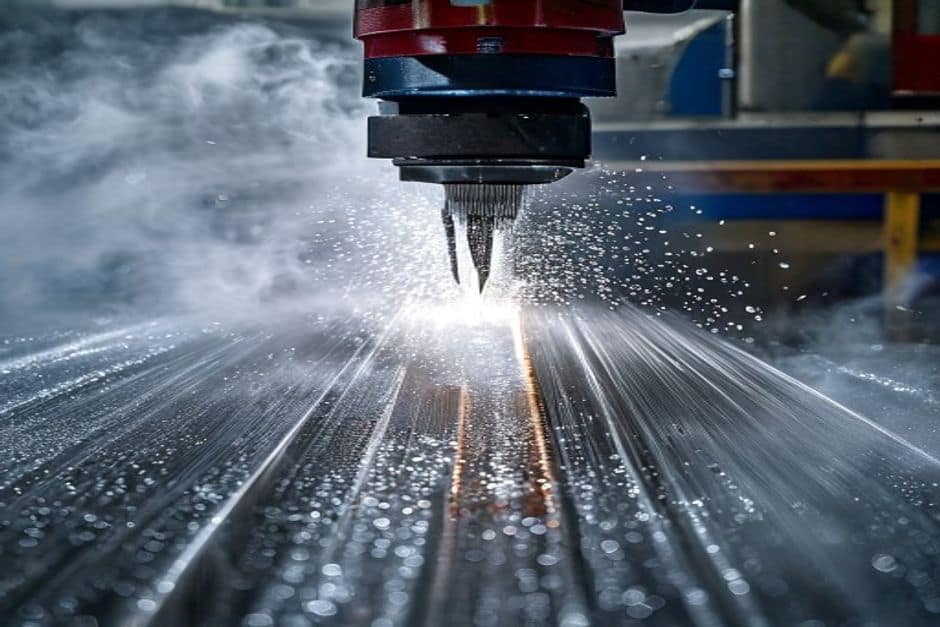
Water jet cutting is a CNC-controlled manufacturing process that uses an extremely high-pressure stream of water – often mixed with abrasive particles – to erode, cut, and shape materials. Unlike thermal cutting processes (laser, plasma) that alter material properties through heat, or mechanical processes (CNC milling) that generate cutting forces, water jet cutting is fundamentally a cold, force-free process. This unique combination of characteristics makes water jet technology indispensable across industries ranging from aerospace to stone fabrication.
How Water Jet Cutting Works
The water jet cutting process begins with a high-pressure pump – typically intensifier or direct-drive type – that pressurizes water to 30,000 to 90,000 PSI (2,000 to 6,200 bar). This ultra-high-pressure water travels through high-pressure tubing to the cutting head, where it passes through a jewel orifice – typically sapphire, ruby, or diamond – with a diameter of 0.003 to 0.020 inches.
Pure Water Jet vs. Abrasive Water Jet
- Pure Water Jet: Uses only pressurized water. Best for soft materials including foam, rubber, textiles, gasket materials, thin plastics, and food products. Produces a very narrow kerf width of 0.003-0.015 inches.
- Abrasive Water Jet: Introduces garnet abrasive particles into the water stream within a mixing tube, dramatically increasing cutting capability. Garnet (80 or 120 mesh) is the most common abrasive, providing the erosive force needed to cut hard materials including tool steel, titanium, stone, glass, ceramics, and thick composites.
Materials Cut by Water Jet
Water jet cutting works on virtually any material, making it one of the most versatile CNC processes:
- Metals: Stainless steel up to 8 inches thick, aluminum, titanium, Inconel, brass, copper, tool steel
- Stone and Tile: Granite, marble, ceramic tile, porcelain, engineered stone – a primary application in architectural fabrication
- Composites: Carbon fiber, fiberglass, Kevlar laminates – without delamination risks of mechanical cutting
- Glass: Laminated and tempered glass for architectural, automotive, and display applications
- Plastics: Engineering plastics including Nylon, POM, polyethylene, polycarbonate, and acrylic – without melting, discoloration, or toxic fumes
- Rubber and Foam: Gaskets, seals, insulation, and packaging materials
Key Advantages of Water Jet Cutting
Cold Cutting – No Heat-Affected Zone
This is the defining advantage of water jet technology. Unlike laser, plasma, or friction-based cutting that melts material and creates a heat-affected zone (HAZ) with altered metallurgical properties, water jet cutting leaves material properties unchanged. For aerospace alloys, medical-grade materials, and any application requiring fatigue-critical or heat-treated components, this is an essential characteristic.
No Mechanical Cutting Forces
Water jet exerts negligible mechanical force on the workpiece – typically less than 1 pound. This means thin, delicate, or easily deformed materials can be cut without clamping distortion. Honeycomb structures, thin foils, and laminated composites all benefit from this characteristic.
Material Versatility
No other single CNC process can cut the breadth of materials that water jet handles. The same machine can cut 6-inch titanium plate, 2-inch granite countertop, 0.5-inch carbon fiber laminate, and 0.25-inch Nylon sheet without changing tools or process parameters beyond adjusting abrasive flow and traverse speed.
Thick Material Capability
Water jet cutting handles material thicknesses impractical for laser cutting – 6 inches or more in metals, 12 inches or more in stone. While cutting speed decreases with material thickness, the process does not have a fundamental thickness limit like laser beam focusing.
Water Jet Cutting vs. CNC Machining
| Characteristic | Water Jet | CNC 加工 |
|---|---|---|
| Process Type | Profiling/2D cutting | 3D material removal |
| Thermal Effect | None – cold process | Frictional heating |
| Mechanical Force | Negligible (< 1 lb) | High (100s of lbs) |
| 3D Features | Limited to 5-axis bevel | Full 3D contouring |
| Kerf Width | 0.020-0.060 inches | Tool diameter (0.125+) |
| Operating Cost | Abrasive + pump maintenance | Tool replacement + coolant |
工業應用
- 航太: Titanium structural components, composite wing skins, engine brackets – no HAZ in fatigue-critical alloys
- 汽車: Gaskets, interior trim panels, headliner substrates, sound-dampening materials
- 建築: Granite countertops, decorative metal panels, ceramic floor medallions, glass partitions
- 電子產品: Circuit board substrates, thermal insulation, EMI shielding gaskets
- 工業設備: Thick steel plate profiles, heavy equipment brackets, mining machinery components
相關文章
Explore our complete guide to engineering plastics and precision manufacturing. For material-specific guidance, review our technical articles on nylon grades, POM/Delrin machining, and CNC process optimization.
常見問題
What industries rely most on this technology?
Aerospace, automotive, medical device manufacturing, and industrial equipment production are the primary industries. Defense contractors, energy sector manufacturers, and consumer electronics producers also depend heavily on precision machining and advanced manufacturing processes.
How does material selection affect the manufacturing outcome?
Material properties-strength, thermal behavior, machinability, and chemical resistance-directly determine tool selection, cutting parameters, and achievable tolerances. Engineering plastics such as Nylon and POM require different feeds, speeds, and coolant strategies compared to metals like aluminum or stainless steel.
What are the typical lead times for production?
Simple parts with standard materials can be produced in 1-3 business days. Complex multi-axis components or large production volumes typically require 2-6 weeks, including programming, machine setup, and quality inspection phases.
Can prototyping and production use the same process?
Yes. One of the primary advantages is that the same programs, tools, and quality standards can be used from prototype through production. This ensures design intent is preserved and validated before scaling to full production volumes.