

Raquetas de tenis de fibra de carbono are not merely equipment; they are the culmination of advanced material science and precision engineering, fundamentally shaping how the modern game is played. By integrating carbon fiber composites into the frame, these racquets deliver an optimal balance of explosive power, arm-saving stability, and pinpoint control that traditional materials cannot match. This guide delves into the technology behind high-performance racquets, explaining why carbon fiber is indispensable for competitive players and how sophisticated manufacturing creates these extensions of a player’s skill.

The Carbon Fiber Advantage: Power Meets Precision
The integration of carbon fiber directly addresses the core physical demands of modern tennis, where shots demand both heavy pace and delicate touch.
- Enhanced Stiffness & Power Transfer: The high modulus of carbon fiber creates an exceptionally rigid frame that flexes minimally upon impact. This maximizes energy transfer from the swing to the ball, generating greater power and a more solid, responsive feel, especially on off-center hits.
- Superior Stability & Vibration Damping: Advanced carbon layups allow engineers to strategically reinforce key areas of the frame (like the throat and hoop) to resist twisting against heavy balls. Combined with integrated damping technologies, this reduces unwanted vibrations that can lead to arm fatigue, promoting comfort and control during long rallies.
- Lightweight Design for Swing Speed: Carbon fiber’s exceptional strength-to-weight ratio allows manufacturers to build incredibly light yet robust frames. This facilitates faster swing speeds, enabling players to generate more racket head speed for spin and power, and to react quicker at the net.
- Customized Performance through Layup Engineering: Unlike uniform materials, carbon fiber sheets (prepreg) can be placed at specific angles and locations within the mold. This allows for fine-tuning the racquet’s flex profile, stiffness zones, and torsional stability to create distinct playing characteristics (e.g., power-oriented vs. control-oriented frames).

Material Evolution: Why Carbon Fiber Dominates
The transition from classic materials to composites marked a revolution in racquet performance. The table below highlights the key differences.
| Material Era / Type | Power Potential | Control & Feel | Vibration & Comfort | Weight & Maneuverability |
|---|---|---|---|---|
| Carbon Fiber Composite Frames | Muy alta (High stiffness, efficient energy transfer) | Alta (Predictable, stable response) | Engineerable (Can integrate dampening) | Excelente (Light & strong, allows for weight customization) |
| Classic Aluminum Frames | Medio | Low-Medium (Less predictable, can vibrate) | Poor (High, harsh vibration) | Poor (Heavier for given strength, less head-light balance options) |
| Classic Wood Frames | Bajo | High (Flexible, unique feel) | Good (Natural dampening) | Poor (Very heavy, slow swing speeds) |
Análisis: While wood offers a classic feel, and aluminum was a step forward, carbon fiber tennis racquets provide a superior, tunable combination of all performance attributes. They allow for the creation of specialized racquets for different player styles. The use of advanced composites, such as those based on high-performance polymers like our PA6-CF materials, can be explored for specific grommets, bumper guards, or internal structural components to enhance durability and performance.
Inside the Frame: Layup Technology & Manufacturing
Constructing a modern performance racquet is a precise, multi-stage process centered around carbon fiber layup.
| Escenario | Tecnología y procesos básicos | Resultados |
|---|---|---|
| 1. Diseño e ingeniería | – Computer simulation of flex, stiffness, and sweet spot. – Layup map design specifying the angle, type, and placement of each carbon fiber prepreg sheet. | A virtual prototype optimized for target playing characteristics (power, control, spin). |
| 2. Mold Preparation & Layup | – Precise, robot-assisted cutting of prepreg sheets. – Hand or machine layup of sheets into a multi-part mold defining the frame’s internal chamber structure. | The “green” frame assembly, where the composite’s performance is dictated by the precision of the fiber placement. |
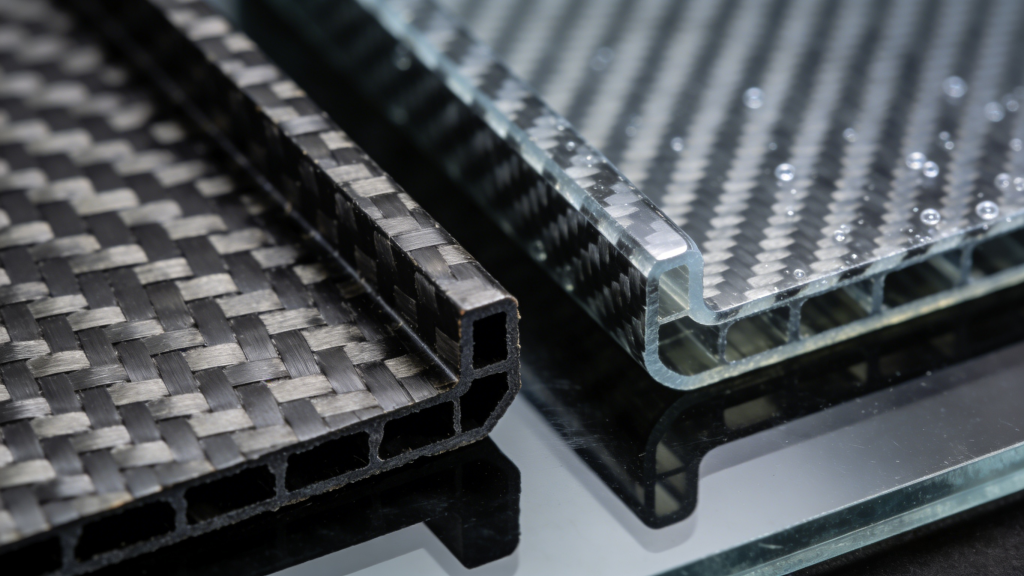
| 3. Curado y consolidación | – The mold is subjected to high heat and pressure in an autoclave. The resin flows and cures, bonding the layers into a single, ultra-strong monocoque structure. | A hollow, seamless frame with exceptional structural integrity and the designed mechanical properties. |
| 4. Finishing & Assembly | – The frame is drilled, sanded, and painted. – The handle pallet (often made via precision injection molding from specialized polymers) is attached, and grommets are installed. | A finished racquet frame ready for stringing, with cosmetics, grip shape, and final weight/balance realized. Our expertise in custom molding is crucial for producing consistent, high-quality components. |
FAQ: Carbon Fiber Tennis Racquets
Q1: Are all carbon fiber racquets stiff and powerful?
A: No. A key advantage of carbon fiber is its tunability. Manufacturers vary the layup (fiber type, orientation, and resin) to create a spectrum of frames. Some are very stiff for power, while others are designed with more flex for control, feel, and arm comfort.
Q2: What do “graphite” and “composite” mean on a racquet?
A: “Graphite” is commonly used as a marketing term for carbon fiber racquets. “Composite” indicates the frame is made from a blend of materials, which is always the case—typically carbon fiber is the primary material, blended with other fibers (e.g., basalt, aramid) or micro-materials for specific dampening or flex properties.
Q3: How does carbon fiber affect the size of the sweet spot?
A: The stiffness and stability of carbon fiber allow engineers to design larger, more forgiving sweet spots without making the frame uncontrollably flexible. Technologies like wider beams and specific throat designs further expand the effective hitting area.
Q4: Are carbon fiber racquets suitable for beginners?
A: Yes. Modern carbon fiber racquets are made in a wide range of specifications. Beginners can benefit from lighter, head-light, and larger-headed carbon models that offer power and forgiveness, helping them learn the game more easily.
Q5: Can you manufacture custom or proprietary racquet components?
R: Por supuesto. For brands developing new racquet technology, we specialize in the engineering and manufacturing of custom components. This includes designing and molding unique grommet systems, bumper guards, throat bridges, or handle systems using advanced polymers and composites to meet specific performance, weight, and durability goals. Contacte con nuestro equipo de ingenieros to collaborate on your next innovation.
Conclusion: A Material That Changed the Sport
Carbon fiber tennis racquets represent the frontier of sports equipment technology. Their capacity to be engineered for specific performance traits has empowered players at all levels to maximize their potential on the court.
Ready to explore how advanced materials can elevate your racquet design? For brands pushing the boundaries of performance, Nylon Plástico proporciona la colaboración esencial en material science, composite engineering, and precision component manufacturing to bring the next generation of championship-caliber racquets to life.
PREGUNTAS FRECUENTES
What is the practical value of Carbon Fiber Tennis Racquets: Engineering the Modern Game?
Carbon Fiber Tennis Racquets: Engineering the Modern Game helps connect material choice, process limits, cost, and application risk before committing to production.
What should be checked first for Carbon Fiber Tennis Racquets: Engineering the Modern Game?
Start with the real application requirements, expected environment, production quantity, tolerance needs, and quality control expectations.
What usually causes problems in Carbon Fiber Tennis Racquets: Engineering the Modern Game?
Problems usually come from unclear requirements, mismatched materials, unrealistic tolerances, missing inspection criteria, or late design changes.
How can buyers reduce risk with Carbon Fiber Tennis Racquets: Engineering the Modern Game?
Buyers can reduce risk by sharing drawings, use conditions, critical dimensions, target quantities, and quality expectations before quoting.

 English
 Dutch
Dutch German
 French
 Korean
 Russian
 Japanese
 Spanish
 Vietnamese
 Chinese
 Portuguese
 Arabic