

Chemical Structure Differences
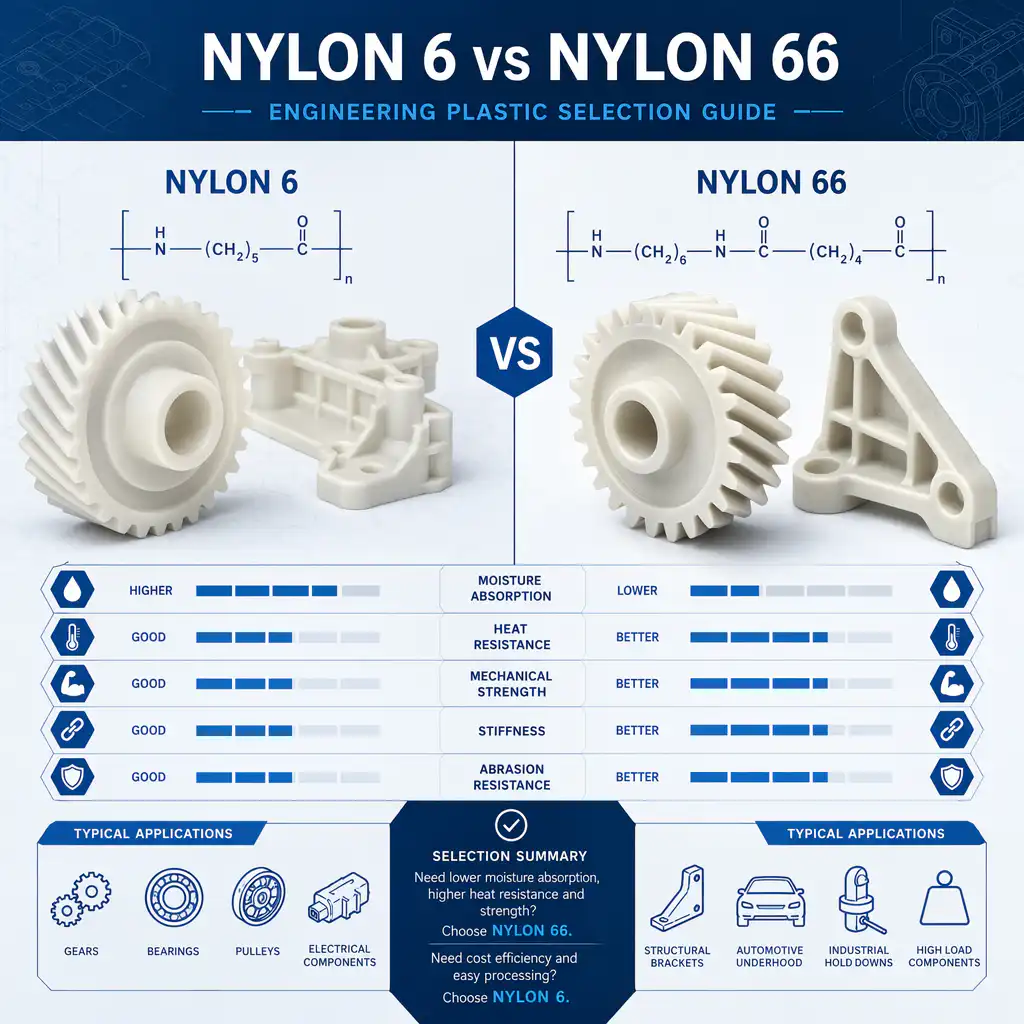
The fundamental difference between PA6 (Nylon 6) en PA66 (Nylon 66) lies in their molecular structure:
- Nylon 6: Made from caprolactam, has 6 carbon atoms in each repeating unit. Less crystalline structure.
- Nylon 66: Made from hexamethylenediamine and adipic acid, has two 6-carbon chains. More crystalline structure.
Mechanical Properties Comparison
| Eigendom | PA6 | PA66 |
|---|---|---|
| Treksterkte | 70-85 MPa | 80-100 MPa |
| Flexural Modulus | 2.5-3.0 GPa | 2.8-3.5 GPa |
| Rek bij breuk | 30-100% | 15-60% |
| Notched Izod Impact | 50-100 J/m | 40-80 J/m |
| Smeltpunt | 220°C | 260°C |
| HDT at 1.8 MPa | 70°C | 90°C |
Vochtabsorptie
Moisture absorption is critical for nylon applications:
| Condition | PA6 | PA66 |
|---|---|---|
| At 50% RH | 2.5-3.0% | 2.0-2.5% |
| Saturation | 8-10% | 6-8% |
Processing Characteristics
Nylon 6 Processing
- Melting Point: 220°C
- Processing Range: 240-280°C
- Schimmeltemperatuur: 40-80°C
Nylon 66 Processing
- Melting Point: 260°C
- Processing Range: 280-320°C
- Schimmeltemperatuur: 60-90°C
Applications by Material
Nylon 6 Applications
- Gears and sprockets
- Industrial monofilament
- Film and packaging
- Consumer products
Nylon 66 Applications
- Automotive under-hood components
- Electrical connectors
- High-temperature bearings
- Precision mechanical components
Reinforced Grades
Both materials are commonly reinforced with glass fiber:
| Rang | PA6 + GF30 | PA66 + GF30 |
|---|---|---|
| Treksterkte | 140-160 MPa | 170-200 MPa |
| HDT (1.8 MPa) | 205°C+ | 250°C+ |
| Vochtabsorptie | 1.0-1.5% | 0.8-1.2% |
Selection Summary
Choose Nylon 6 when:
- Impact resistance is critical
- Cost sensitivity is high
- Operating temperatures are moderate
Choose Nylon 66 when:
- Higher mechanical strength is required
- Elevated temperatures are expected
- Dimensional stability is critical
FAQ
When is Nylon 6 vs Nylon 66 — Engineering Plastic Selection Guide a good option?
Nylon 6 vs Nylon 66 — Engineering Plastic Selection Guide is a good option when fast iteration, complex geometry, low tooling cost, or low-volume production is more important than molded-part unit cost.
What should be checked before choosing Nylon 6 vs Nylon 66 — Engineering Plastic Selection Guide?
Controleer de onderdeelgrootte, materiaaleigenschappen, oppervlakteafwerking, maattolerantie, blootstelling aan hitte, belastingsrichting en of nabewerking nodig is.
How does Nylon 6 vs Nylon 66 — Engineering Plastic Selection Guide compare with CNC machining?
Met 3D-printen kunnen complexe vormen snel worden gemaakt, terwijl CNC-bewerking vaak sterker is voor precieze oppervlakken, nauwere toleranties en productiematerialen.
What affects the cost of Nylon 6 vs Nylon 66 — Engineering Plastic Selection Guide?
De kosten zijn afhankelijk van het materiaal, het bouwvolume, de printtijd, de laaghoogte, het verwijderen van de ondersteuning, de afwerking, de inspectie en het aantal onderdelen in de bouw.

 English
  Dutch
Dutch  German
  French
  Korean
  Russian
  Japanese
  Spanish
  Vietnamese
  Chinese
  Portuguese
  Arabic