
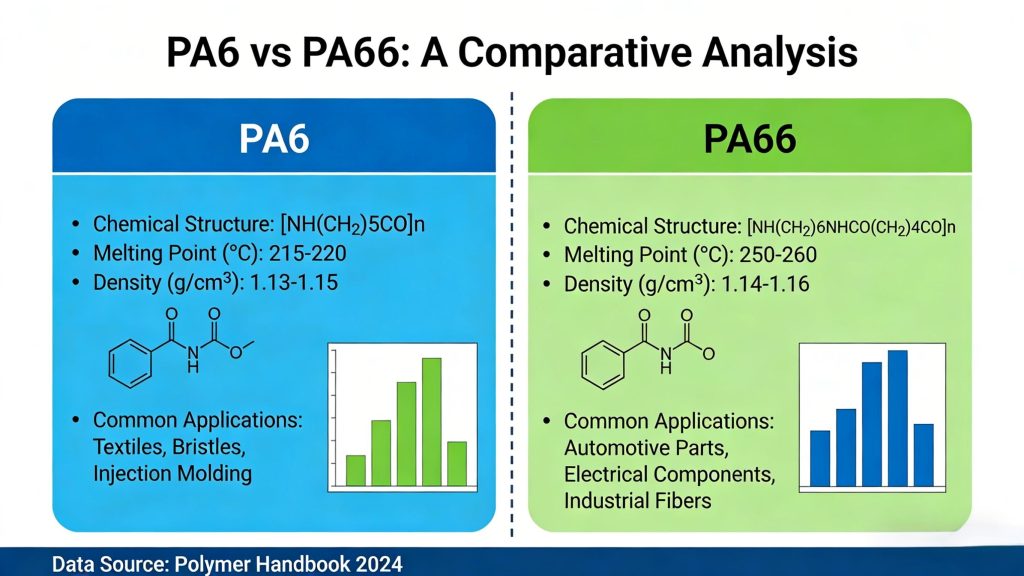
PA6 VS PA66: Key Differences, Properties & How to Choose
In the world of engineering plastics, PA6 (Nylon 6) and PA66 (Nylon 66) are two of the most widely used polyamide materials. Both offer an excellent balance of strength, toughness, and processability, making them indispensable in automotive, electrical, industrial machinery, and consumer goods.
However, when comparing PA6 VS PA66, significant differences emerge — from molecular structure and mechanical performance to processing conditions and cost. Understanding these differences helps manufacturers select the right material, optimize product design, and improve reliability.
1. Overview: What Are PA6 and PA66?
PA6(尼龍 6)
PA6 is produced by ring-opening polymerization of caprolactam. It is a semi-crystalline plastic known for:
High toughness and impact resistance
Excellent processability (injection molding, extrusion)
Cost-effectiveness, making it ideal for mass-produced parts
Typical applications: gears, bushings, housings, and consumer goods.
PA66 (Nylon 66)
PA66 is synthesized through condensation polymerization of hexamethylene diamine and adipic acid. It offers:
Higher rigidity and strength than PA6
Better thermal stability and dimensional stability
Improved chemical resistance, especially to oils and solvents
Typical applications: automotive engine components, electrical connectors, high-load structural parts.
2. Chemical Structure Differences
The chemical structure of PA6 is characterized by repeating amide groups (-CONH-) within the polymer chain. PA66, on the other hand, is formed by alternating hexamethylene and adipic acid units, resulting in a more regular, symmetric structure. This gives PA66 a higher density of hydrogen bonding, contributing to its superior mechanical strength and thermal stability.
3. Key Properties Comparison: PA6 VS PA66
| 財產 | PA6 | PA66 |
|---|---|---|
| 熔點 | ~223°C | ~255°C |
| 拉伸強度 | ~84 MPa | ~90 MPa |
| Stiffness (Modulus) | ~3,300 MPa | ~3,550 MPa |
| 吸水性(24 小時) | 0.72% | 0.6% |
| Saturated Absorption | 6.6% | 8.0% |
| Heat Deflection Temp | ~80°C | ~85°C |
3.1 Melting Point & Heat Resistance
PA66 has a higher melting point (255°C vs 223°C), making it better suited for applications involving elevated temperatures, such as under-hood automotive components.
3.2 Strength & Stiffness
PA66 generally offers higher tensile strength and stiffness, especially at higher temperatures. PA6, while slightly less rigid, provides better impact toughness in some formulations.
3.3 Moisture Absorption
Both materials are hygroscopic, but PA6 absorbs moisture more rapidly in the short term (0.72% vs 0.6% in 24h). However, PA66 has a higher saturated absorption (8.0% vs 6.6%). For precision parts in humid environments, glass-filled grades are recommended to reduce dimensional changes.
3.4 Chemical Resistance
Both PA6 and PA66 exhibit good resistance to oils, fuels, and many solvents. PA66 offers slightly better resistance due to its higher crystallinity and denser molecular structure.
4. Processing & Cost Considerations
Processing PA6
Lower melting point (~220°C) allows for easier processing
Shorter cycle times and lower energy consumption
Less demanding tooling requirements
Generally lower raw material cost
Processing PA66
Requires higher processing temperatures (~260°C)
Longer cycle times and higher energy consumption
Tooling must withstand higher thermal stress
Higher raw material cost, but offers superior mechanical performance
Cost Summary: PA6 is more cost-effective for applications where extreme heat resistance or maximum strength is not required. PA66 justifies its higher cost with better performance in demanding environments.
5. Applications Across Industries
汽車
PA66: engine covers, intake manifolds, radiator end tanks, airbags, fuel lines
PA6: gears, bearings, bushings, lightweight housings
電子電機
PA66: connectors, switches, sockets, circuit breakers
PA6: cable ties, insulating materials, components requiring toughness
工業機械
PA66: high-load gears, bearings, rollers, wear pads
PA6: general-purpose components, films, packaging
Consumer Goods
PA66: luggage, backpacks, power tool housings
PA6: toothbrushes, utensils, household appliance parts
6. How to Choose Between PA6 and PA66
Selecting the right nylon depends on your specific application requirements:
| 因子 | Recommendation |
|---|---|
| Operating Temperature >100°C | PA66 is preferred |
| Cost-Sensitive, Moderate Temperatures | PA6 offers better value |
| High Mechanical Load | PA66 provides higher strength |
| Impact Toughness Priority | PA6 may be more suitable |
| Precision Parts in Humid Environments | Consider glass-filled grades of either material |
| Chemical Exposure (Oils, Fuels) | PA66 offers slightly better resistance |
7. About Nylon Plastic: Your Engineering Plastics Partner
At 尼龍塑膠, we specialize in high-performance polyamide materials and one-stop injection molding services. Since 2005, we have been providing fully integrated solutions — from material compounding and precision mold making to high-volume production.
Our certifications: ISO 9001, ISO 14001, ISO 45001, IATF 16949
Global reach: Exported to over 30 countries
Industries served: Automotive, electronics, home appliances, industrial machinery
We offer:
PA6 product range: View PA6 materials →
PA66 product range: View PA66 materials →
Custom compounding (glass-filled, mineral-filled, impact-modified, heat-stabilized)
Low MOQ with free samples
DFM analysis and rapid prototyping
Whether you need standard grades or customized formulations, our technical team is ready to assist.
8. Frequently Asked Questions: PA6 VS PA66
1. Which is stronger, PA6 or PA66?
PA66 generally offers higher tensile strength, stiffness, and heat resistance. However, PA6 provides better impact toughness in some formulations.
2. Which nylon absorbs more moisture?
PA6 absorbs moisture faster initially, while PA66 has a higher saturated absorption rate. Both require drying before processing.
3. Can I use PA66 as a direct replacement for PA6?
Not always. Differences in mold shrinkage, processing temperature, and mechanical performance require testing under actual application conditions.
4. How do I choose between PA6 and PA66 for my application?
Consider operating temperature, mechanical load requirements, cost constraints, and environmental conditions like humidity and chemical exposure.
5. Does Nylon Plastic provide custom PA6 or PA66 compounds?
Yes. We offer glass-filled, mineral-filled, impact-modified, lubricated, and heat-stabilized grades tailored to your specifications.
9. Need Help Selecting the Right Nylon?
Our material experts are here to help you choose the optimal grade for your application. Contact us for technical consultation, free samples, or to discuss your custom compounding needs.
📞 +86 18719180813
📧 [email protected]
🌐 https://nylonplastic.com/


 English
 Dutch
Dutch German
 French
 Korean
 Russian
 Japanese
 Spanish
 Vietnamese
 Chinese
 Portuguese
 Arabic