


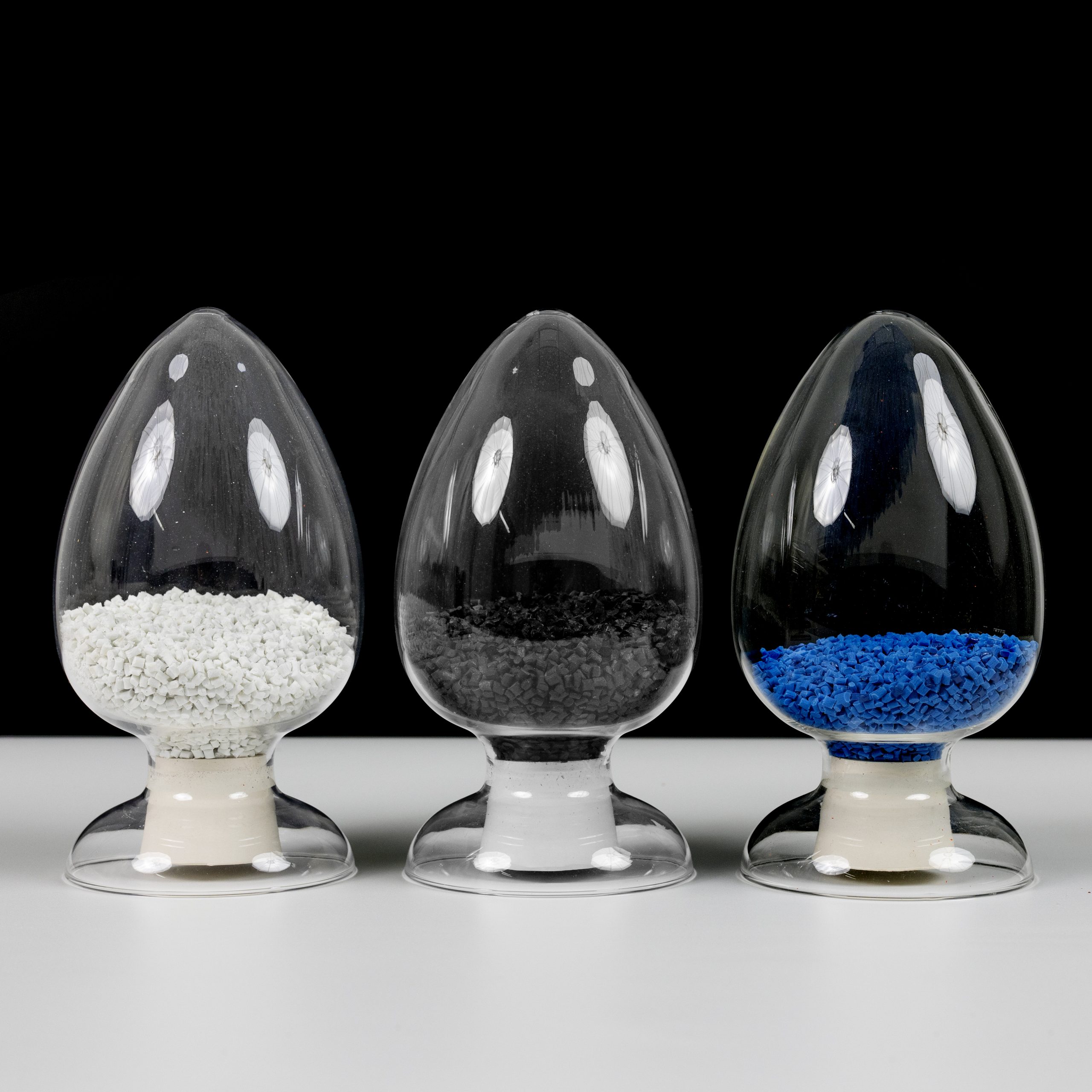
PBT GF10 Technical Data (Estimated Typical Values)
| Imóveis | Valor | Norma de ensaio |
|---|---|---|
| Conteúdo de fibra de vidro | 10% | ISO 1172 |
| Resistência à tração | 70 - 85 MPa | ISO 527 |
| Módulo de flexão | 5.000 - 6.500 MPa | ISO 178 |
| Resistência ao impacto entalhado | 5 - 7 kJ/m² | ISO 180 |
| HDT @1,8 MPa | 180 - 195 °C | ISO 75 |
| Índice Comparativo de Acompanhamento (CTI) | 600 V | IEC 60112 |
Tabela de comparação de desempenho da série PBT GF (valores típicos estimados)
| Imóveis | PBT GF10 | PBT GF15 | PBT GF20 | PBT GF30 | PBT GF40 | PBT GF50 |
|---|---|---|---|---|---|---|
| Conteúdo de fibra de vidro | 10% | 15% | 20% | 30% | 40% | 50% |
| Resistência à tração | 70 - 85 MPa | 85 - 100 MPa | 100 - 120 MPa | 120 - 140 MPa | 135 - 155 MPa | 150 - 170 MPa |
| Módulo de flexão | 5.000 - 6.500 MPa | 6.500 - 7.800 MPa | 7.500 - 9.000 MPa | 9.000 - 11.000 MPa | 11.000 - 13.000 MPa | 13.000 - 16.000 MPa |
| Resistência ao impacto entalhado | 5 - 7 kJ/m² | 5,5 - 7,5 kJ/m² | 6 - 8 kJ/m² | 7 - 9 kJ/m² | 6,5 - 8,5 kJ/m² | 6 - 8 kJ/m² |
| HDT @1,8 MPa | 180 - 195 °C | 190 - 205 °C | 200 - 210 °C | 210 - 220 °C | 215 - 225 °C | 220 - 230 °C |
| CTI (Comparative Tracking Index) | 600 V | 600 V | 575 V | 550 V | 525 V | 500 V |
| Perfil-chave | Rigidez económica e ciclos rápidos | Nível de entrada equilibrado para peças técnicas | Precisão e excelente acabamento de superfície | O melhor equilíbrio entre força, calor e eletricidade | Elevada rigidez para peças estruturais exigentes | Rigidez máxima para substituição de metal |
PBT GF10 Key Advantages
✅ Enhanced Stiffness & Faster Cycles: Glass fiber reinforcement significantly increases rigidity and reduces molding cycle times compared to unfilled PBT, boosting productivity.
✅ Estabilidade dimensional superior: Extremely low moisture absorption and low molding shrinkage ensure parts maintain precise dimensions and flatness.
✅ Excellent Electrical Insulation: Retains PBT‘s high dielectric strength and comparative tracking index (CTI), ideal for safety-critical electrical components.
Aplicações do sector:

Explore a série de fibra de vidro PBT em detalhe
Clique nas hiperligações abaixo para ver os dados técnicos completos, as principais vantagens e os detalhes de aplicação para cada tipo específico.
| Grau | Melhor para | Visão geral | Detalhes completos |
|---|---|---|---|
| PBT GF10 | Melhoria rentável da rigidez, estabilidade dimensional e velocidade em componentes eléctricos. | O grau GF mais acessível, oferecendo tempos de ciclo mais rápidos, maior rigidez e excelente isolamento elétrico em relação ao PBT não preenchido. | Ver a ficha técnica completa do PBT GF10 → |
| PBT GF20 | Peças estruturais de alta precisão que exigem estabilidade, acabamento superficial suave e boas propriedades eléctricas. | Um desempenho equilibrado, excelente em termos de precisão dimensional, qualidade de superfície e um perfil de propriedades robusto para componentes técnicos. | Ver a ficha técnica completa do PBT GF20 → |
| PBT GF30 | Componentes de elevada resistência sob tensão térmica e mecânica com requisitos eléctricos rigorosos. | A referência da indústria, proporcionando um equilíbrio ótimo de elevada resistência mecânica, resistência térmica e propriedades dieléctricas inabaláveis. | Ver a ficha técnica completa do PBT GF30 → |
| PBT GF40 | Aplicações ultra-rígidas e de carga elevada em que a fluência mínima e a estabilidade dimensional máxima são fundamentais. | Concebidos para uma rigidez máxima e estabilidade dimensional a longo prazo sob carga contínua, mesmo a temperaturas elevadas. | Ver a ficha técnica completa do PBT GF40 → |
| PBT GF50 | Máximo desempenho mecânico para substituição de metal em aplicações eléctricas/estruturais exigentes. | O grau mais elevado, com força, rigidez e resistência ao calor máximas para as aplicações técnicas mais exigentes. | Ver a ficha técnica completa do PBT GF50 → |
Potenciar a inovação em todos os sectores
| Indústria | Principais aplicações |
|---|---|
| Automóvel | Tampas de motor, colectores de admissão, suportes estruturais, caixas de sensores, conectores. Explorar aplicações automóveis → |
| Eletricidade e eletrónica | Disjuntores, interruptores, caixas de conectores, componentes isolantes. Descubra as soluções E&E → |
| Equipamento industrial | Engrenagens, rolamentos, caixas de máquinas, rolos, componentes mecânicos. Ver Usos industriais → |

Como escolher o tipo certo de PBT GF?
Em termos simples:
Para uma melhoria económica da rigidez, estabilidade dimensional e tempos de ciclo mais rápidos em caixas eléctricas, conectores ou peças estruturais básicas, considerar PBT GF10.
Para um equilíbrio ótimo entre resistência, precisão, acabamento superficial e excelentes propriedades eléctricas em componentes técnicos exigentes como engrenagens, sensores para automóveis ou conectores de alta qualidade, escolha PBT GF30. É a referência de desempenho para a maioria das aplicações eléctricas estruturais.
Para a máxima rigidez, resistência e estabilidade dimensional a longo prazo sob carga contínua elevada e calor em aplicações estruturais de substituição de metal ou de carga elevada, considere PBT GF50.
Não tem a certeza de qual é o ideal para a sua peça? Descreva a sua aplicação aos nossos engenheiros para obter uma recomendação personalizada: https://nylonplastic.com/contact/
Porquê escolher-nos?


PBT GF10 FAQ
Q1: What are the main benefits of adding glass fiber to PBT?
Adding glass fiber to PBT provides: Increased Stiffness & Strength: For more robust and load-bearing parts. Improved Dimensional Stability: Much lower shrinkage and warpage for precise dimensions. Maior resistência ao calor: Increased Heat Deflection Temperature (HDT) for use in warmer environments. Faster Cycle Times: The reinforcement accelerates crystallization, allowing faster demolding.
Q2: Is PBT GF10 suitable for connector housings?
Yes, it is one of the most common applications. PBT GF10 offers an excellent combination of high dielectric strength, good stiffness, low warpage, and fast cycling, making it an industry-standard material for a wide range of electrical connectors, sockets, and switch housings.
Q3: How should PBT GF10 be processed?
Para melhores resultados: Secagem: Essential. Dry at 120°C for 3-4 hours to avoid hydrolysis (property degradation due to moisture). Temperatura de fusão: 240-260°C is typical. Avoid excessive temperatures and residence time. Temperatura do molde: 60-80°C is recommended for optimal crystallinity and surface gloss. Fast Injection: Utilize its fast-crystallizing nature with relatively high injection speeds.

 English
 Dutch
Dutch German
 French
 Korean
 Russian
 Japanese
 Spanish
 Vietnamese
 Chinese
 Portuguese
 Arabic