
Services
3D Printing Services for Prototyping and Production
What is 3D Printing?
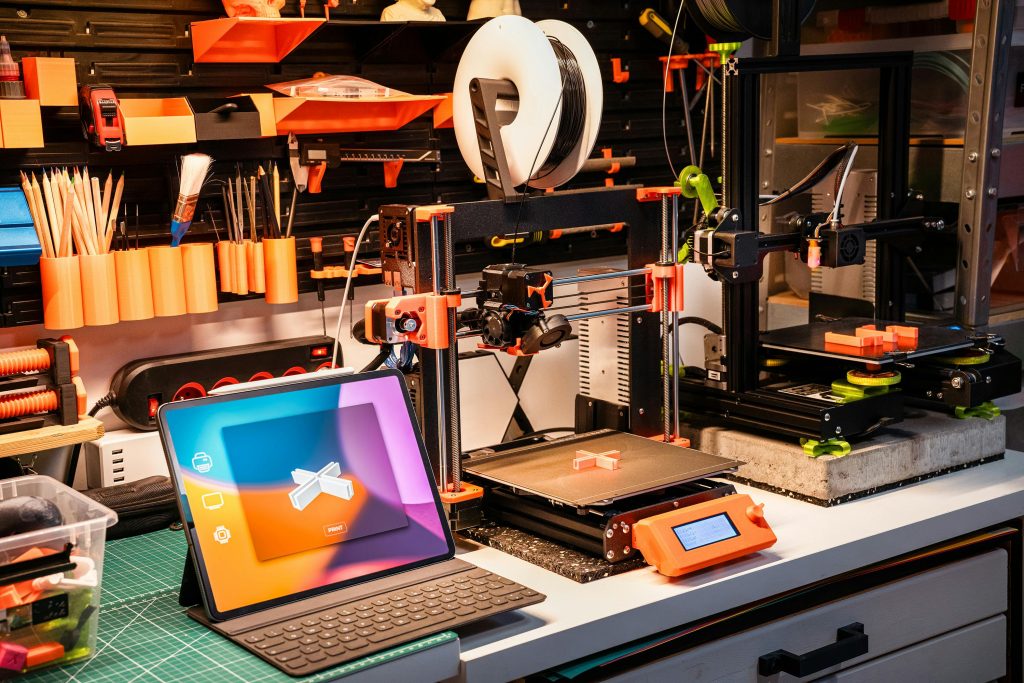
3D printing is a manufacturing process that creates three-dimensional solid objects directly from digital files. The technology works by using specialized software that translates digital models into instructions for the printing machine, which builds objects using various raw materials including polymers, resins, or metal powders.
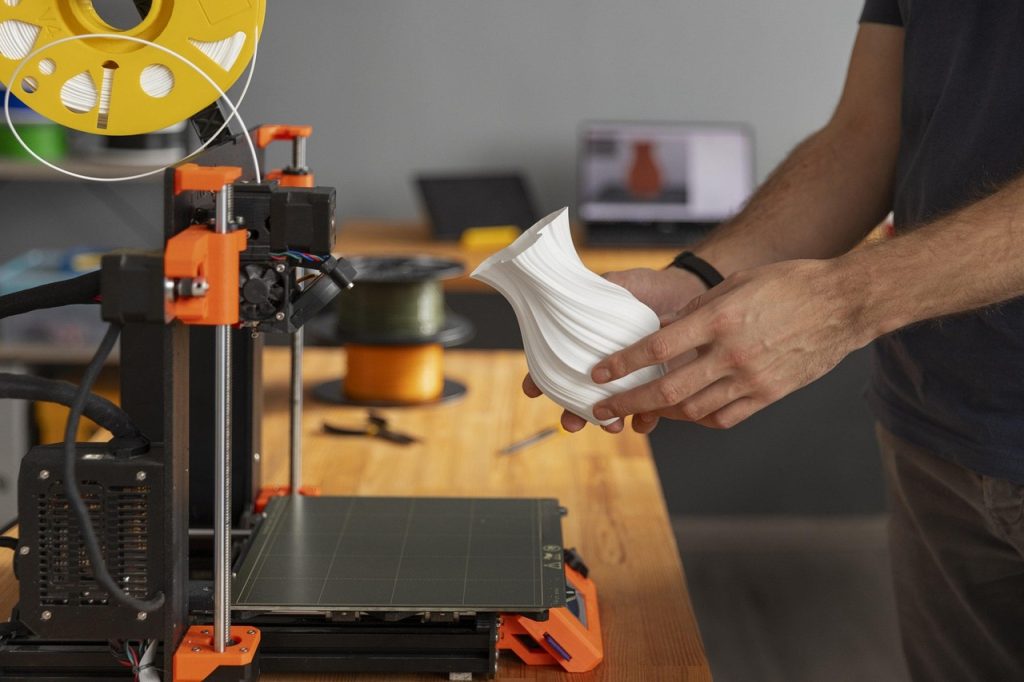
The process operates on additive manufacturing principles, constructing objects by depositing successive layers of material that immediately solidify according to the program’s specifications. Depending on the printer’s speed, you can observe the object gradually taking shape throughout the process.
The workflow integrates several key components. It begins with a 3D model, either originally designed using computer-aided design software or sourced from online model libraries. Once obtained, the digital file undergoes “slicing” to prepare it for printing.
Slicing software digitally divides the 3D model into numerous thin horizontal layers. These layer instructions are then transferred to the 3D printer via USB, WiFi, or other file transfer methods. With the prepared file loaded, the printing process commences.
After preparing the 3D printing machine and loading the file, the manufacturing process begins. Completion time ranges from minutes to hours, determined by the object’s complexity and the printer’s capabilities. This technology offers remarkable design freedom, enabling the creation of virtually any geometry imaginable.
3D Printing Materials Overview
Material Selection Guide:
Metals: Ideal for high-strength, heat-resistant applications
Engineering Plastics: Perfect for functional prototypes and end-use parts
Specialty Polymers: Best for flexible or chemically resistant components
Photopolymer Resins: Excellent for high-detail models and visual prototypes
| Material Category | Material Type | Key Properties | Common Applications |
|---|---|---|---|
| Metals | Aluminum | Lightweight, good strength-to-weight ratio | Automotive parts, aerospace components |
| Copper | Excellent thermal & electrical conductivity | Heat exchangers, electrical components | |
| Stainless Steel | Corrosion resistance, durability | Medical instruments, industrial parts | |
| Titanium | High strength, biocompatible | Aerospace, medical implants | |
| Plastics & Polymers | ABS | Impact resistant, durable | Prototypes, consumer products |
| PA (Nylon) | Strong, flexible, wear-resistant | Functional parts, gears, hinges | |
| Polycarbonate | High strength, transparent | Engineering components, protective gear | |
| Polypropylene | Chemical resistant, flexible | Living hinges, containers | |
| TPU | Flexible, rubber-like | Gaskets, seals, flexible parts | |
| Resins | Digital Photopolymer | High detail, smooth surface | Detailed prototypes, dental models |
Our 3D Printing Processes
Advanced Manufacturing Technologies for Every Stage of Product Development
Stereolithography (SLA)
Selective Laser Sintering (SLS)
PolyJet
Multi Jet Fusion (MJF)
Digital Light Synthesis (DLS)
3D Printing Services FAQ
Send the controlled 3D model, intended use, material or performance requirements, quantity, critical dimensions, appearance needs, inspection method and delivery destination. Identify the file revision and any assembly or test conditions.
Choose the process around the validation goal, not the technology name alone. Compare geometry, feature size, surface, anisotropy, support removal, material behavior, quantity and post-processing before selecting SLA, SLS, FDM, PolyJet, MJF or another route.
Define load, temperature, chemicals, moisture, flexibility, flame or electrical requirements and the required material record. For polyamide-specific questions, use the nylon 3D printing guide and verify the exact grade and conditioning state in the quote.
Tolerance depends on process, machine, material, orientation, feature size, support strategy, post-processing and measurement method. Mark critical dimensions and datums on the drawing, then agree conditioning, fixture, sample size and report format before production.
These depend on the selected machine, part envelope, nesting, material availability, finishing, inspection and queue. Ask the quotation to state the machine/process, usable build envelope, part orientation, batch quantity, included operations and milestone dates.
Use the plastic prototype manufacturing comparison when the decision depends on production-grade material, tighter machined features, molded shrinkage, repeat quantity or the transition to tooling. A route comparison should state what evidence the prototype must provide.
Request a 3D Printing Review
Send the model, drawing, material or performance requirement, quantity, critical dimensions, finish and inspection needs. The quotation should identify its assumptions and the selected process.