Recycled nylon (rPA) can reduce virgin-resin demand, but recycled-content percentage alone does not prove that a grade is suitable. Project teams must verify waste source, PA family, contamination control, molecular-weight consistency, reinforcement, additives, certification chain, and lot approval against the real part requirement.
What Is Recycled Nylon (rPA)?
Recycled nylon, designated as rPA, is nylon resin produced from recovered waste materials rather than virgin petrochemical feedstock. It falls into two primary categories:
PCR (Post-Consumer Recycled): Material recovered from products after consumer use — discarded automotive parts, carpet fibers, fishing nets, and packaging. PCR content is what most sustainability mandates refer to when specifying “recycled content.”
PIR (Post-Industrial Recycled): Material recovered from manufacturing scrap — injection molding sprues and runners, extrusion trim, rejected parts. PIR has the advantage of known provenance and consistent quality, but it does not carry the same sustainability premium as PCR.
Quality grades for rPA range from Grade A (virgin-equivalent mechanical properties, consistent color) to Grade C (property degradation, color variation, suitable only for non-loaded applications).
The rPA Recycling Process
Producing high-quality rPA requires a multi-step process:
1. Collection and Sorting: Waste nylon is collected from industrial and post-consumer sources. Near-Infrared (NIR) spectroscopy is the primary sorting technology, capable of distinguishing PA6 from PA66 from other plastics at conveyor-belt speed. Manual sorting supplements NIR for heavily contaminated streams.
2. Washing: Contaminants like oils, dirt, and labels are removed through hot washing and friction cleaning. For post-consumer material, this is the most critical quality step.
3. Grinding: Clean nylon is ground into flakes or chips of uniform size (typically 8–12mm), ready for extrusion.
4. Compounding: Nylon flakes are melted, filtered (melt filtration removes residual contaminants down to 40–80μm), and compounded with additives: heat stabilizers, processing aids, impact modifiers, and — for reinforced grades — glass fiber (typically 15–30%).
5. Pelletizing and Testing: The compound is strand-pelletized, dried, and tested for melt flow index, mechanical properties, moisture content, and color consistency before packaging.

rPA Properties vs Virgin Nylon
There is no universal property-retention percentage for recycled nylon. Results depend on the waste stream, number of heat histories, hydrolysis, contamination, filtration, stabilization, reinforcement, and test conditioning. Use supplier data for screening and test the final compounded grade.
| Approval Area | Virgin Nylon Baseline | rPA Review |
|---|---|---|
| Identity and traceability | Qualified resin source and grade | Waste source, PA family, PCR/PIR claim, and chain of custody |
| Mechanical performance | Grade-specific conditioned data | Lot variation, weld lines, impact, fatigue, and creep testing |
| Processing | Known drying and viscosity window | Moisture, viscosity drift, contamination, odor, and color variation |
| Compliance | Exact grade declarations | Recycled-content verification plus application-specific compliance |
Quality Challenges with Recycled Nylon
Thermal Degradation: Every heat history cycle causes chain scission in the polyamide backbone, reducing molecular weight and consequently mechanical properties. This is measured by Relative Viscosity (RV) — a drop from RV 2.7 (virgin) to RV 2.3 can mean 10–15% tensile strength loss.
Contamination: Cross-contamination with other polymers (especially PP and PE) is the most common quality issue. Even 1% PP contamination creates delamination and weak spots in molded parts because the materials are incompatible. Melt filtration at 40–60μm is the primary defense.
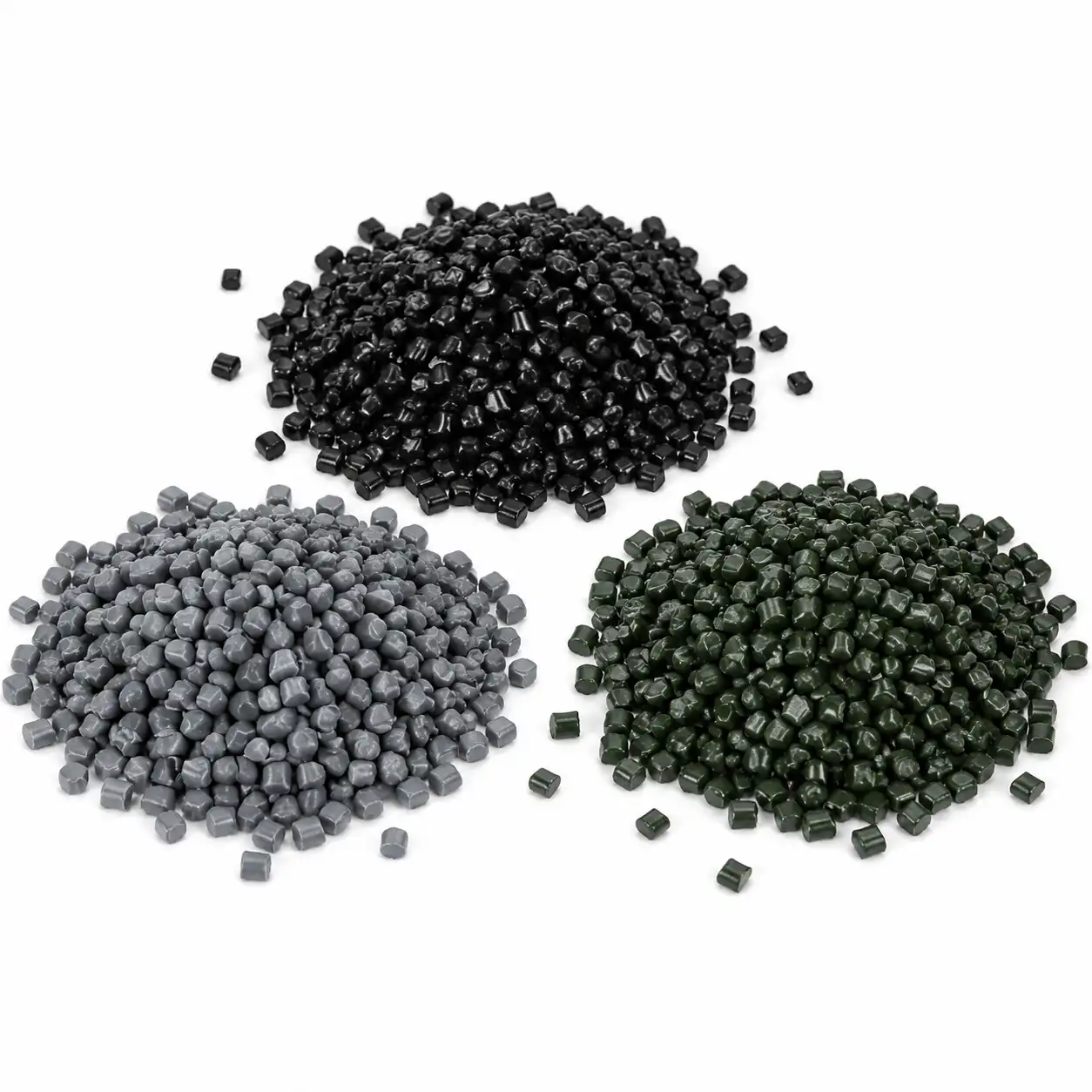
Color Variation: PCR nylon is almost always dark gray to black because different colored waste streams blend into a dark mass. If your application needs light or bright colors, PCR nylon will be a challenge unless you select a supplier with exceptional sorting and washing capability.
Odor: Post-consumer nylon can carry residual odors from its previous life — automotive fluids, food packaging, cleaning chemicals. For interior automotive or consumer applications, this needs to be managed through vented compounding and thermal desorption.
rPA Grades Available
| Grade | Source | Typical PCR% | Key Applications |
|---|---|---|---|
| rPA6 | Carpet fiber, fishing nets | 30–100% | Cable ties, fasteners, non-critical housings |
| rPA66 | Airbag fabric, automotive scrap | 30–100% | Engine covers, brackets, structural supports |
| rPA66 GF30 | Composite auto parts | 25–50% | Under-hood components, fan shrouds, intake manifolds |
| rPA6 GF30 | Industrial waste streams | 25–50% | Tool housings, electrical enclosures |
Certification Standards
Proving that your nylon is genuinely recycled requires third-party certification:
- GRS (Global Recycled Standard): The most widely recognized certification. GRS verifies recycled content, tracks it through the supply chain (chain of custody), and sets social and environmental requirements for recycling operations. GRS 4.0 is the current version.
- ISO 14021: Defines how companies can make self-declared environmental claims, including recycled content percentages. Requires documented evidence but not third-party audit.
- UL 2809 ECOLOGO: UL’s Environmental Claim Validation for recycled content. Provides independent third-party verification that a product contains the claimed percentage of recycled material.
- EU Recycled Plastics Regulation (EU 2022/1616): Specifically for food-contact recycled plastics, this regulation governs the use of recycled materials in food packaging and requires EFSA safety assessment.
Cost Comparison: rPA vs Virgin
Recycled nylon is not automatically cheaper. Sorting, cleaning, testing, certification, stabilization, low-volume compounding, yield loss, and supply consistency can offset feedstock savings. Compare landed approved-material cost, not a generic price per kilogram.
Questions That Should Be Resolved in the RFQ
- Is the recycled claim PCR, PIR, mass-balance, or another documented route?
- Are PA family, reinforcement, additives, color, and allowed contamination defined?
- Which COA properties and incoming tests release each lot?
- Does a material or source change require notification and re-approval?
- Are critical, regulated, or safety-related applications covered by customer-specific approval?
How Nylon Plastic Supports the Review
Nylon Plastic has worked across material modification and finished plastic-part manufacturing since 2005. This allows project teams to connect the resin decision with compounding, incoming inspection, injection molding, and sample validation rather than approving a grade from a family name or one dry data-sheet value.
- Compare unfilled PA, PA-GF20, and PA-CF30 against the actual failure mode.
- Review custom compounding when a standard grade misses stiffness, impact, color, wear, heat, or compliance requirements.
- Define TDS, COA, moisture, sample approval, traceability, and lot-release requirements before volume ordering.
Recycled Nylon Selection Summary
Use rPA only after the exact grade demonstrates the required performance and documentation. For applications where lot variation or approval risk is unacceptable, unfilled virgin PA, PA-GF20, or PA-CF30 may remain the safer commercial route.
Conclusion
Recycled nylon is ready for prime time — but not for every application. For non-safety-critical automotive under-hood components, industrial housings, furniture, and construction products, high-grade rPA66 and rPA66 GF30 can meet performance requirements while delivering sustainability credentials. For safety-critical, high-temperature, or tight-tolerance applications, virgin nylon remains the safer choice. The key is working with a supplier who can provide consistent quality, documented certifications, and realistic performance data — not just a “green” label.
Related Reading
For detailed PA66 GF30 properties and grade selection, see our glass-filled nylon grade comparison guide covering GF15, GF30, and GF60 stiffness, heat, warpage, and molding data.
Frequently Asked Questions
Is recycled nylon as strong as virgin nylon?
It can approach a virgin grade in selected properties, but there is no universal retention percentage. Waste source, degradation, contamination, formulation, conditioning, and lot control determine performance.
What is the difference between PCR and PIR nylon?
PCR comes from products recovered after consumer use. PIR comes from controlled manufacturing scrap. The labels describe source, not automatic fitness for a specific part.
What documents should an rPA supplier provide?
Define recycled-content verification, TDS, SDS, batch COA, traceability, compliance declarations, source-change control, sample approval, and lot-release requirements.
Can recycled PA-GF30 replace a virgin grade?
Only after the exact compound passes material, molding, dimensional, mechanical, environmental, and customer approval requirements. Do not approve substitution from filler percentage alone.
Request a Recycled Nylon Grade Review
Send the incumbent grade, required recycled-content route, drawing, volume, approvals, and lot-control requirements for a grade and process review.

