Material qualification guide
A matching polymer and glass-fiber percentage are only the start.
General engineering guidance. An alternative resin can match the incumbent's polymer name and glass-fiber percentage yet behave differently in a real mold and part. An exact grade also includes its flow, stabilization, color and other formulation choices. For example, BASF lists both B3EG6 and heat-aging-resistant B3WG6 as PA6-GF30 grades. Their shared PA6-GF30 designation alone does not establish interchangeability. BASF B3EG6 BASF B3WG6
The decision is whether a candidate can meet the approved part specification under the intended processing and service conditions. The original grade remains the control until the customer's change process authorizes a substitute.
PA6 → exact grade
PA66 → exact grade
PBT → exact grade
Why buyers replace engineering plastic grades
Typical triggers include interrupted availability, a long lead time, regional sourcing, a supplier change, cost review, a revised compliance requirement or a performance problem. Record the trigger first: it determines whether the aim is a like-for-like supply alternative, a formulation change or a part redesign. A cheaper resin that needs a tool correction or fails an approval test may cost more overall; calculate the project cost only after defining the validation scope.
Why two PA66 GF30 grades are not automatically equivalent
“PA66-GF30” identifies a polymer family and nominal glass loading. It does not identify base-resin viscosity, glass fiber type or retained length, sizing and coupling system, heat stabilizer, lubricant, impact modifier, flame-retardant system or color package. Ask the candidate supplier which of these distinctions matter to the application and which details can be disclosed. Published grade ranges already show that the formulation and processing response are grade-specific; BASF's A3EG6 and A3WG6 LT illustrate standard and heat-aging-resistant PA66-GF30 variants. BASF Ultramid brochure BASF A3EG6 BASF A3WG6 LT
Even matching test-bar values do not prove matching part performance. Moisture conditioning changes the mechanical behavior and dimensions of polyamides. Glass-fiber orientation, wall distribution, gate position and processing conditions influence shrinkage and warpage in molded parts. These are reasons to test critical dimensions, weld lines and loaded features in the production geometry. BASF Ultramid brochure
Step 1 — collect the incumbent requirements
Create one controlled comparison pack before screening candidates:
| Record | Minimum question |
|---|---|
| Incumbent identity | Exact manufacturer, grade, color and approved supplier; is the designation on the drawing or purchase order? |
| Technical basis | Current TDS revision, drawing revision, critical dimensions and acceptance tests; which values are mandatory rather than typical? |
| Application | What does the part do, where can it fail, and what happens if it does? |
| Service environment | Load and duration, temperature range, humidity, chemicals or fluids, UV exposure and intended life. |
| Processing | Mold and cavity, machine, drying, melt and mold settings, regrind policy, and observed process window. |
| Approval | Customer-specific change control, electrical or flammability requirements, destination-market rules and required documents. |
If a drawing or incumbent TDS is unavailable at first contact, send the exact grade name and application. The missing records can be resolved before a candidate is approved; a CAD file is not required for the initial material inquiry.
Step 2 — compare datasheets on the same basis
Use the table below as a project worksheet. Populate it with current, named-grade documents; leave cells blank if evidence is unavailable. Compare method, test temperature, specimen thickness, dry/conditioned state and flow direction before comparing the numerical result. A heat-deflection temperature under one load is not interchangeable with a result under another load. BASF's grade sheets illustrate why conditions and dry/conditioned columns matter. BASF B3EG6 BASF A3EG6 BASF PBT B4300 G6 HR
| Property or requirement | Original grade | Candidate grade | Difference / condition | Acceptance criterion | Verification required |
|---|---|---|---|---|---|
| Exact polymer, reinforcement, additives and color | Supplier confirmation | ||||
| Tensile and flexural behavior, dry and conditioned | Same-method comparison; part test if critical | ||||
| Impact and weld-line-sensitive features | Molded-part functional test | ||||
| Heat behavior and exposure duration | Matching load and aging test | ||||
| Moisture uptake and dimensional state | Conditioning and dimension study | ||||
| Melt flow, drying and processing window | Controlled mold trial | ||||
| Flow/transverse shrinkage and warpage | Critical-dimension study | ||||
| Chemical and electrical performance | Application-specific test | ||||
| Flame rating and compliance documents | Exact-grade/document check |
The customer and part engineer set the acceptance criteria. A datasheet is a screening input, not a replacement for the approved drawing and finished-part tests.
Step 3 — review regulatory and project documents
Request the documentation that the actual product and destination require. For electrical equipment, the applicable RoHS scope may need review; for an EU-bound article, REACH duties may apply depending on the substance, article and destination. Neither a polymer name nor a generic supplier statement proves compliance of the selected formulation. European Commission RoHS European Commission REACH
If a flammability or electrical recognition is specified, verify the candidate's exact listing, including the relevant thickness and color, with the current UL record and the customer's end-product approval process. A Yellow Card describes a recognized material and its tested properties; it does not automatically transfer to a different grade. UL Yellow Card UL material substitution
Food contact, automotive/IMDS, FAI or PPAP information should be requested only when the end application and customer approval plan call for it. Confirm availability for the named grade and project; do not assume any supplier can provide every document.
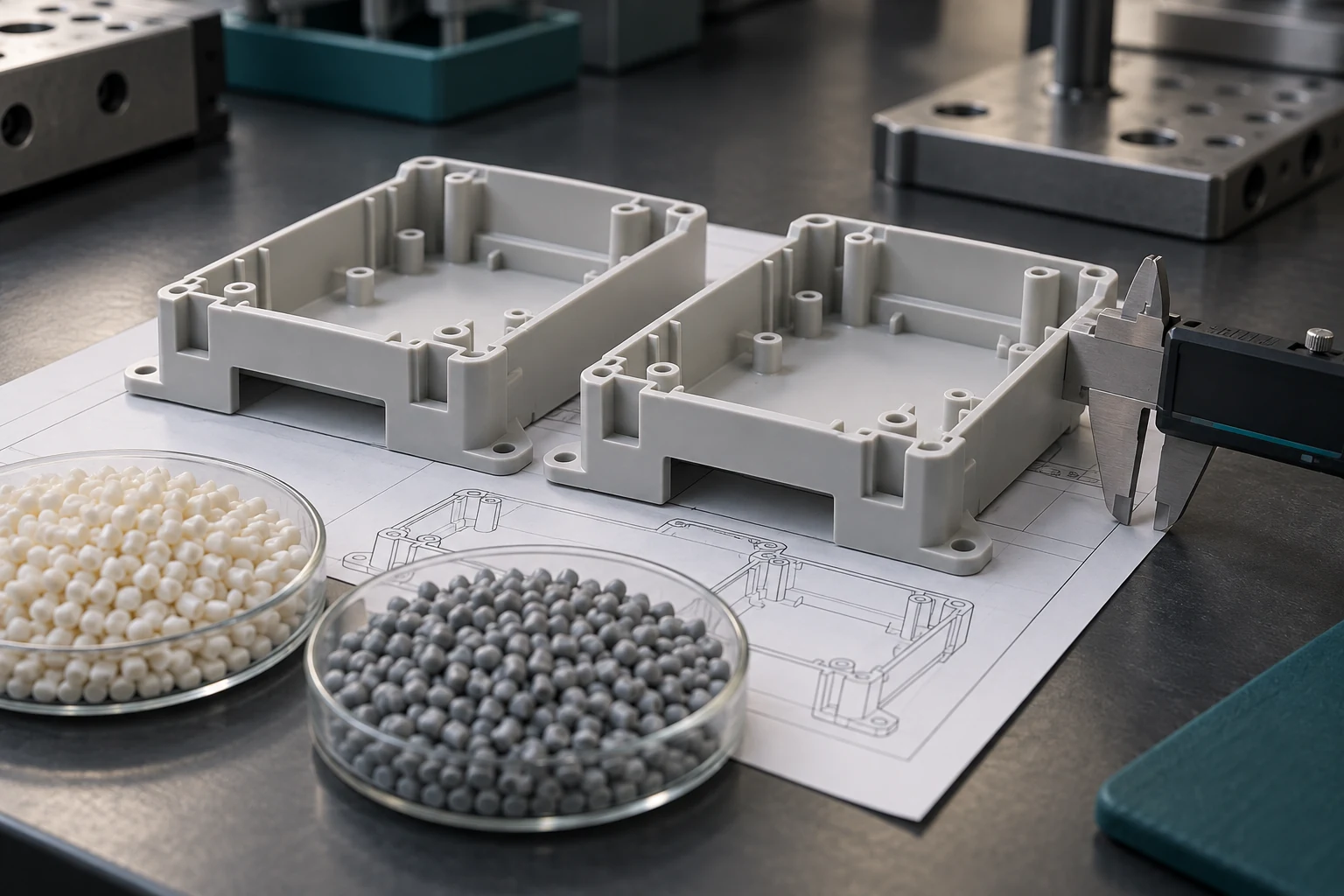
Step 4 — run a controlled mold trial
Use the intended tool and record the candidate's grade and lot alongside the incumbent baseline. Follow the supplier's current handling advice and record actual pellet moisture or drying condition where relevant. For each trial, capture melt and mold temperatures, injection and holding settings, cooling and cycle, fill behavior, ejection, surface, weld-line position, flash, sinks and warpage. Do not present settings from another supplier's grade as the candidate's processing window. BASF's PA and PBT processing guides show that shrinkage and warpage depend on both grade and molding conditions. BASF Ultramid brochure BASF Ultradur brochure
If the candidate only passes after a major process or tool change, evaluate that change explicitly. The material substitution and the tool/process revision may require separate approval.
Step 5 — validate the finished part
Measure critical dimensions at a stated time after molding and in the condition that represents service. Then run the tests tied to the part's failure modes: assembly and retention, load/impact, thermal aging, exposure to the actual chemicals or fluids, and electrical or flammability requirements where applicable. Include features near weld lines and gates. Test methods, sample size and acceptance limits belong in the customer's validation plan; there is no universal pass percentage for “equivalent PA66” or “equivalent PBT.”
Step 6 — record final approval and production monitoring
- 01 Original gradeDocument the approved material and part requirements.
- 02 Candidate screeningIdentify an exact named grade.
- 03 Datasheet reviewCompare the same test methods and conditions.
- 04 Mold trialRun the candidate in the intended process.
- 05 Dimensional validationCheck critical features in a defined condition.
- 06 Functional testingTest the part against its failure modes.
- 07 Authorized approvalRecord the customer or project decision.
- 08 Production monitoringTrack the characteristics that drove the change.
Record the approved supplier, full grade and color, TDS revision, sample/lot, tool and process settings, test evidence, deviations and approving authority. Keep the incumbent and candidate lots traceable during transition. After release, monitor the characteristics that drove the substitution, such as moisture, fill, dimensional drift, warpage or appearance. Escalate a change in formulation or supplier through the same customer change process.
Common reasons a replacement grade fails
| Symptom | Check first |
|---|---|
| Dimensions or fit move | Flow/transverse shrinkage, measurement timing and moisture condition. |
| Part warps | Fiber orientation, gate, wall thickness, cooling and mold temperature. |
| Loaded feature fails at a weld line | Weld-line location and representative part strength, not only tensile-bar data. |
| Surface or color changes | Pigment, additive package, glass exposure and mold finish. |
| Incomplete fill or changed cycle | Grade-specific flow and processing window. |
| Performance changes after humidity exposure | Dry versus conditioned data and service conditioning. |
| Flame or compliance documents do not match | Exact grade, color, thickness, destination and current listing. |
Send your current grade for replacement review
Send the incumbent manufacturer and full grade, its current TDS if available, the part application, service conditions and the change trigger. Add the drawing or target tests when you have them. A phone number and CAD file are optional. If the quantity is not known, enter “Not sure yet” and explain the project stage.
Related site pages: Material Selection · PA6 · PA66 · PBT GF30 · Injection Molding.
Sources / technical references
These third-party manufacturer and authority sources support the decision method. Their named grades are examples, not claims about a Nylon Plastic supplied grade or this project's approval.
- [S1] BASF, Ultramid (PA) Product Brochure: grade variants; moisture/conditioning; shrinkage, warpage and processing dependencies.
- [S2] BASF, Ultramid B3EG6 product data: named PA6-GF30 example and test-condition structure.
- [S3] BASF, Ultramid B3WG6 processing data: named heat-aging-resistant PA6-GF30 variant.
- [S4] BASF, Ultramid A3EG6 product data: named PA66-GF30 example.
- [S5] BASF, Ultramid A3WG6 LT BK product data: named heat-aging-resistant PA66-GF30 variant.
- [S6] BASF, Ultradur B 4300 G6 HR product data: named PBT-GF30 example and test-condition structure.
- [S7] UL Solutions, How to Read the Yellow Card: scope of a material recognition card.
- [S8] European Commission, RoHS Directive: regulated electrical/electronic equipment scope.
- [S9] European Commission, REACH regulation: conditional REACH regulatory context.
- [S10] UL Solutions, Material Substitution and Modification for Plastics: substitution and recognition context.
- [S11] BASF, Ultradur (PBT) Product Brochure: processing, shrinkage and warpage dependencies.