

Why Importers Are Diversifying Beyond China
For two decades, China has been the undisputed center of global plastic manufacturing. But the landscape is shifting rapidly. Rising labor costs, US Section 301 tariffs (up to 25% on many plastic goods), and the supply chain disruptions exposed during recent global events have pushed importers to rethink single-country dependency.
Vietnam and India have emerged as the two most credible alternatives. Each country brings a different value proposition to the table, and the right choice depends heavily on your product category, volume, quality requirements, and risk tolerance. This guide provides a head-to-head comparison to help you make an informed manufacturing-location decision.
Three-Country Comparison at a Glance
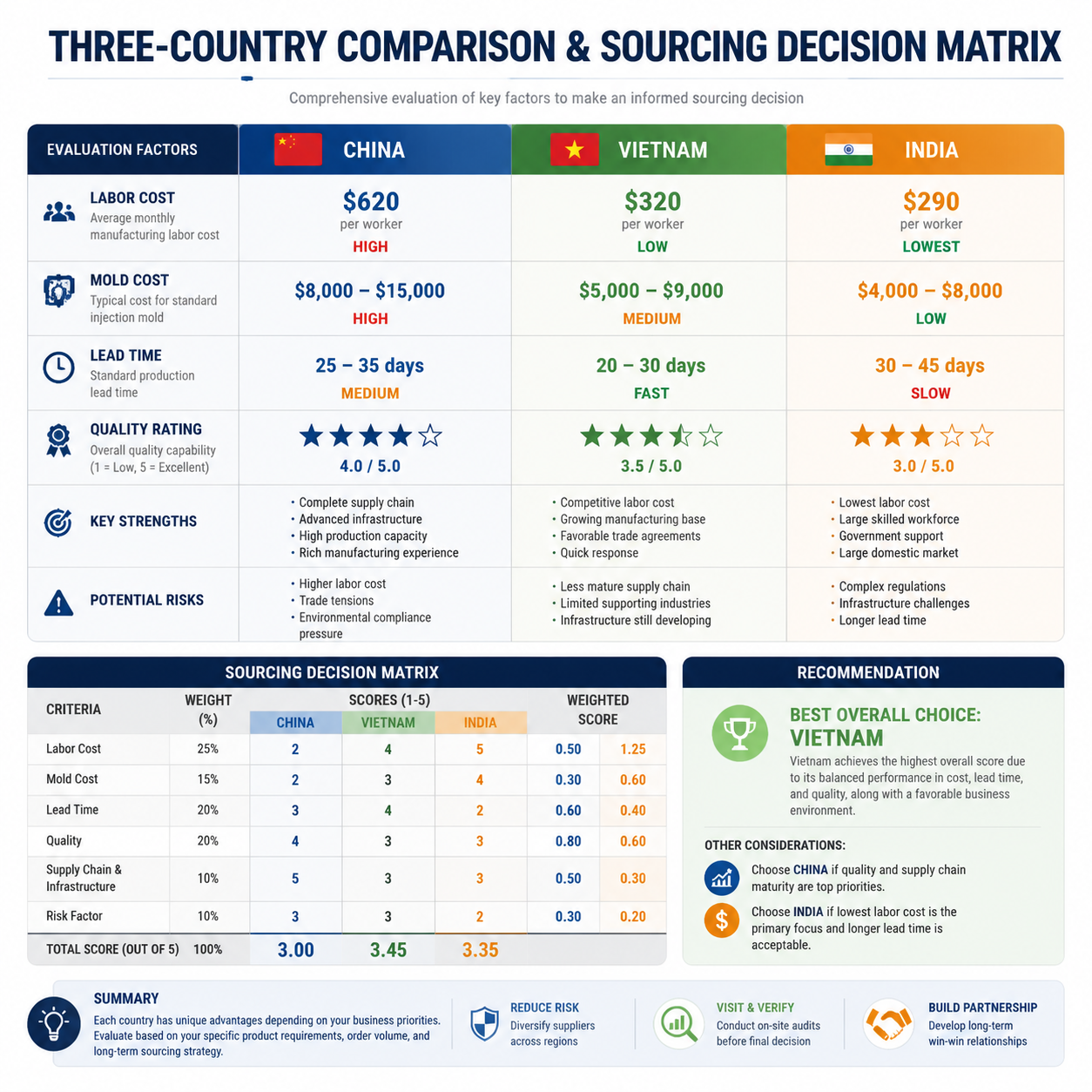
The table below summarizes key manufacturing metrics across all three countries. Use this as your quick-reference scorecard before diving into the detailed analysis.
| Factor | China | Vietnam | India |
|---|---|---|---|
| Avg. Factory Labor Cost (USD/hr) | $5.50 – $8.00 | $2.80 – $4.50 | $1.80 – $3.50 |
| Mold Cost Index | 100 (baseline) | 105 – 115 | 90 – 100 |
| Material Availability | Excellent; full resin supply chain | Good; growing domestic + China imports | Good; strong domestic petrochemical base |
| Typical Lead Time (FOB) | 25 – 40 days | 35 – 55 days | 35 – 60 days |
| Quality Maturity | High; decades of refinement | Medium; improving rapidly | Medium; strong in automotive/medical |
| IP Protection | Moderate; enforcement improving | Moderate; smaller enforcement capacity | Moderate; legal framework present but slow |
| Logistics Infrastructure | World-class ports and roads | Developing; key ports operational | Improving; major ports operational |
| English Proficiency | Moderate in export hubs | Low to moderate | High; strong English-speaking workforce |
| Typical MOQ | 1,000 – 5,000 units | 2,000 – 5,000 units | 1,000 – 3,000 units |
| Payment Terms | 30% deposit, 70% before shipment | 30% deposit, 70% against documents | 30% deposit, 70% against documents or LC |
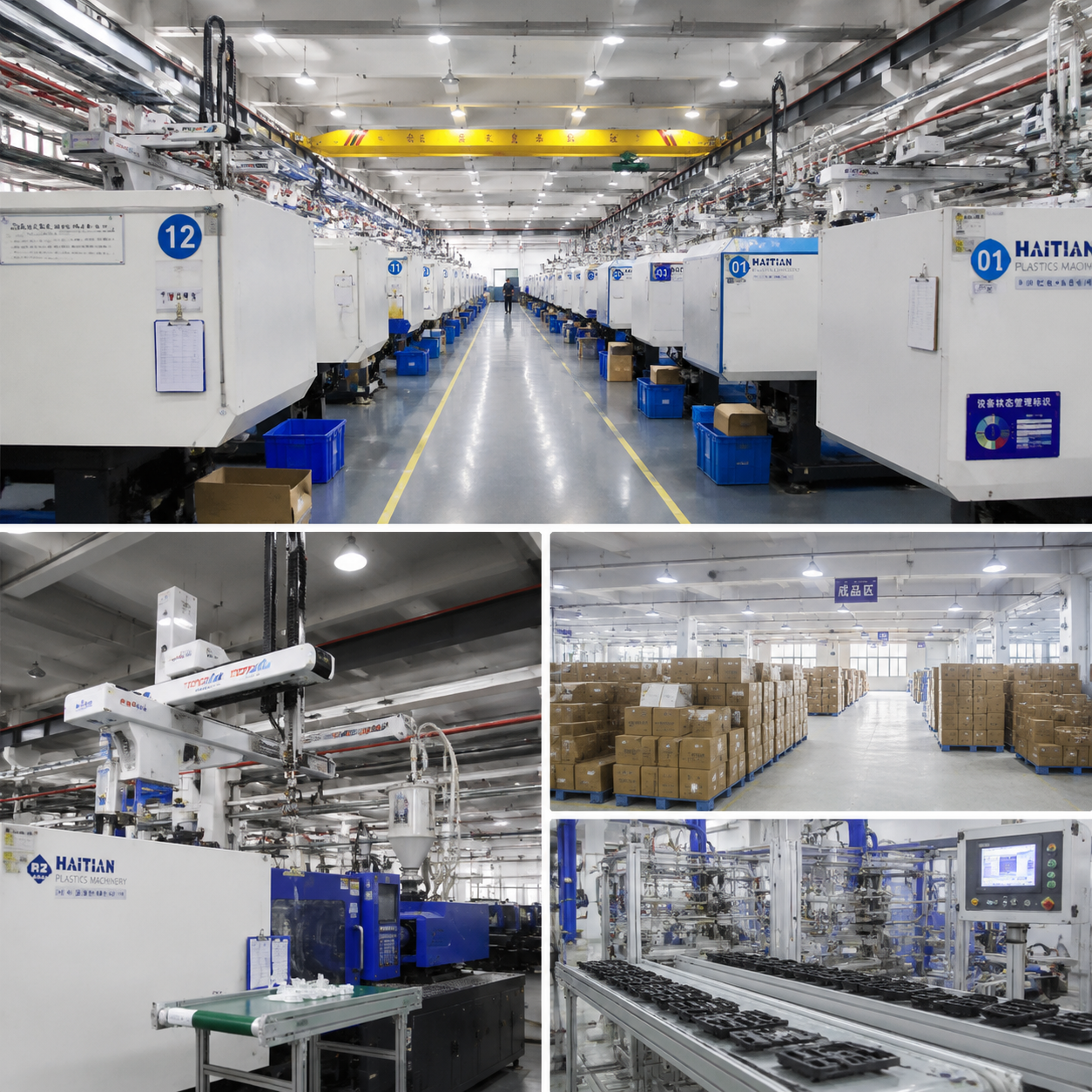
China: The Established Powerhouse
China remains the default choice for plastic manufacturing, and for good reason. The ecosystem is unmatched: thousands of specialized factories, a complete raw material supply chain, world-class mold-making capabilities, and logistics infrastructure that moves containers faster than anywhere else in Asia.
Strengths: China excels at high-complexity plastic parts requiring precision molds, multi-material molding, or tight tolerances. The mold-making industry in Shenzhen, Dongguan, and Ningbo is arguably the most mature in the world. If your product involves overmolding, insert molding, or requires Class A surface finish, China is still the strongest option.
Weaknesses: Labor costs in coastal manufacturing hubs have tripled over the past 15 years. Tariff exposure is significant for US-bound goods. Environmental enforcement has become stricter, occasionally disrupting production. And while IP protection has improved, it remains a concern for proprietary designs.
Best for: High-complexity parts, products requiring rapid iteration, large-volume runs where mold amortization matters, and categories not subject to Section 301 tariffs.
Vietnam: The Rising Alternative
Vietnam has been the biggest beneficiary of the China-plus-one strategy. Its proximity to China’s raw material supply chain, improving infrastructure, and favorable trade status (no US Section 301 tariffs, EU FTA benefits) make it a compelling option for labor-intensive plastic products.
Strengths: Vietnam offers significantly lower labor costs than coastal China, with a young and trainable workforce. The country enjoys strong trade relationships with both Western and Asian markets. Many Chinese-owned factories have established operations in Vietnam, bringing technical expertise and supply chain connections with them.
Weaknesses: Mold-making capability is still developing; complex molds are often imported from China, adding cost and lead time. Raw material availability can be less consistent, with many factories relying on resin imported from China or South Korea. The supplier base for specialized plastic processing is thinner than China’s.
Best for: Labor-intensive plastic assembly, simple to medium-complexity injection molding, products where tariff avoidance is the primary driver, and EU-bound goods leveraging FTA benefits.

India: The Underestimated Contender
India is often overlooked in plastic manufacturing discussions, but that is changing quickly. With the lowest labor costs among the three, a massive domestic market that provides scale, strong English communication, and a rapidly improving manufacturing policy environment (Make in India, Production-Linked Incentive schemes), India deserves serious consideration.
Strengths: India offers the lowest labor costs of the three countries, often 40-60% below China for equivalent roles. English proficiency among factory management and export staff is significantly higher than in China or Vietnam, reducing communication friction. India has a strong domestic petrochemical industry, providing good availability of commodity resins like PP, PE, and PVC.
Weaknesses: Logistics infrastructure, while improving, still lags behind China. Lead times tend to be the longest of the three. Quality consistency can vary more between factories, requiring thorough supplier vetting. Bureaucracy and customs procedures can be slower and less predictable.
Best for: Cost-sensitive products with medium complexity, products destined for the Indian domestic market or Middle Eastern/African markets, categories where English communication is critical, and products using commodity-grade resins.
Decision Framework: What to Source Where
Use this framework to guide your country selection based on product characteristics:
| Product Type | Recommended Country | Rationale |
|---|---|---|
| High-precision technical parts | China | Best mold-making and tight-tolerance capability |
| Labor-intensive assembly | Vietnam or India | Significant labor cost advantage over China |
| Large commodity plastic items | India | Strong domestic resin supply, lowest production cost |
| Tariff-sensitive US-bound goods | Vietnam | No Section 301 tariffs; growing capacity |
| EU-bound products | Vietnam or India | Both have favorable EU trade arrangements |
| Products requiring rapid prototyping | China | Fastest mold turnaround and iteration speed |
| Products with complex IP requirements | Split production | Keep critical components in one country, assembly elsewhere |

Practical Supplier Management for Multi-Country Operations
Managing suppliers across three countries is more complex than working with a single source. Here are actionable recommendations based on real-world importer experience:
- Audit in person or via a trusted third party. Factory audits in all three countries are essential. Consider hiring a local quality assurance firm for ongoing inspections rather than relying solely on your own travel.
- Start with a pilot order. Before committing to large volumes, run a small pilot order through any new supplier to validate quality, communication, and on-time delivery.
- Understand the mold ownership terms. In all three countries, clarify whether you own the mold, whether it is amortized into the part price, and what happens if you move production. Get this in writing before cutting steel.
- Build redundancy into lead times. Plan for 7-14 days of buffer beyond quoted lead times, especially when working with a new supplier or during peak shipping seasons.
- Negotiate payment terms carefully. Letter of credit (LC) options are more readily available in India; Vietnam and China tend to prefer telegraphic transfer (T/T) structures.
Frequently Asked Questions
How do US Section 301 tariffs affect plastic products from China compared to Vietnam and India?
As of 2026, many plastic products from China are subject to Section 301 tariffs ranging from 7.5% to 25%, depending on the specific HTS code. Vietnam and India are not subject to these additional tariffs, which can create a 10-25% landed cost advantage before factoring in other variables like freight and production cost differences. Always verify the specific HTS classification for your product, as tariff lists are updated periodically. For tariff-sensitive categories, Vietnam typically offers the strongest net advantage once all-in landed costs are calculated.
Can I transfer existing molds from China to Vietnam or India?
Yes, mold transfer is feasible but requires planning. Standard injection molds are physically transferable. However, you must verify that the receiving factory has compatible machine specifications (clamping force, platen size, ejector pattern). Mold ownership must be clearly documented and the original Chinese factory must release the mold. Expect 4-8 weeks for shipping, installation, and trial runs. Budget for potential modifications if machine interfaces differ. Some importers choose to create duplicate molds rather than transfer, which adds upfront cost but provides dual-supply flexibility.
What is the minimum viable order quantity when starting with a new factory in Vietnam or India?
For injection molding, expect minimum order quantities (MOQ) of 2,000-5,000 units in Vietnam and 1,000-3,000 units in India. These are generally comparable to or slightly higher than China’s MOQs, which typically range from 1,000-5,000 units. For blow molding or extrusion, MOQs can be lower. Many Vietnamese and Indian factories are willing to accept smaller trial orders (500-1,000 units) for first-time customers to build a relationship, though unit pricing will reflect the smaller volume. Always negotiate MOQ flexibility upfront as part of your supplier qualification process.
How should I approach quality audits differently across China, Vietnam, and India?
In China, focus audits on raw material traceability and subcontracting practices, as unauthorized subcontracting is more common in high-demand periods. Engage a third-party inspection firm familiar with the local industrial cluster (Ningbo, Dongguan, etc.). In Vietnam, pay extra attention to incoming material inspection processes since many factories import resin, and verify mold maintenance records as local mold repair capability is still developing. In India, emphasize process documentation and consistency, as quality variation between production batches can be wider; also check for proper calibration of measuring equipment. In all three countries, an Initial Production Check (IPC) plus a During Production Inspection (DPI) is recommended over relying solely on a final random inspection.