
CNC Machining Materials for Precision Parts
Compare metals and engineering plastics by strength, machinability, wear resistance, temperature capability, weight, and cost—so your CNC parts are easier to quote, machine, inspect, and use in production.
Choose CNC materials by function, not just by name
A material that looks strong on a datasheet may still machine poorly, warp after stress relief, absorb moisture, or drive up cycle time. The practical choice depends on load, tolerance, surface finish, operating environment, inspection requirements, and volume.
For early prototypes, machinability and fast delivery often matter most. For production parts, durability, dimensional stability, repeatability, and total cost become more important. This page helps you compare common CNC machining materials in a buyer-friendly way before sending drawings for quotation.

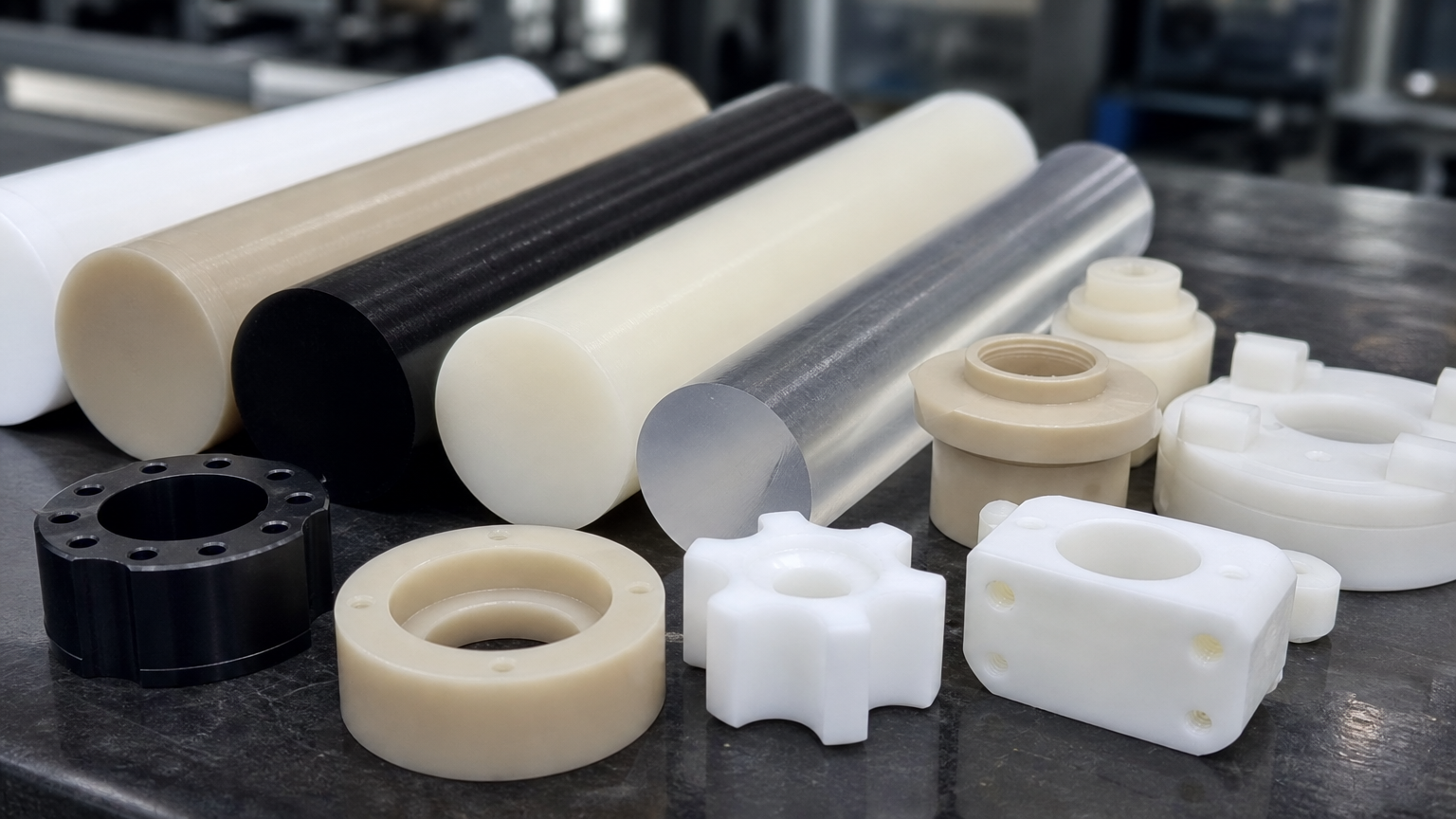
Engineering plastics for CNC machining
Plastics are often selected when parts need lower weight, electrical insulation, corrosion resistance, low friction, or quieter operation than metal components.
Nylon (PA6 / PA66)
Strong, tough, wear-resistant, and suitable for gears, bearings, rollers, and structural components.
Wear resistantToughCost-effective
POM / Acetal
Excellent dimensional stability and low friction for precision moving components.
Low frictionStablePrecision
PEEK / PTFE / PC / ABS
Use PEEK for high-performance service, PTFE for chemical resistance and low friction, PC for impact clarity, and ABS for economical prototypes.
High tempChemical resistancePrototype
Metals and alloys for CNC machining
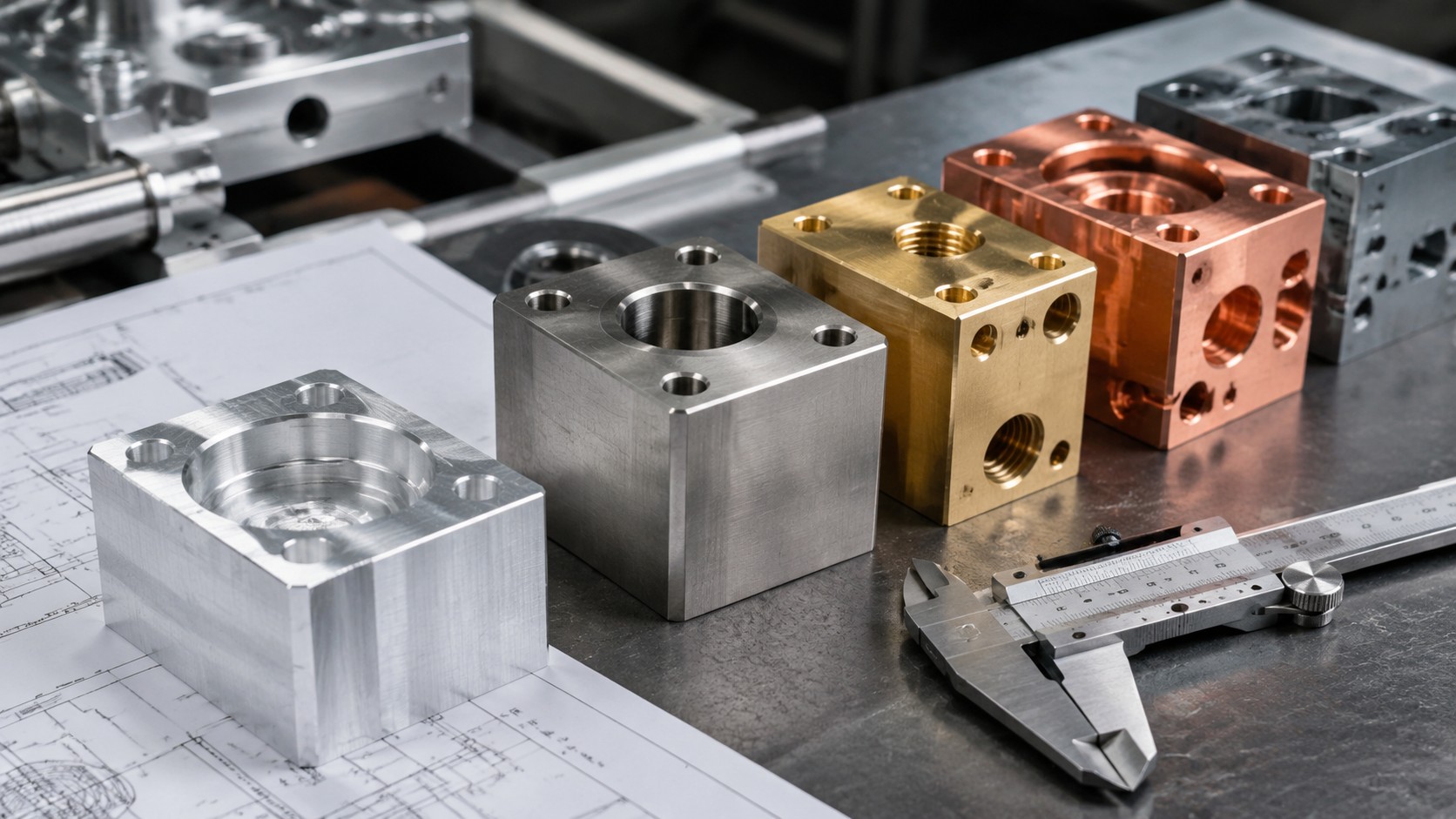
Metals are usually chosen when parts require high load capacity, threaded strength, heat conduction, EMI shielding, or long-term mechanical reliability.
Aluminum 6061 / 7075
Fast to machine, lightweight, and suitable for housings, brackets, fixtures, and aerospace-grade structures.
LightweightFast machining
Stainless steel
Good strength and corrosion resistance for medical, marine, food, and durable industrial components.
Corrosion resistantStrong
Brass, copper, titanium
Choose brass for machinability, copper for conductivity, and titanium for strength-to-weight and biocompatibility.
ConductivePremium
Material properties comparison
The values below are typical references for standard grades. Final performance depends on the exact grade, stock form, heat treatment, humidity, machining strategy, and part geometry.
Common CNC metals
| Material | Why buyers choose it | Typical applications | Watch-outs |
|---|---|---|---|
| Aluminum 6061 | Good balance of strength, cost, weight, and machinability | Housings, brackets, prototypes, fixtures | Not as strong as 7075 |
| Aluminum 7075 | High strength-to-weight ratio | Aerospace, robotics, performance parts | Higher cost; corrosion protection may be needed |
| Stainless 304 / 316 | Corrosion resistance and durable appearance | Medical, marine, food, outdoor parts | Slower machining than aluminum |
| Brass C360 | Excellent machinability and clean finish | Fittings, bushings, electrical parts | Heavier than aluminum |
| Titanium Grade 5 | High strength, low weight, corrosion resistance | Medical, aerospace, premium components | Expensive; requires careful machining |
Common CNC plastics
| Material | Why buyers choose it | Typical applications | Watch-outs |
|---|---|---|---|
| Nylon PA6 / PA66 | Toughness, wear resistance, good mechanical strength | Gears, rollers, bushings, wear pads | Moisture absorption can affect dimensions |
| POM / Acetal | Low friction and dimensional stability | Precision gears, sliding blocks, fixtures | Not ideal for high heat |
| PEEK | High temperature, chemical resistance, strength | Medical, aerospace, semiconductor, high-load parts | High material cost |
| PTFE | Very low friction and chemical resistance | Seals, liners, chemical components | Soft; difficult to hold very tight tolerances |
| PC / ABS | Impact strength or economical prototyping | Enclosures, covers, appearance prototypes | Grade selection affects finish and stability |
How to decide
Use these three filters before locking the material on a CNC drawing.
Start with function
List load, wear, friction, temperature, chemical exposure, electrical needs, and whether the part is cosmetic or functional.
Check machinability
Review tolerance, wall thickness, internal corners, surface finish, post-processing, and whether the material is likely to warp or burr.
Balance cost and volume
For prototypes, choose available stock and fast machining. For production, compare unit cost, inspection risk, service life, and finishing needs.
Industry application examples
Practical questions before quoting
What is the best material for CNC machined plastic parts?
For many functional plastic parts, nylon and POM are the first materials to compare. Nylon is strong and wear-resistant, while POM is more dimensionally stable and lower friction. PEEK, PTFE, PC, and ABS are selected when the application needs high temperature resistance, chemical resistance, transparency, impact strength, or lower prototype cost.
When should I choose aluminum instead of plastic?
Choose aluminum when the part needs higher stiffness, better heat transfer, stronger threads, metallic appearance, EMI shielding, or more predictable dimensional stability under load. Choose plastic when weight, insulation, corrosion resistance, sliding performance, or noise reduction matters more.
Can tight tolerances be held on CNC plastic parts?
Yes, but the material and geometry matter. POM and PC are generally more stable than moisture-sensitive nylon. Thin walls, large flat areas, and soft materials such as PTFE may need wider tolerances or special machining strategy.
What information helps you recommend the right material?
Send the CAD file or drawing, expected quantity, tolerance requirements, operating temperature, load, friction or wear conditions, chemical exposure, target finish, and whether the part is for prototype testing or production use.
Need help choosing a CNC machining material?
Share your drawing, material preference, working environment, and quantity. We can help compare practical material options for machining cost, tolerance risk, and long-term performance.
We do not sell, trade, or rent your personal data. You can contact us at any time to request, update, or delete your information.
 English
 Dutch
Dutch German
 French
 Korean
 Russian
 Japanese
 Spanish
 Vietnamese
 Chinese
 Portuguese
 Arabic