This page is the supplier-selection article in the cluster. It is broader than a quoting guide, narrower than an introduction to machining, and more general than a China-specific sourcing article. The central question is simple: how do you judge whether a CNC machining service is the right long-term manufacturing partner for your parts? That means looking beyond price and beyond machine lists. A strong service partner shows process discipline, communication speed, realistic lead-time promises, revision control, and a willingness to surface risk before production starts. If your problem is vendor choice rather than quote formatting or overseas sourcing, this is the article that should answer it.
This guide is for engineers, procurement managers, and anyone who’s been burned by a shop that delivered late, out-of-tolerance, or “close enough.” What actually matters when choosing a CNC machining service partner isn’t the glossy website claims — it’s the real indicators of quality that predict whether you’ll get good parts on time.

Core Concepts & Fundamentals
Before you evaluate any CNC machining service, you need to understand what kind of service you’re actually looking for. Not all CNC shops are the same, and sending the wrong type of work to the wrong type of shop is the fastest way to a bad experience.
The three tiers of CNC machining services:
Tier 1 — Prototype & Low-Volume Shops: These shops specialize in quick-turn, one-off, and small-batch work. They’re fast, flexible, and usually willing to work from incomplete documentation because they understand you’re still figuring things out. The trade-off: they’re not set up for production efficiency, so their per-part pricing at volume won’t be competitive. Think of them as your development partner.
Tier 2 — Production Machine Shops: These are the workhorses. They run parts in quantities from hundreds to tens of thousands. They’ve invested in fixturing, automation, and process optimization. They care deeply about cycle time because 30 seconds saved per part at 10,000 parts is real money. They need complete documentation and they’ll push back hard on anything that slows down production.
Tier 3 — Full-Service Manufacturing Partners: These shops do CNC plus other processes: injection molding, sheet metal, finishing, assembly. They’re not just cutting metal — they’re delivering finished, assembled products. The advantage is single-source accountability. If the CNC parts don’t fit the injection-molded housings, there’s no finger-pointing — it’s all under one roof. This is where nylonplastic.com operates.
What nobody tells you: many shops claim to do all three tiers. Very few actually do all three well. The skills, equipment, and mindset for quick-turn prototyping are fundamentally different from high-volume production. A shop that’s great at turning around five prototype parts in a week might struggle to deliver 5,000 parts consistently over six months.
Know which tier you need before you start evaluating shops. If you’re in development, prioritize speed and communication over per-part price. If you’re in production, prioritize consistency and process control over flexibility.
Key Service Types & Capabilities
When you’re comparing CNC machining services, look beyond “we have CNC machines” and dig into what they actually do well. Here’s the capability matrix that matters:
| Service Type | Best For | Typical Tolerance | Relative Cost |
|---|---|---|---|
| 3-Axis Milling Service | Prismatic parts, brackets, housings, plates | ±0.005″ (0.127mm) | $ |
| 5-Axis Milling Service | Complex aerospace/medical components, impellers, optical housings | ±0.002″ (0.05mm) | $$$ |
| CNC Turning Service | Shafts, pins, bushings, threaded components, pulleys | ±0.001″ (0.025mm) | $ |
| Swiss Turning Service | Miniature turned parts, medical device components, watch parts | ±0.0005″ (0.0127mm) | $$ |
| Multi-Axis Mill-Turn | Complex parts needing both milling and turning, single-setup efficiency | ±0.002″ (0.05mm) | $$ |
| Wire EDM Service | Thick materials, sharp internal corners, hard tool steels, mold components | ±0.0002″ (0.005mm) | $$$$ |
Don’t get seduced by machine lists. A shop with three well-maintained 5-axis machines and excellent operators will smoke a shop with twenty 3-axis machines and high turnover. Look for capability depth in the processes your parts actually need, not machine count.
The red flag: a shop that says “yes, we can do that” to everything without asking follow-up questions. A good shop will ask about quantities, tolerances, materials, and application before committing. A great shop will tell you when they’re not the best fit for a particular job.
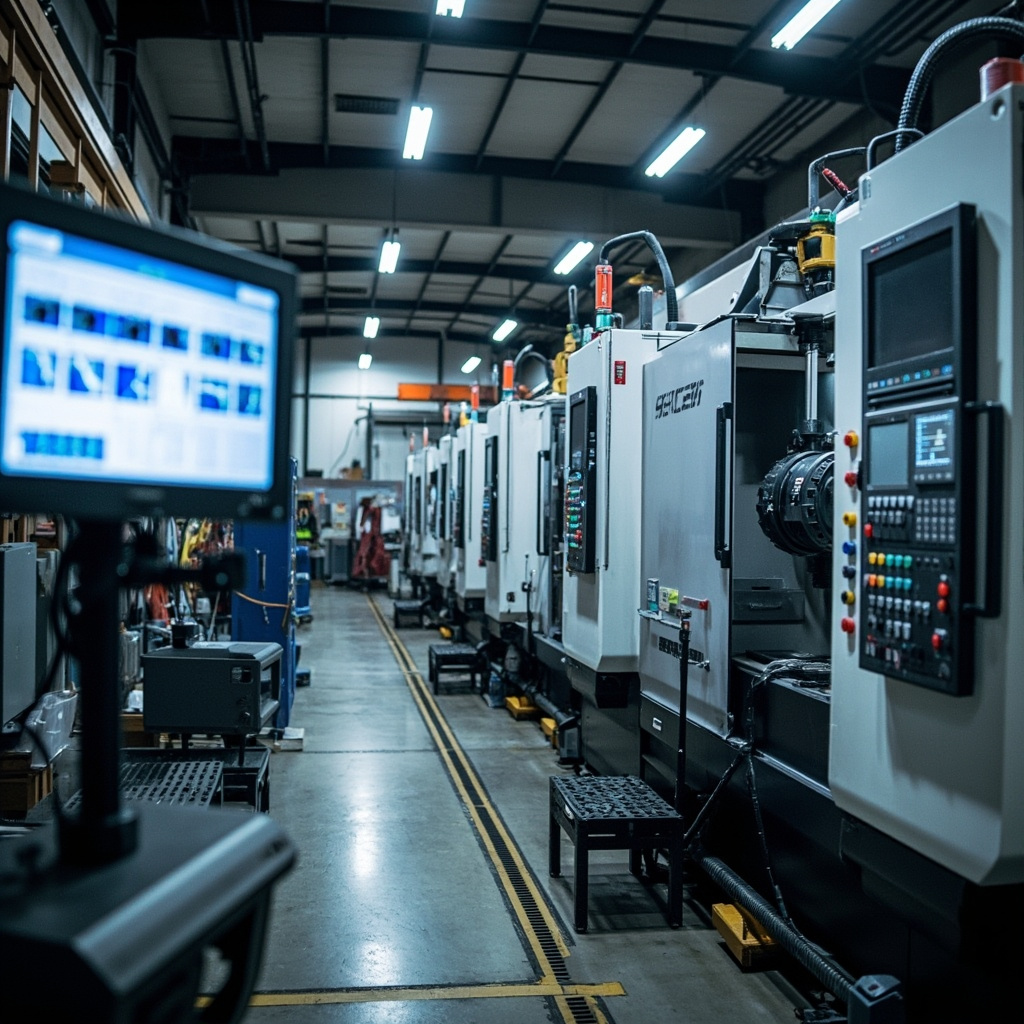
Industrial Applications & Service Specialization
Different industries demand different things from a CNC machining service. A shop that crushes it on automotive brackets might be completely out of their depth on medical implant tooling. Here’s how industry specialization maps to what you should look for:
| Industry | Typical Application | Critical Material | Key Service Requirement | nylonplastic.com Advantage |
|---|---|---|---|---|
| Automotive | Engine components, EV battery housings, custom aftermarket parts, transmission parts | 6061-T6, 4140 Steel, Cast Iron | PPAP documentation, high-volume consistency, JIT delivery | Production-ready process control with full PPAP support and Kanban-managed inventory |
| Aerospace | Structural airframe brackets, hydraulic manifold blocks, turbine blade fixturing | Ti-6Al-4V, 7075-T6, Inconel 625/718 | AS9100/ISO 9001, full material traceability, FAI per AS9102, NADCAP finishing | Complete certification package: material certs + CMM reports + serial number tracking per part |
| Medical Device | Surgical instrument handles, implant prototyping, diagnostic equipment chassis | 316LVM Stainless, PEEK, UHMWPE, Titanium Grade 5 ELI | Biocompatibility validation, cleanroom-ready finishing, ISO 13485 awareness | Surface finishing expertise for medical-grade Ra requirements, passivation & electropolishing |
| Electronics | RF amplifier housings, thermal management plates, EMI-shielded enclosures, connector bodies | 6061-T6, Copper C110, Engineering Plastics | Tight flatness, fine threading, conductive surface treatments, rapid prototyping | Combined CNC + injection molding for complete electronic enclosures — no multi-vendor coordination |
| Industrial Equipment | Pump volutes, hydraulic manifolds, wear-resistant liners, gearbox components | Ductile Iron, 17-4 PH, 4140 HT, Wear-Grade Nylon | Heavy stock removal capability, large-part capacity, durability testing data | Material selection hub ensures correct alloy + heat treat for your operating environment |
| Robotic Automation | End-of-arm tooling, lightweight structural arms, sensor brackets, harmonic drive components | 7075-T6, Carbon-Fiber-Reinforced Nylon, 17-4 PH H900 | Mass optimization, modular fixturing, fast design iteration, multi-process integration | Hybrid CNC + 3D printing + injection molding approach optimizes weight, cost, and stiffness |
The takeaway: don’t assume any CNC shop can handle any industry. The documentation, certification, and process control requirements for an aerospace part are fundamentally different from an industrial bracket. Ask about industry-specific experience. A shop that’s done work in your industry before will spot potential issues your drawing doesn’t capture.
Material Selection — What Actually Works with CNC Machining Services
The material availability reality: A CNC machining service’s quoted lead time often depends more on material availability than machine capacity. 6061 aluminum is almost always in stock. 7075-T7351 in specific thicknesses can take weeks. Inconel 718 plate in the size you need might be a special mill run. Good shops will be upfront about material lead times — if they quote the same lead time for aluminum and Inconel, they either have it in stock or they’re not being honest.
What shops wish you knew about materials:
- 6061-T6 aluminum: Most shops cut this in their sleep. Fast machining, wide tool selection, predictable behavior. If 6061 works for your part, use it. Your quote will be lower, your lead time shorter, and your scrap rate minimal.
- Stainless 304: Gummy. Work-hardens if you look at it wrong. Requires experienced mers who know conservative feeds and speeds. Expect higher quotes — it takes 2-3x longer to machine than aluminum.
- Titanium: Slow cutting speeds (the material retains heat and destroys tools if pushed too hard), expensive tooling, expensive material. A part that takes 30 minutes in aluminum might take 2 hours in titanium. Budget accordingly.
- PEEK: Expensive raw material, but machines fast and cleanly. The shop’s real concern is material waste — a ming mistake on a block of PEEK is a painful lesson in economics. Shops with plastic experience know to conservatively and verify s before cutting.
- Delrin (Acetal): A machinist’s best friend among plastics. Cuts like butter, holds tight tolerances, low internal stress. If your application allows it, Delrin is the answer. It’s also significantly cheaper than PEEK.
At nylonplastic.com, our Material Selection Hub walks you through the decision systematically. But the bottom line is this: the best material for machining isn’t always the best material for your application. A good service partner helps you navigate that trade-off honestly.
Cost & Performance Trade-offs — The Honest Breakdown
Let’s talk about what CNC machining services actually cost — and why two shops quoting the same part can have wildly different prices.
What’s in a CNC machining quote:
- ming & setup (fixed cost): Creating the CAM , designing and building s, loading tools into the machine, and running the first article. This cost is the same whether you order 1 part or 1,000. It’s why prototypes feel expensive — you’re paying for all the upfront work concentrated into a few parts.
- Machine time (variable cost): The actual cutting time multiplied by the shop’s hourly rate. 3-axis machining typically runs $60-120/hour. 5-axis runs $120-200/hour. These rates include operator labor, tooling consumption, coolant, and machine amortization — not just electricity.
- Material cost (variable): Raw material plus the shop’s handling markup. Shops buy material in bulk and mark it up to cover storage, cutting, and inventory carrying costs. Expect 15-30% over mill-direct pricing.
- Post-processing & finishing (optional): Deburring, anodizing, plating, heat treating, painting, powder coating. Each adds cost and lead time. Some shops do this in-house; most outsource it. In-house finishing is generally faster and more accountable, which is why nylonplastic.com keeps surface finishing capabilities under our own roof.
- & documentation (variable): Basic dimensional verification is usually included. Full FAI with CMM reports, material certs, and serial number tracking costs extra. Budget 10-25% more if you need aerospace-level documentation.
Why quotes vary so much:
Shop A quotes $85/part. Shop B quotes $210/part. Same drawing. Here’s what could be happening:
- Shop A is quoting with standard tolerances; Shop B is quoting to hold your called-out ±0.001″ everywhere. Shop A might not have noticed the tight tolerance. Shop B did — and priced it.
- Shop A is using 6061-T6; Shop B is pricing 7075-T6 because your application requires it and they asked what the part does.
- Shop A has open machine time they need to fill; Shop B is running at 95% capacity.
- Shop A is 3-axis with multiple setups; Shop B is 5-axis with one setup. The 5-axis part might actually be better despite the higher quote.
- Shop A plans a quick caliper check; Shop B is budgeting CMM time on every critical dimension.
The lowest quote is rarely the best value. The question is: what’s included in each quote that the other didn’t capture? Always ask shops to explain their pricing assumptions.
Quality Standards & How to Evaluate a CNC Machining Service
Here’s how you separate shops that talk about quality from shops that live it:
1. Look at their equipment — not their machines.
Ask what CMM they use and when it was last calibrated. A Zeiss or Mitutoyo CMM with annual calibration tells you they take measurement seriously. A shop that says “our guys check parts with calipers” is fine for non-critical brackets and not fine for anything else.
2. Certification depth matters.
ISO 9001 is the table stakes. It means they have a documented quality system. But ISO 9001 doesn’t tell you whether they actually follow it when nobody’s looking. AS9100 (aerospace) and ISO 13485 (medical) are more rigorous. If a shop has invested in these certifications, they’ve demonstrated real commitment to process control — not just document management.
3. Ask about their scrap rate.
Every shop scraps parts. The question is whether they track it and learn from it. A shop that says “we don’t scrap parts” is lying to you. A shop that says “our internal scrap rate is 1.2% and here’s what we do when it trends above 1.5%” is running a real quality system.
4. Check their communication before you order.
5. Visit if you can. Virtual tour if you can’t.

Getting Started — How to Vet and Onboard a CNC Machining Service
Here’s the practical playbook for finding and vetting a CNC machining service that won’t let you down:
Step 1: Define your requirements before you contact anyone.
- Quantity range: 1-10, 10-100, 100-1,000, 1,000+?
- Material(s): Known or need guidance?
- Critical tolerances: Which features actually matter?
- Required certifications: ISO 9001, AS9100, ISO 13485, ITAR?
- Timeline: Hard deadline or flexible?
- Budget range: Ballpark — is this a $500 project or a $50,000 project?
Step 2: Send the same RFQ package to 3-5 shops.
Same drawing, same quantities, same requirements. This lets you compare apples to apples and see who asks the right questions. Don’t just compare prices — compare the quality of their response. A shop that sends back a detailed quote with DFM notes and questions is worth more than a shop that sends back just a number.
Step 3: Evaluate quotes on total value, not unit price.
Step 4: Start with a small test order.
Don’t hand a new shop a 5,000-part production order on day one. Start with a prototype or small pilot run — 5 to 50 parts. Evaluate their quality, communication, and delivery before scaling up. This is the cheapest insurance you’ll ever buy against a bad supplier relationship.
Step 5: Debrief after the first order.
What went well? What could have been better? A good shop wants this feedback. A great shop will proactively ask for it. The shops that get defensive about feedback are the ones you don’t want as long-term partners.
At nylonplastic.com, we make this process straightforward: upload your design through our one-stop manufacturing portal, get DFM feedback within 24 hours, and receive a transparent quote that breaks down what you’re paying for. No mystery surcharges, no bait-and-switch on materials, no “we’ll figure it out after we get the PO.”
Conclusion
Choosing a CNC machining service isn’t that different from hiring an employee. You’re looking for competence, communication, and character — and the cheapest option rarely delivers all three.
The shops worth working with will push back on your drawing. They’ll ask what the part does. They’ll tell you when a tolerance is unnecessarily tight or a material is unnecessarily expensive. They’ll quote honestly — not low to win the work and then hit you with change orders later.
At nylonplastic.com, that’s how we operate. We’re not the cheapest CNC machining service you’ll find, and we won’t pretend to be. But we’ll give you honest DFM feedback, transparent pricing, certified quality, and — when your part would be better served by injection molding or 3D printing — we’ll tell you that too. Because we do all of it under one roof, we have no reason to push you toward a process that isn’t right.
That’s the difference between a vendor and a partner. And in manufacturing, partners are worth their weight in titanium.
Find Your CNC Machining Partner
Upload your CAD file and tell us about your project. You’ll get honest DFM feedback within 24 hours, a transparent quote that shows exactly what you’re paying for, and practical advice from engineers who’ve been in your shoes. No sales pitch, no pressure, no “let me check with my manager.” Just straight answers from people who make parts every day.
FAQ
When is CNC Machining Services: How to Choose the Right Partner for Your Parts the right choice?
CNC Machining Services: How to Choose the Right Partner for Your Parts is the right choice when the part requires machined accuracy, controlled surfaces, repeatable features, and a material that can be cut reliably.
What should be confirmed before ordering CNC Machining Services: How to Choose the Right Partner for Your Parts?
Confirm the drawing version, material grade, tolerances, quantity, critical dimensions, surface finish, and inspection requirements before production starts.
What usually drives cost in CNC Machining Services: How to Choose the Right Partner for Your Parts?
Cost is usually driven by material, setup time, machine time, tolerance difficulty, fixturing, tool access, finishing, inspection, and order quantity.
How can quality risk be reduced in CNC Machining Services: How to Choose the Right Partner for Your Parts?
Quality risk is reduced by marking critical features clearly, avoiding unnecessary tight tolerances, confirming manufacturability early, and using inspection data for important dimensions.
Related Reading
- CNC Machining Services — Full Capability Overview
- CNC Machining Materials — Metals & Engineering Plastics Guide
- Material Selection Hub — Interactive Guide for Engineers
- One-Stop Manufacturing — CNC, Injection Molding, 3D Printing & More
- CNC Milling Services: 3-Axis vs 5-Axis and What Your Parts Actually Need
- Online CNC Machining Services: From Upload to Delivery — How the Process Works
- Deburring in CNC Machining: Methods, Standards, and What Your Parts Actually Need