
| Property | Test Method | LCP GF30 (Type II) | LCP Unfilled (Type II) |
|---|---|---|---|
| Density | ISO 1183 | 1.62 g/cm³ | 1.40 g/cm³ |
| Melting Temperature | ISO 11357 | 280°C | 280°C |
| HDT @ 1.80 MPa | ISO 75 | 240–260°C | 190–210°C |
| Tensile Modulus (flow direction) | ISO 527 | 15,000 MPa | 10,000 MPa |
| Tensile Modulus (transverse) | ISO 527 | 5,000 MPa | 3,000 MPa |
| Tensile Strength (flow direction) | ISO 527 | 180 MPa | 180 MPa |
| Tensile Strength @ 200°C | ISO 527 | ~150 MPa | N/A |
| Elongation at Break | ISO 527 | 1.5–2.5% | 1.5–3.0% |
| Flexural Modulus | ISO 178 | 13,000 MPa | 9,000 MPa |
| Charpy Notched Impact +23°C | ISO 179/1eA | 15–25 kJ/m² | 20–30 kJ/m² |
| CTE (flow direction) | ISO 11359 | 1–3 × 10⁻⁶/°C | 1–5 × 10⁻⁶/°C |
| CTE (transverse) | ISO 11359 | 15–30 × 10⁻⁶/°C | 25–50 × 10⁻⁶/°C |
| Water Absorption (23°C, 24h) | ISO 62 | < 0.05% | < 0.05% |
| Flammability (UL94) | UL94 | V-0 @ 0.2 mm | V-0 @ 0.2 mm |
| Mold Shrinkage (flow) | ISO 294-4 | 0.0–0.2% | 0.0–0.3% |
| Mold Shrinkage (transverse) | ISO 294-4 | 0.4–0.7% | 0.5–0.9% |
| Dielectric Constant @ 1 GHz | IEC 60250 | 3.5–4.0 | 3.0–3.5 |
| Dissipation Factor @ 1 GHz | IEC 60250 | 0.005–0.010 | 0.003–0.008 |
LCP vs. PPS vs. PEEK: High-Temperature Thermoplastics Showdown
LCP liquid crystal polymer materials are selected when engineers need thin walls, low warpage, and high dimensional precision.
LCP, PPS, and PEEK are the three most frequently cross-shopped materials in the >200°C thermoplastic space. The table below shows why none of them displaces the others entirely — each material has a performance-cost profile that matches a specific application envelope.
| Property | LCP GF30 | PPS GF40 | PEEK 30% GF |
|---|---|---|---|
| Density | 1.62 g/cm³ | 1.65 g/cm³ | 1.49 g/cm³ |
| HDT @ 1.80 MPa | 240–260°C (Type II) 300–350°C (Type I) |
265°C | 315°C |
| Continuous Use Temp | 200–240°C (Type II) 260–300°C (Type I) |
200–220°C | 250°C |
| CTE (flow direction) | 1–3 × 10⁻⁶/°C | 15–25 × 10⁻⁶/°C | 15–25 × 10⁻⁶/°C |
| Tensile Modulus @ 200°C | ~10,000 MPa | ~12,000 MPa | ~8,000 MPa |
| Tensile Strength @ 200°C | ~150 MPa | ~130 MPa | ~120 MPa |
| Impact Toughness @ RT | Low (15–25 kJ/m²) | Moderate (25–40 kJ/m²) | High (50–70 kJ/m²) |
| Flammability | V-0 inherent (no additives) | V-0 (with additives) | V-0 (with additives) |
| Water Absorption | < 0.05% | 0.03% | 0.1% |
| Chemical Resistance | Excellent (acids, solvents) | Excellent (nearly universal below 200°C) | Excellent (except strong acids) |
| Weld Line Strength | Poor (inherently weak) | Fair | Good |
| Wall Thickness Minimum | 0.1 mm | 0.3 mm | 0.5 mm |
| Processing Temp | 300–350°C | 320–340°C | 380–400°C |
| Mold Temp | 80–120°C | 130–150°C | 170–200°C |
| Relative Cost / kg | $$$ | $$ | $$$$ |
| Best For | Ultra-thin-wall electronics, CTE-critical, SMT | Chemical plant, hot water, structural | Maximum toughness, medical implants, structural aerospace |
Decision Rules
- Choose LCP when: You need CTE near steel (1–3 ppm/°C), walls thinner than 0.3 mm, or inherent V-0 without property trade-offs. Electronics connectors, SIM trays, and 5G antenna substrates are LCP’s home turf.
- Choose PPS when: Chemical resistance is paramount (especially hot water, steam, or aggressive acids at 150°C+), you need better toughness than LCP, and CTE is less critical. PPS is also roughly 30–40% cheaper per kilogram than LCP.
- Choose PEEK when: Toughness is non-negotiable, continuous use approaches 250°C, or biocompatibility is required. PEEK is the only option in this group for load-bearing medical implants, and it tolerates steam sterilization better than either LCP or PPS.
LCP Commercial Grade Selector
| Manufacturer | Brand | Grade | GF % | Type | Key Feature | Typical Application |
|---|---|---|---|---|---|---|
| Celanese | Vectra | A130 | 30% | II | General-purpose GF30, standard flow | Connectors, bobbins, coil forms |
| Celanese | Vectra | E130i | 30% | II | Improved weld-line strength, higher toughness | Complex connector geometries |
| Celanese | Vectra | A150 | 50% | II | Maximum stiffness, lowest shrinkage | High-rigidity structural electronics |
| Celanese | Vectra | A230 | 30% carbon fiber | II | Conductive, high stiffness | ESD-sensitive electronics |
| Celanese | Vectra | E820i Pd | 40% (GF+mineral) | II | Platable grade, LDS-compatible | 3D-MID circuits, antenna substrates |
| Celanese | Vectra | E830i Pd | 30% GF | II | Platable, FDA compliant | Medical device housings |
| Celanese | Zenite | 6130L | 30% | II | Low warp, balanced flow | SMT connectors, DDR sockets |
| Celanese | Zenite | 6145L | 45% | II | Low warp, high stiffness | Long, thin connectors |
| Polyplastics | Laperos | A130 | 30% | II | Standard GF30, high flow | Consumer electronics |
| Solvay | Xydar | G-930 | 30% | I | Type I GF30 — 300°C+ HDT | Oven components, aerospace connectors |
| Solvay | Xydar | G-945 | 45% | I | Type I max stiffness | High-temp structural |
| Sumitomo | SUMIKASUPER | E6000 | 30% | II | Ultra-low dielectric for 5G | 5G antenna substrates, mmWave |
| Toray | Siveras | LX70G30 | 30% | II | Improved toughness GF30 | USB-C connectors, camera modules |

Processing LCP: Injection Molding Parameters
| Parameter | Recommended Value | Notes |
|---|---|---|
| Pre-drying | 140–160°C for 4 hours | Desiccant dryer required. Target moisture < 0.01% |
| Melt Temperature | 300–350°C | Type II grades; Type I requires 350–400°C |
| Mold Temperature | 80–120°C | Lower than PPA or PEEK — water-heated molds often sufficient |
| Injection Speed | Fast | LCP solidifies rapidly — fill speed is critical for thin walls |
| Holding Pressure | 40–60 MPa | LCP shrinkage is near-zero in flow direction; pack lightly |
| Residence Time | Minimize (≤ 10 min) | LCP is thermally stable but extended residence reduces properties |
LCP liquid crystal polymer materials are selected when engineers need thin walls, low warpage, and high dimensional precision.
Critical processing insights:
- Weld lines are the Achilles’ heel: LCP’s highly oriented molecular structure creates inherently weak weld lines — strength at a weld line can be 30–50% of the bulk value. Gate placement is more consequential for LCP than for any other engineering thermoplastic. When possible, design parts to avoid weld lines in load-bearing regions, or use multi-gate sequential valve gating to knit fronts under pressure.
- Drying is mandatory: Although LCP absorbs almost no water at room temperature, any surface moisture on pellets hydrolyzes the polymer at 330°C. The 0.01% moisture target is stricter than for most engineering polymers.
- Anisotropy is designed-in: LCP’s mechanical properties are inherently anisotropic — strong in the flow direction, weaker transversely. Part design must account for this. Where isotropy is needed, consider mineral-filled or specialty grades, but expect a stiffness penalty.
- Low shrinkage, high precision: Near-zero shrinkage in the flow direction means LCP molds can hold extraordinarily tight tolerances — but this also means the mold cavity must be cut to essentially final dimensions. No “sizing factor” allowance like with polyolefins.
- Fast cycle times: LCP solidifies almost instantly upon contacting the mold wall. Cycle times of 2–5 seconds for small electronic connectors are routine — this is LCP’s single greatest processing advantage.
Key LCP Applications
| Industry | Application | Driving Property |
|---|---|---|
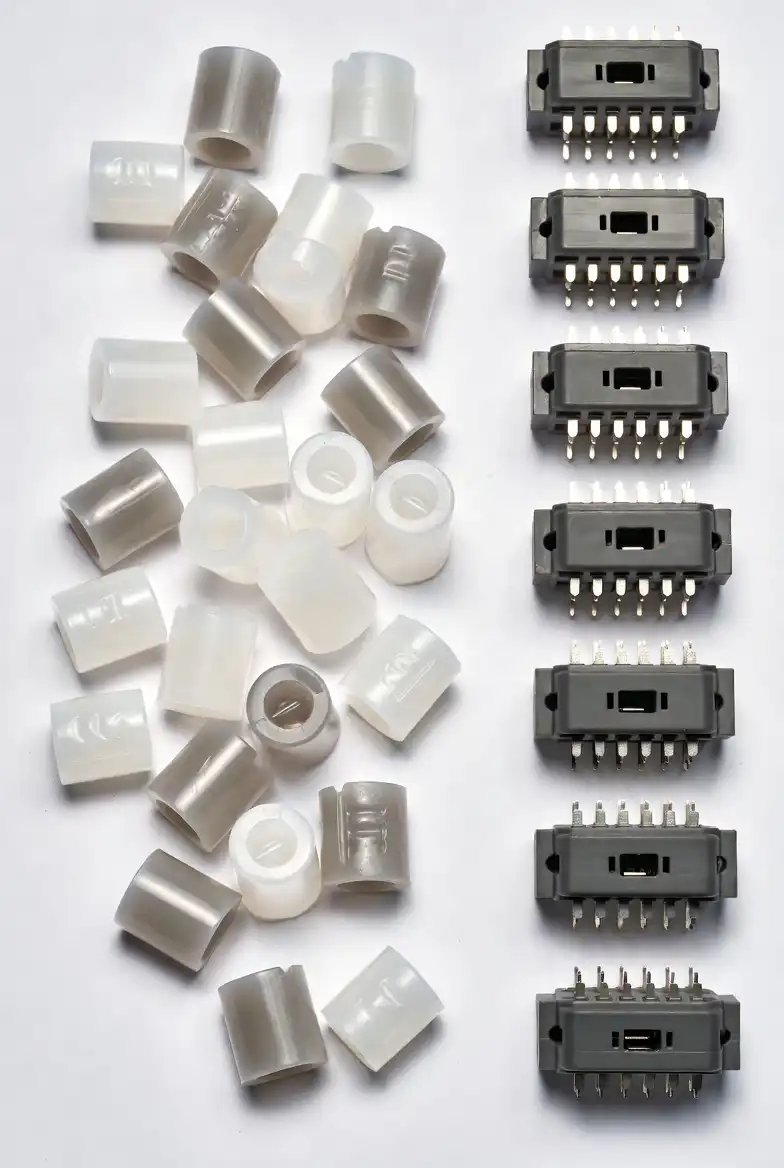
| Consumer Electronics | SIM card trays, USB-C connectors, DDR memory sockets, camera module housings | Thin-wall (0.1–0.3 mm), V-0, survives reflow, CTE match to copper |
| 5G / Telecommunications | Antenna substrates, mmWave lens arrays, base station connector bodies | Low Dk/Df at GHz frequencies, dimensional stability |
| Automotive | Ignition coil bobbins, transmission speed sensors, relay bases | Heat resistance, oil resistance, electrical insulation |
| Medical | Surgical instrument handles, dental tool bodies, catheter components | Steam sterilizable, chemical resistance, dimensional precision |
| Fiber Optics | Optical fiber connectors (MT, MPO ferrules), alignment sleeves | CTE match to glass fiber, micromolding precision |
| Aerospace | High-temperature connector inserts, waveguide components, radome structures | Type I grades: 300°C+ service, low outgassing, lightweight |
| Industrial | Pump wear rings, chemical valve seats, bearing cages (high-temp) | Chemical resistance at 150°C+, dimensional stability in aggressive media |

LCP Limitations
- Weld line weakness: This cannot be overstated. If your part has converging melt fronts in a stressed area, LCP is probably not the right material. Weld line strength in LCP is worse than PPS, far worse than PA66.
- Low impact toughness: Unfilled and GF LCP grades are inherently brittle. Charpy notched values of 15–25 kJ/m² make them unsuitable for snap-fit applications or parts subject to impact loads.
- Anisotropic properties: Tensile modulus can vary 3:1 between the flow direction and transverse direction. This is manageable when the mold designer knows it, but problematic if the part was designed for an isotropic material.
- Cost: LCP costs 3–6× a standard PA66 GF30 and roughly 2× PPS GF40. You are paying for the unique combination of CTE, thin-wall capability, and inherent V-0.
- Limited colorability: LCP is typically black or natural. Light colors are difficult due to the high processing temperatures.
- Notch sensitivity: LCP’s sharp notches propagate cracks readily. Avoid sharp internal corners in part design.
What Is LCP?
LCP liquid crystal polymer materials are selected when engineers need thin walls, low warpage, and high dimensional precision.
LCP (Liquid Crystal Polymer) occupies a unique position in the engineering polymers hierarchy. It is not a nylon, not a polyester in the conventional sense, and not a filled compound — LCP is a wholly aromatic polyester that forms ordered, rod-like molecular structures in the melt state. When LCP flows into a mold, those rigid molecular rods align along the flow direction, giving the molded part an effect analogous to self-reinforcement: tensile modulus and strength along the flow axis far exceed what the resin’s density and composition suggest.
LCP liquid crystal polymer materials are selected when engineers need thin walls, low warpage, and high dimensional precision.
The practical result: HDT values exceeding 300°C, thermal expansion coefficients comparable to steel (1–3 × 10⁻⁶/°C), wall-thickness capability down to 0.1 mm, and inherent UL94 V-0 flammability without additive loading. No other thermoplastic combines this set of properties at LCP’s price point.
LCP liquid crystal polymer materials are selected when engineers need thin walls, low warpage, and high dimensional precision.
For engineers and buyers searching for LCP datasheets, Vectra vs Zenite grade comparisons, LCP vs PPS vs PEEK selection guidance, or LCP thin-wall molding parameters, this page consolidates the key specifications, grades, processing windows, and application data.
LCP Type Classification: I, II, III
LCP liquid crystal polymer materials are selected when engineers need thin walls, low warpage, and high dimensional precision.
The LCP family is divided into three types based on heat deflection temperature (HDT), which is driven by the monomer chemistry and resulting backbone rigidity.
| Type | HDT Range (°C) | Base Chemistry | Example Brand | Key Feature | Typical Use |
|---|---|---|---|---|---|
| Type I | 250–350 | Para-hydroxybenzoic acid + biphenol + terephthalic acid | Xydar (Solvay), Ekonol | Highest heat resistance, can survive 300°C+ continuous | Ovenware, aerospace, high-temp connectors |
| Type II | 180–240 | Para-hydroxybenzoic acid + 6-hydroxy-2-naphthoic acid | Vectra (Celanese), Zenite (Celanese) | Best balance of processability, properties, and cost | Electronics connectors, SMT, 5G components |
| Type III | 60–210 | Ethylene terephthalate + para-hydroxybenzoic acid | X7G, Rodrun | Lowest cost, lowest heat — used where flow matters more than T | Thin-wall consumer goods, fibers |
LCP liquid crystal polymer materials are selected when engineers need thin walls, low warpage, and high dimensional precision.
In practice, Type II (Vectra/Zenite) dominates commercial injection molding — roughly 80% of LCP consumption falls here. Type I is reserved for the highest-temperature applications where cost is secondary. Type III has largely been displaced by Type II as processors gained experience with the higher-temperature grades.
LCP GF30 Typical Properties

LCP Engineering Notes
LCP Meaning and Melt Structure
LCP liquid crystal polymer materials are selected when engineers need thin walls, low warpage, and high dimensional precision.
LCP stands for Liquid Crystal Polymer. The name comes from the material’s unique behavior: even in the molten state, LCP molecules maintain a degree of orientational order (a “liquid crystalline” phase), unlike conventional polymers whose molecules are randomly coiled when melted. This liquid-crystalline melt structure is what gives LCP its extreme flowability, self-reinforcing properties, and low thermal expansion.
LCP Type I, II and III
LCP liquid crystal polymer materials are selected when engineers need thin walls, low warpage, and high dimensional precision.
The three types are distinguished by heat deflection temperature (HDT): Type I (250–350°C, e.g., Xydar) for the highest-temperature applications like aerospace; Type II (180–240°C, e.g., Vectra, Zenite) for general-purpose electronics and automotive, which represents the majority of commercial LCP consumption; and Type III (60–210°C, e.g., X7G) which is a lower-cost variant now mostly displaced by Type II.
LCP and PEEK Selection Boundary
LCP liquid crystal polymer materials are selected when engineers need thin walls, low warpage, and high dimensional precision.
“Better” depends on the requirement. LCP has higher flow-direction stiffness at 200°C, lower CTE (1–3 vs. 15–25 ppm/°C), faster cycle times (2–5 seconds vs. 30+ seconds), and lower per-kilogram cost than PEEK. PEEK has dramatically better impact toughness (50–70 vs. 15–25 kJ/m²), higher continuous-use temperature (250°C vs. 200–240°C), and weld line strength far exceeding LCP. If your part has converging melt fronts under load, choose PEEK. If it’s a thin-wall electronic connector needing CTE match and V-0, LCP wins.
LCP Metal-Replacement Applications
LCP liquid crystal polymer materials are selected when engineers need thin walls, low warpage, and high dimensional precision.
In specific applications, yes. LCP’s CTE of 1–3 × 10⁻⁶/°C matches steel and copper better than any other unfilled thermoplastic. This is why LCP has replaced metal in SIM card trays, camera module housings, and optical fiber ferrules — the part maintains dimensional compatibility with metal and glass components across assembly and operating temperatures.
LCP Moisture Absorption
LCP liquid crystal polymer materials are selected when engineers need thin walls, low warpage, and high dimensional precision.
No — and this is one of LCP’s defining advantages. Water absorption is below 0.05%, meaning LCP parts neither swell in humid environments nor require conditioning before use. Combined with its near-zero flow-direction mold shrinkage, this makes LCP the go-to material for parts that must arrive at assembly with tight tolerances regardless of shipping or storage humidity.
LCP Temperature Capability
LCP liquid crystal polymer materials are selected when engineers need thin walls, low warpage, and high dimensional precision.
Type II LCP (Vectra/Zenite) has a continuous-use rating of 200–240°C, with short-term excursions to 260°C for lead-free reflow soldering. Type I LCP (Xydar) can sustain 260–300°C continuous. The melting point for Type II is approximately 280°C; for Type I it exceeds 350°C.
LCP liquid crystal polymer materials are selected when engineers need thin walls, low warpage, and high dimensional precision.
Need LCP pellets, Vectra or Zenite datasheets, or help selecting the right LCP grade? We supply GF-carbon, platable, and low-warp LCP grades from Celanese, Polyplastics, and Sumitomo. Contact us with your part geometry, temperature, and electrical requirements.
Frequently Asked Questions
What makes LCP different from other engineering plastics?
LCP liquid crystal polymer materials are selected when engineers need thin walls, low warpage, and high dimensional precision.
Liquid Crystal Polymer (LCP) has a unique rigid-rod molecular structure that self-reinforces during molding, achieving flow-direction properties comparable to some metals. It offers ultra-high chemical resistance, near-zero moisture absorption (<0.03%), and exceptional thin-wall flowability — enabling wall sections as thin as 0.2mm.
What are the main applications of LCP in electronics?
LCP liquid crystal polymer materials are selected when engineers need thin walls, low warpage, and high dimensional precision.
LCP is the dominant material for high-frequency connectors (5G, USB-C), fine-pitch SMT connectors, relay components, and smartphone internal structural parts. Its low dielectric constant (3.0-3.5) and low dissipation factor at GHz frequencies make it ideal for high-speed signal integrity.
How does Vectra LCP compare to Zenite LCP?
LCP liquid crystal polymer materials are selected when engineers need thin walls, low warpage, and high dimensional precision.
Vectra (Celanese) and Zenite (DuPont/Celanese) are both thermotropic LCP families. Vectra A-series is the general-purpose grade with HDT of ~280°C. Zenite grades are often formulated for enhanced weld line strength and improved flow in complex, multi-gate molds. Both offer similar base properties with grade-specific trade-offs.
Can LCP be used for medical applications?
LCP liquid crystal polymer materials are selected when engineers need thin walls, low warpage, and high dimensional precision.
Yes, certain LCP grades meet USP Class VI and ISO 10993 biocompatibility requirements for short-term patient contact. They are used in surgical instruments, drug delivery device components, and dental tools. LCP’s ability to withstand repeated autoclave sterilization without degradation is a key advantage over many other polymers.
LCP liquid crystal polymer materials are selected when engineers need thin walls, low warpage, and high dimensional precision.
Last updated: June 2026. Datasheet values are typical. Always verify specific grade properties with the manufacturer’s current technical data sheet. Vectra and Zenite are registered trademarks of Celanese. Xydar is a registered trademark of Solvay. PEEK is a registered trademark of Victrex. PPS is sold under various trademarks including Ryton (Solvay) and Fortron (Celanese).