
Nylon mechanical properties are useful only when they are tied to the real part condition. Tensile strength, flexural modulus, creep resistance and moisture uptake all change the way a nylon part behaves in the field.
If humidity or splash exposure matters, pair these properties with our nylon moisture absorption guide and nylon chemical compatibility chart.
For B2B buyers, the wrong mistake is reading a datasheet without asking how the nylon will be loaded, conditioned and measured. Nylon Plastic can help turn the numbers into a material choice.
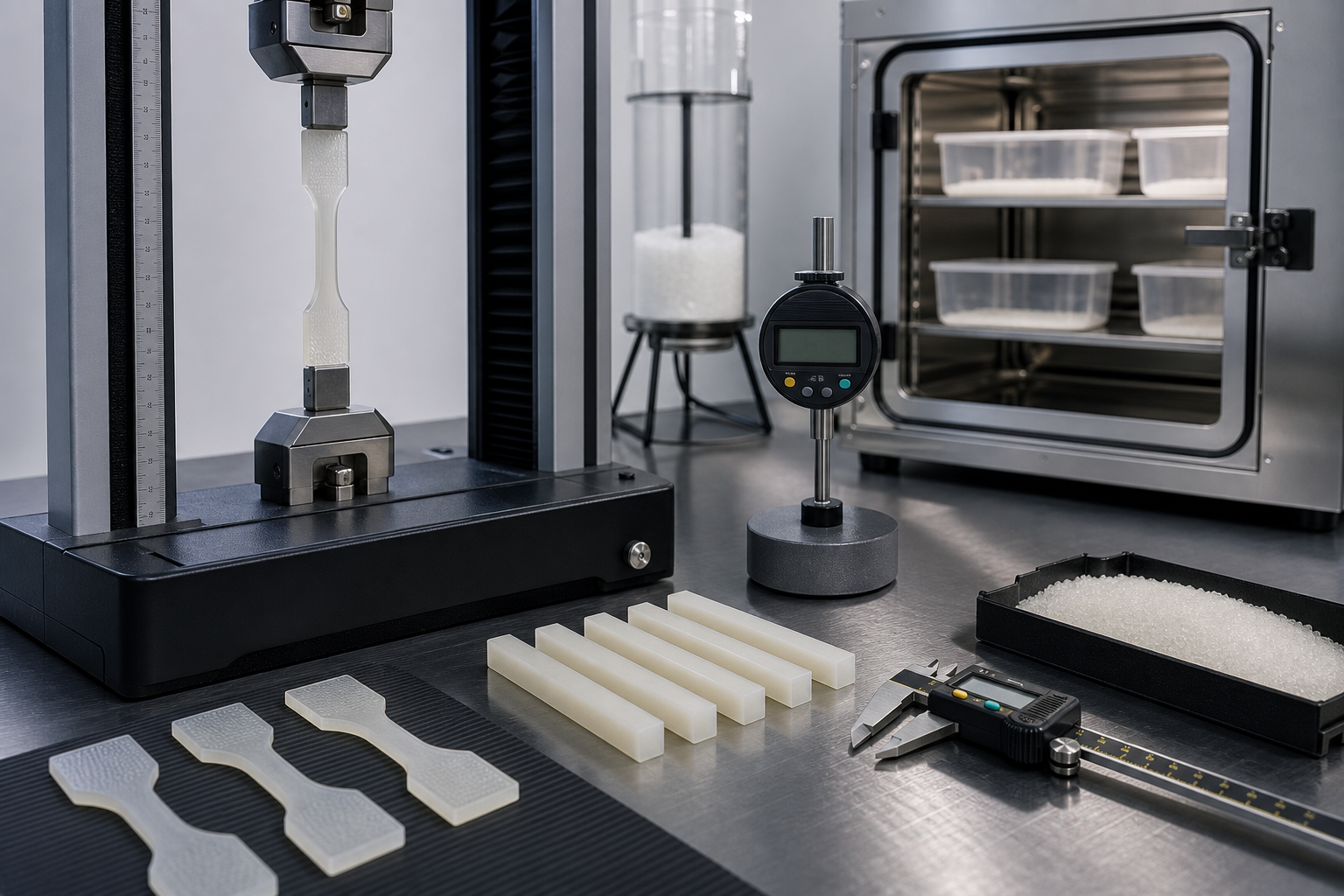
At a Glance
| Property | What It Tells You | Why It Matters |
|---|---|---|
| Tensile strength | How much pull load the material can handle | Important for brackets, clips and supports |
| Flexural modulus | How stiff the part feels in bending | Helps when deflection must stay low |
| Creep | How the part changes under long-term load | Critical for loaded assemblies and fasteners |
| Moisture absorption | How much water the nylon takes up | Changes dimensions and stiffness over time |
| Impact behavior | How the part reacts to sudden loading | Important for snaps and drop-prone parts |
How Nylon Properties Change in Real Use
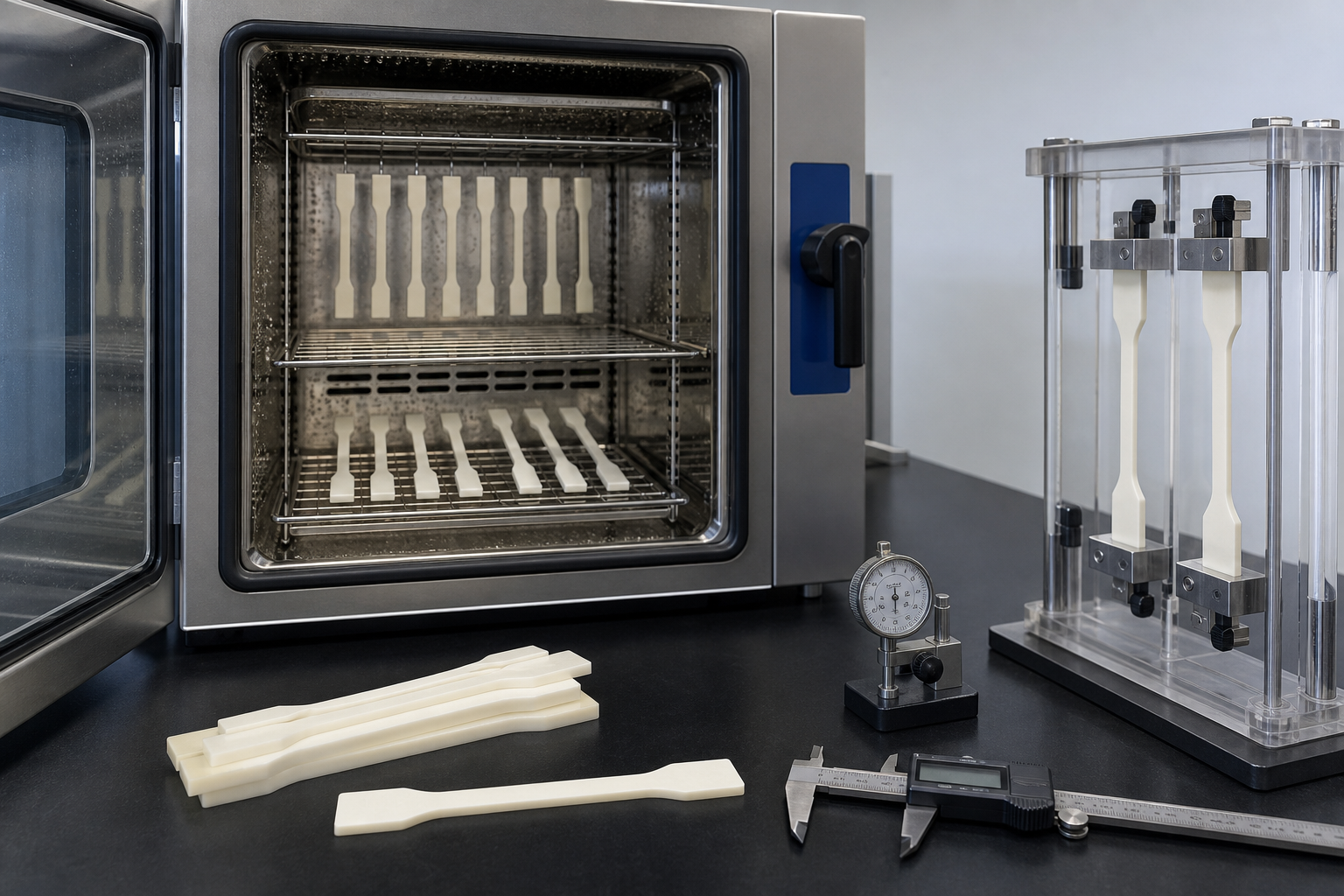
Dry nylon does not behave like conditioned nylon. Moisture usually reduces stiffness while improving toughness, which means a part can look perfect on paper and still move in the field. Temperature, wall thickness, load direction and cycle time also change the result.
What Buyers Should Ask Before Choosing Nylon
- Will the part be loaded once, or will it carry a load for months?
- Will the part live in a dry room, a humid plant or outdoors?
- Does the design need stiffness, toughness or dimensional stability first?
- Will the part be inspected dry, conditioned or after assembly?
- Can the geometry be adjusted to reduce creep and warp risk?
Common Property Misreads
| Misread | Why It Happens | Better Approach |
|---|---|---|
| Using dry data as final performance | Moisture changes nylon behavior | Define the actual conditioning state |
| Chasing tensile strength only | Strength is not the same as stiffness | Check flexural modulus and creep too |
| Ignoring load direction | Nylon is not isotropic in molded parts | Review flow, ribs and gate position |
| Expecting one grade to fit all | PA6, PA66 and PA12 behave differently | Match the grade to use and environment |
How to Turn Data Into a Buying Decision
If stiffness is the main issue, look at flexural modulus and creep. If environmental stability matters more, check moisture behavior and the final assembly condition. If the part is a snap or drop-prone component, toughness and notches matter more than the highest strength number.
Why Choose Nylon Plastic
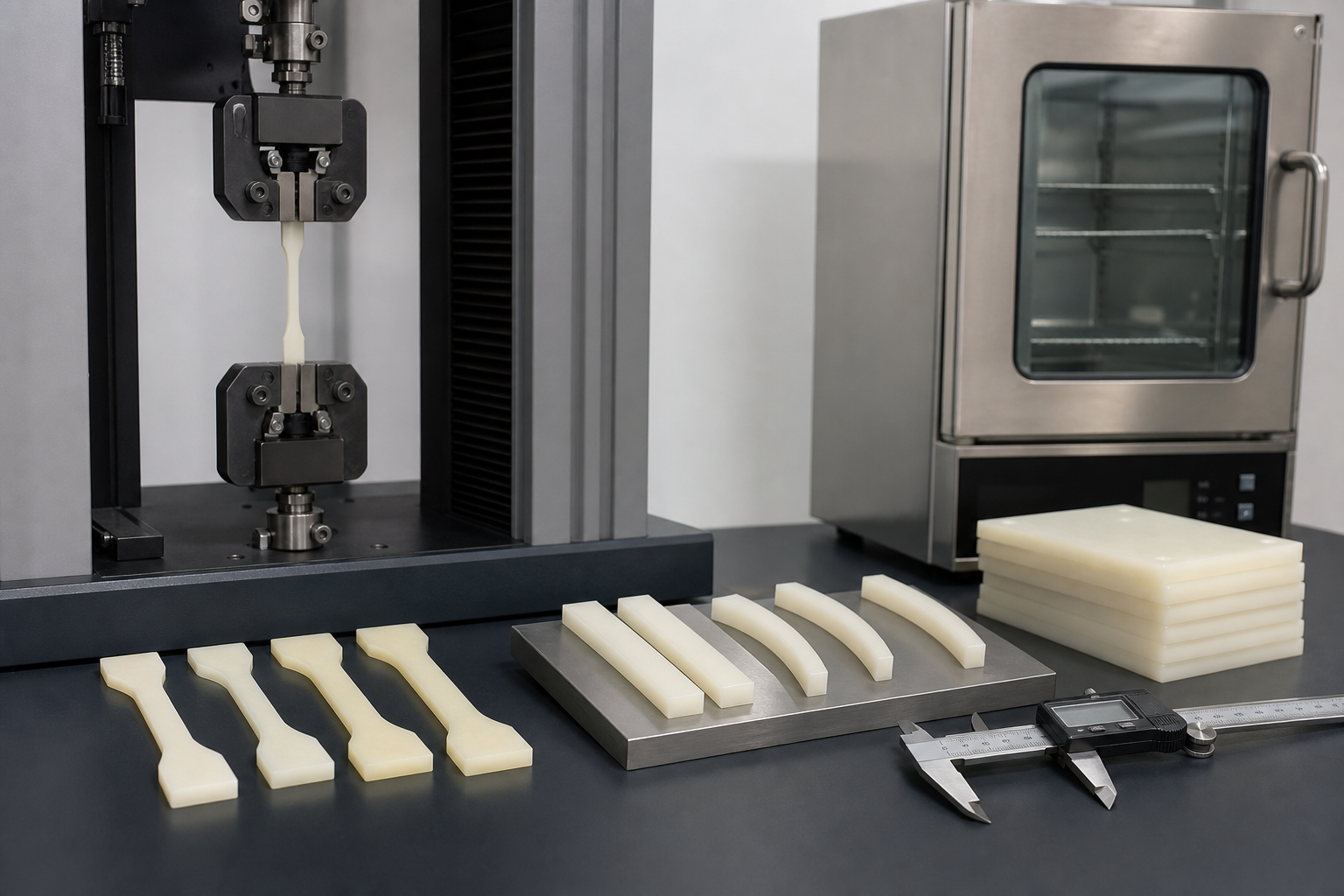
Nylon Plastic helps buyers translate nylon mechanical properties into a practical part choice. That is faster than sorting datasheets alone and safer than guessing from the highest strength value.
Buyer Pain Points When Comparing Mechanical Data
- Dry and conditioned values are mixed in one comparison.
- Flow-direction reinforced data is applied to transverse or weld-line loads.
- Short-term tensile strength is used to predict creep, fatigue, wear, or impact.
- Property targets are not tied to a feature, load case, temperature, or tolerance.
A useful material requirement translates each property into a part-level check. For example, modulus should connect to maximum deflection at a named load; creep should connect to clamp force or fit after a defined time and temperature; impact should identify the notch, direction, and conditioning state; and dimensional stability should identify the humidity and inspection condition. This makes supplier data comparable and prevents an impressive number from replacing a functional acceptance test.
How Nylon Plastic Supports the Review
Nylon Plastic has worked across material modification and finished plastic-part manufacturing since 2005. This allows buyers to connect the resin decision with grade selection, molding orientation, machining condition, and part-level testing rather than approving a grade from a family name or one dry data-sheet value.
- Compare unfilled PA, PA-GF20, and PA-CF30 against the actual failure mode.
- Review custom compounding when a standard grade misses stiffness, impact, color, wear, heat, or compliance requirements.
- Define TDS, COA, moisture, sample approval, traceability, and lot-release requirements before volume ordering.
Related Reading
For detailed PA66 GF30 properties and grade selection, see our glass-filled nylon grade comparison guide covering GF15, GF30, and GF60 stiffness, heat, warpage, and molding data.
Frequently Asked Questions
Which nylon mechanical properties matter most?
Use the property tied to the failure mode: modulus for deflection, creep for sustained load, impact for sudden loading, fatigue for repeated cycles, and conditioned dimensions for fit.
Why does humidity change nylon performance?
Absorbed moisture generally lowers stiffness and strength while increasing toughness and changing dimensions. The magnitude depends on grade and conditioning.
Does reinforcement make nylon stronger in every direction?
No. Glass and carbon fibers create directional behavior. Flow, transverse, and weld-line properties must be considered separately.
What should be sent for a material review?
Send the drawing, load case, temperature, humidity, chemicals, life target, critical dimensions, incumbent grade, and failure evidence.
Request a Nylon Property Review
Send the drawing and failure mode so unfilled PA, GF20, GF30, and CF30 can be compared using the relevant property and moisture state.

