
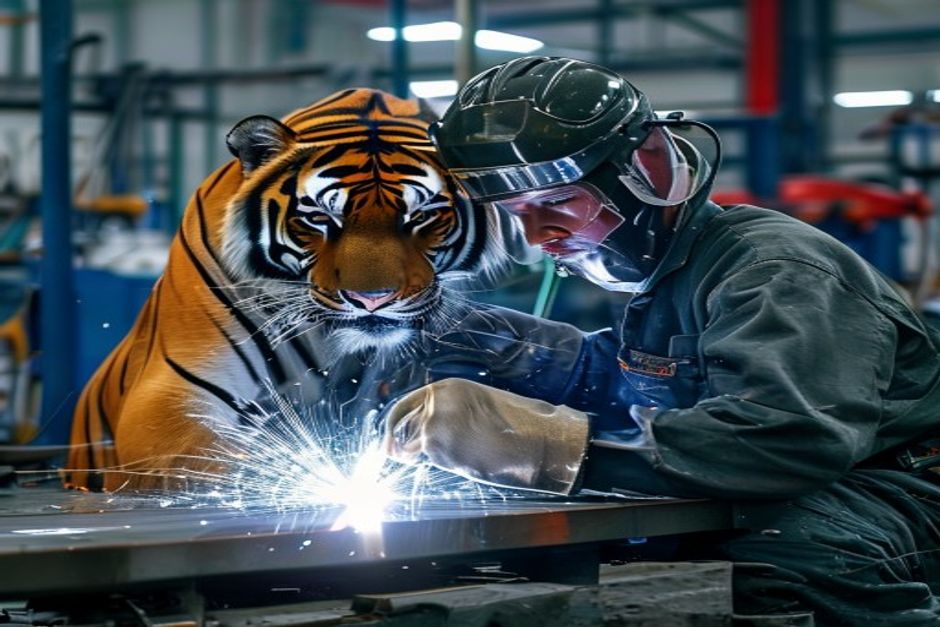
Welding and CNC machining are fundamentally different manufacturing processes that frequently complement each other in production environments. Welding joins materials — primarily metals — through fusion, creating monolithic structures from multiple components. CNC machining removes material from a solid workpiece to achieve precise dimensions and surface finishes. Understanding the strengths, limitations, and typical applications of each process enables informed manufacturing decisions.
Welding: Process Overview
Welding is a fabrication process that joins materials (typically metals or thermoplastics) by applying heat, pressure, or both, with or without filler material. The result is a fused joint with continuous metallurgical or chemical structure across the interface. Common industrial welding processes include:
- MIG (GMAW — Gas Metal Arc Welding): Continuous wire electrode fed through a torch with shielding gas. High deposition rate, suitable for production environments. Primary applications: structural steel fabrication, automotive manufacturing, general fabrication.
- TIG (GTAW — Gas Tungsten Arc Welding): Non-consumable tungsten electrode with manual filler rod. Produces the highest-quality welds with excellent appearance. Primary applications: aerospace, nuclear, food-grade stainless steel, precision piping.
- Stick (SMAW — Shielded Metal Arc Welding): Flux-coated consumable electrode. Rugged, portable, works in outdoor conditions with wind. Primary applications: construction, field repair, pipeline welding.
Welding vs CNC Machining: Comparative Analysis
| Factor | Welding | CNC Machining |
|---|---|---|
| Process Type | Joining (additive-like) | (subtractive) |
| Precision | ±0.030-0.125 inches | ±0.001-0.005 inches |
| Material Efficiency | High (additive, minimal waste) | Moderate (chips, swarf) |
| Speed (large structures) | Fast (welds 20+ feet/day) | Slow (machining from solid billet) |
| Speed (small precision part) | Slow (many small joints) | Fast (minutes per part) |
| Post-Processing Required | Distortion, grinding, stress relief | Deburring only (for most parts) |
The Weld-Machine Integration
In many manufacturing operations, welding and CNC machining are integrated into a sequential workflow:
- Component Preparation: Individual plates, tubes, and forgings are CNC-machined to create weld preparation features (bevels, root faces, alignment features)
- Welding: Components are assembled and welded into the structural form. Tolerances at this stage are ±0.030 inch or more.
- Stress Relief: The weldment undergoes thermal stress relief (typically 1,100-1,200°F for steel) to relieve welding-induced residual stresses that would cause distortion during subsequent machining
- Blanchard Grinding or Face Milling: Critical surfaces are ground or machined flat as reference datums for subsequent machining
- CNC Machining: The weldment is d on previously machined datums, and precision features (bores, bolt circles, mounting pads) are machined to final tolerance
- Final : CMM verification against drawing tolerances
When to Choose Each Process
- Choose Welding for: Large structural assemblies (frames, bases, platforms), joining thick plates (1+ inch), creating closed fabrications (tanks, pressure vessels), field assembly and repair, cost-effective production of structures where precision is not required on weld joints
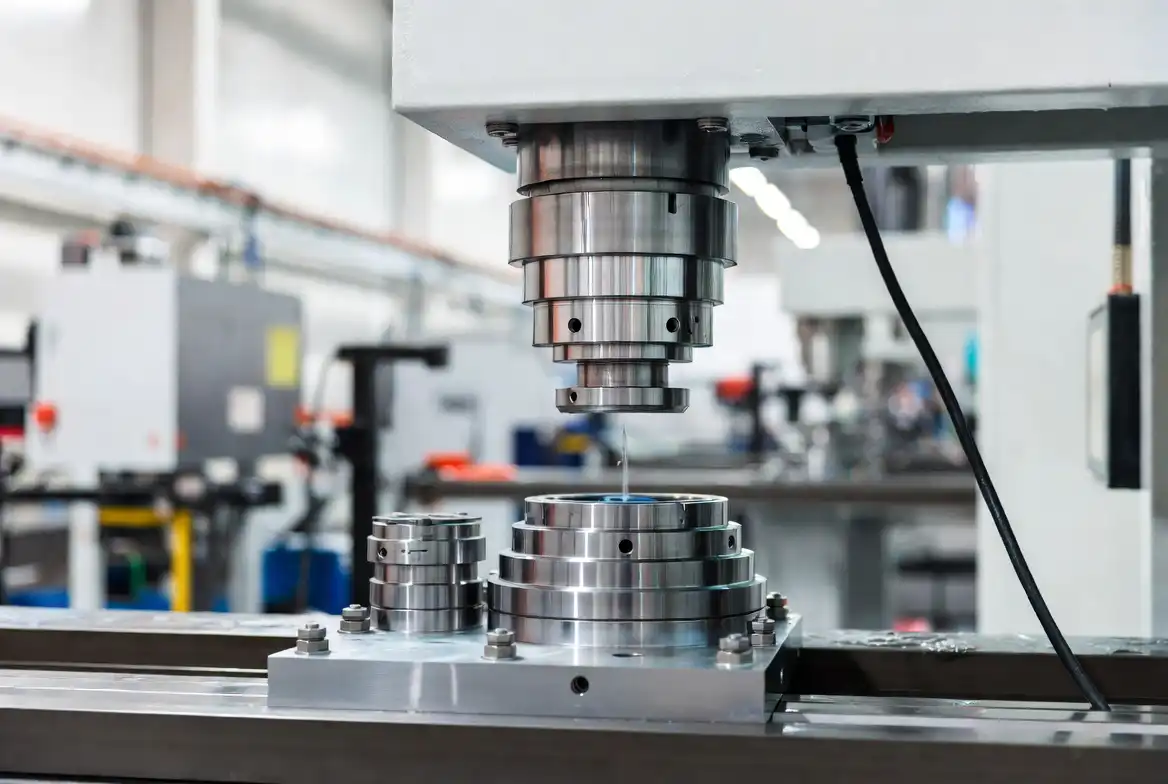
- Choose CNC Machining for: Precision components (±0.001 inch required), complex 3D geometries from solid material, high surface finish requirements, production of interchangeable components, plastic components (cannot be conventionally welded)
- Choose Weld + Machine for: Large precision structures (machine tool bases, CMM frames, aerospace structural components), situations where machining a large solid billet would be prohibitively expensive, mixed-material assemblies requiring precision features
Welding vs CNC Machining: Route Decision Table
| Requirement | Welding | CNC machining |
|---|---|---|
| Geometry | Joins fabricated plates, tubes or formed sections | Removes material from a solid or semi-finished blank |
| Tolerance | Plan distortion, weld shrinkage and post-weld machining | Control tool deflection, workholding and thermal growth |
| Material limit | Heat-affected zone and joint compatibility govern the route | Machinability, residual stress and chip control govern the route |
| Inspection | Visual, NDT and dimensional checks may be required | Use gauges, CMM or process capability checks on critical features |
Choose the route from the finished geometry and acceptance plan. A hybrid weld-plus-machining route can be valid when a fabricated blank reduces material waste but critical interfaces still need machined datums.
FAQ
When is Welding vs CNC Machining: When to Use Each Manufacturing Process the right choice?
Welding vs CNC Machining: When to Use Each Manufacturing Process is the right choice when the part requires machined accuracy, controlled surfaces, repeatable features, and a material that can be cut reliably.
What should be confirmed before ordering Welding vs CNC Machining: When to Use Each Manufacturing Process?
Confirm the drawing version, material grade, tolerances, quantity, critical dimensions, surface finish, and inspection requirements before production starts.
What usually drives cost in Welding vs CNC Machining: When to Use Each Manufacturing Process?
Cost is usually driven by material, setup time, machine time, tolerance difficulty, fixturing, tool access, finishing, inspection, and order quantity.
How can quality risk be reduced in Welding vs CNC Machining: When to Use Each Manufacturing Process?
Quality risk is reduced by marking critical features clearly, avoiding unnecessary tight tolerances, confirming manufacturability early, and using inspection data for important dimensions.

