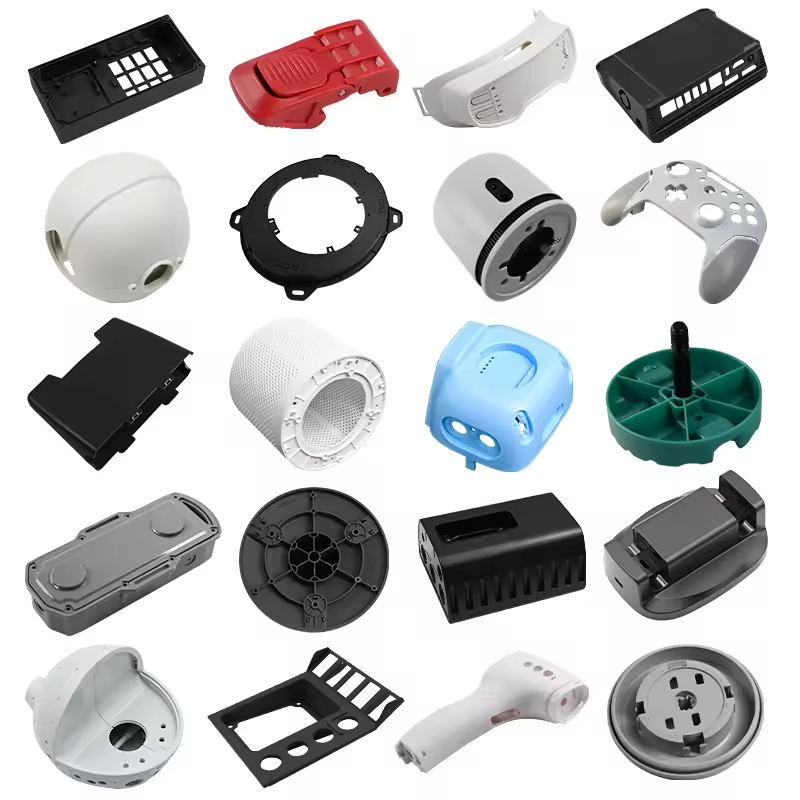
Injection Molding Cost: The Engineering Answer
Injection molding cost is the sum of tooling, recurring production, secondary operations, quality requirements, and logistics. A simple mold may cost only a few thousand dollars, while a hardened multi-cavity production tool with slides, a hot runner, texture, and validation can cost tens of thousands of dollars or more. The correct comparison is therefore not “Which mold quote is lowest?” but “Which quotation produces the lowest controlled cost over the required program volume?”
A reliable comparison starts by normalizing every quotation against the same mold specification, annual volume, resin grade, cycle-time assumption, inspection plan, packaging requirement, and delivery term. If any of those inputs differ, the quoted totals are not directly comparable.
| Decision Question | Cost Driver to Confirm | Why It Changes the Quote |
|---|---|---|
| How many parts are required per year? | Cavity count, mold steel, automation, cycle time | Annual demand determines whether a cheaper single-cavity tool or a higher-output production mold has the lower total cost. |
| What service life must the mold achieve? | Steel grade, hardness, replaceable inserts, wear protection | A prototype tool and a one-million-cycle tool should not be priced or evaluated as equivalent equipment. |
| Which dimensions are critical? | Machining precision, mold alignment, process capability, inspection | Tight tolerances can increase tooling, sampling, metrology, and process-control cost. |
| What does the delivered part include? | Degating, inserts, assembly, marking, inspection, packaging | A low molded-piece price may exclude operations needed to create a shippable finished component. |
Introduction: Why Injection Molding Costs Vary So Dramatically
Two factories quote $3,800 and $11,200 for the same mold. Both say “P20 steel, two-cavity.” What explains a 3x spread? The answer is rarely dishonesty — more often, it is differences in what the quote actually covers: steel certification, cavity hardening, texture depth, ejector pin count, cooling layout, lifetime warranty assumptions, spare insert sets, and post-processing operations that one supplier bundles while the other bills separately.
This guide breaks injection molding costs into a three-bucket model, explains what drives each cost line, gives you 10 questions that instantly separate serious suppliers from time-wasters, and provides reference ranges so you know whether a quote is competitive before you negotiate.

The Three-Bucket Cost Model
Every injection molding project, whether you are ordering 5,000 units or 500,000, breaks down into exactly three cost buckets. Quoting them separately — and refusing lump-sum quotes — is the single most effective tactic for controlling costs.
| Bucket | What It Covers | Typical Share of Total Cost | One-Time or Recurring |
|---|---|---|---|
| Bucket 1: Mold Tooling | Mold base, cavity/core machining, hot runner, ejection, cooling channels, fitting, trial, first-article inspection | 60–85% of first-year spend (low volume) or 10–25% (high volume) | One-time (amortize over project life) |
| Bucket 2: Part Unit Price | Raw material, machine-hour rate, operator labor, electricity, overhead, profit margin | 15–40% of first-year spend (low volume) or 75–90% (high volume) | Recurring per shot |
| Bucket 3: Secondary Operations | Trimming/de-gating, ultrasonic welding, pad printing, hot stamping, insert placement, assembly, packaging | 5–25% of total part cost (varies widely by part complexity) | Recurring per part |
Key insight: A supplier that offers a low tooling quote may compensate with an inflated part unit price. Always request Bucket 1 and Bucket 2 on separate lines in every quote. If a supplier refuses to break them out, treat that as a red flag.
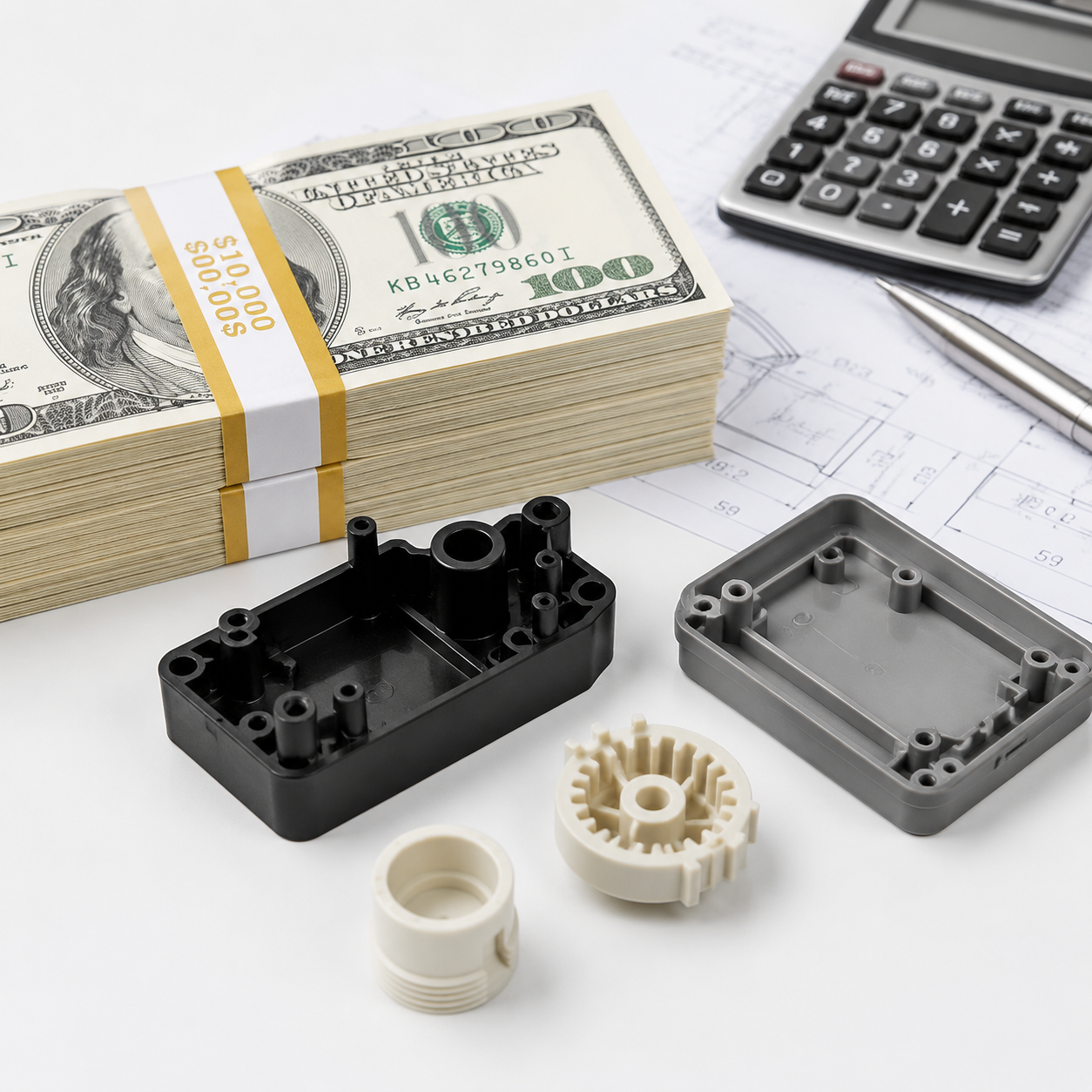
Mold Tooling: What Drives the Price
Steel Grade Selection
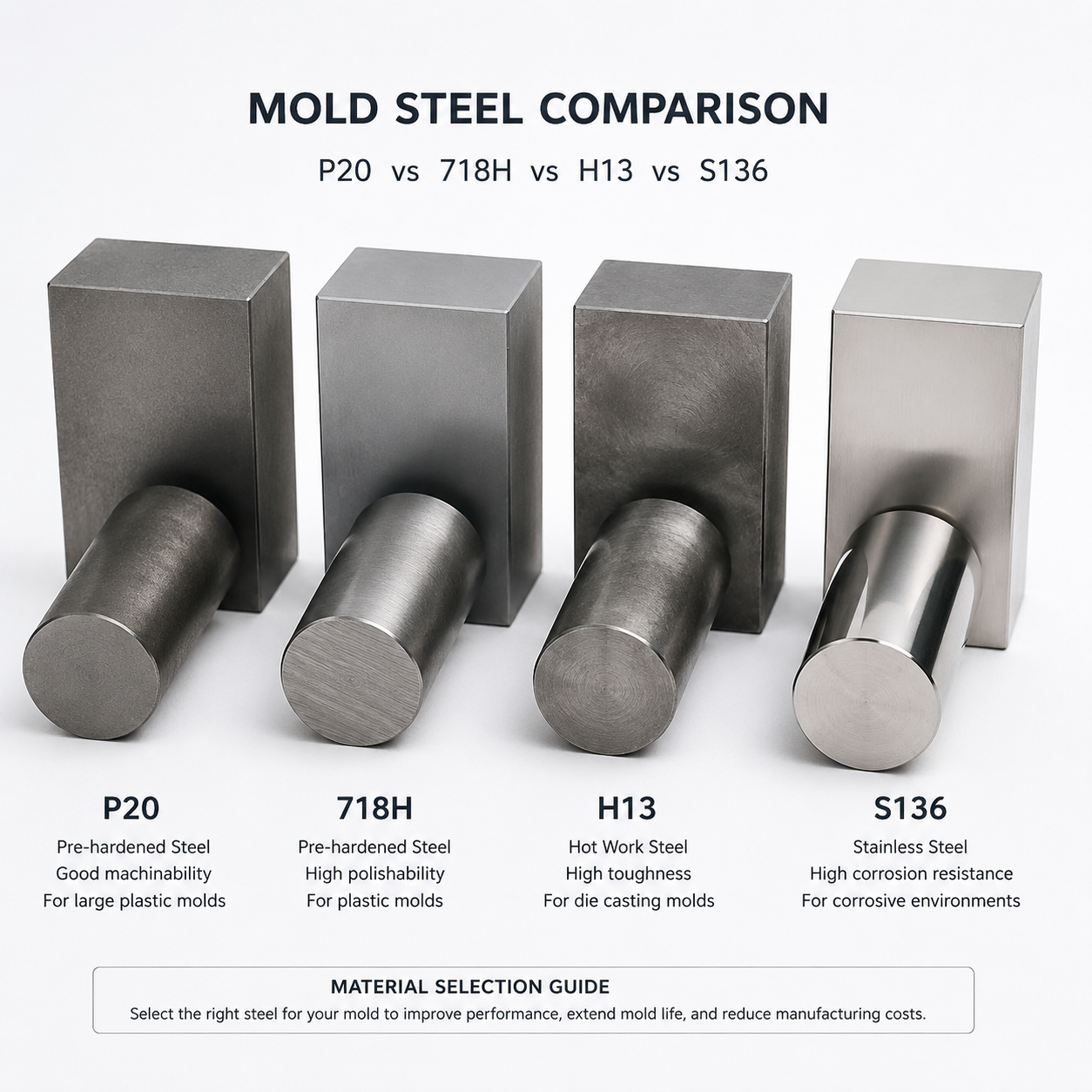
The single largest cost driver in any mold is the steel grade selected for the cavity and core inserts. For prototype molds (under 10,000 shots), aluminum or P20 may suffice. For production molds targeting 500,000+ cycles, H13 or S136 hardened steel becomes essential — and costs 3–5x more up front.
| Steel Grade | Hardness (HRC) | Target Life (Shots) | Best For | Relative Cost Index |
|---|---|---|---|---|
| P20 (pre-hardened) | 28–32 | 50,000–200,000 | General-purpose, non-abrasive resins (ABS, PP, PE) | 1.0x (baseline) |
| 718H (pre-hardened, improved polish) | 33–38 | 100,000–300,000 | High-gloss cosmetic parts, lenses, clear parts | 1.3–1.6x |
| H13 (hot work, through-hardened) | 48–52 | 500,000–1,000,000+ | Glass-filled resins, high-wear applications, high-volume production | 2.0–3.5x |
| S136 / 420 stainless (hardened) | 48–54 | 300,000–800,000 | Medical devices, food-contact, corrosive resins (PVC, POM) | 2.5–4.0x |
Practical rule: For production volumes under 50,000 units, P20 is almost always the right choice unless you are running glass-filled nylon or rigid PVC. Do not let a supplier upsell you to H13 for a 20,000-unit program — it simply will not pay back.
Cavities and Multi-Cavity Economics
Adding cavities is the classic trade-off: higher upfront tooling cost in exchange for lower part unit prices. The relationship is not linear. A single-cavity mold costs X; a two-cavity mold costs roughly 1.6–1.8x (not 2x), because the mold base, cooling manifold, and hot-runner manifold are shared. Beyond 8 cavities, complexity increases sharply due to filling balance and cooling uniformity challenges.
| Cavities | Tooling Cost Factor vs. Single Cavity | Cycle Time Impact | Best For (Annual Volume) |
|---|---|---|---|
| 1 | 1.0x | Baseline | 1–10,000 |
| 2 | 1.6–1.8x | Parts per cycle double; cycle time roughly same | 10,000–50,000 |
| 4 | 2.5–3.2x | 4x output; slightly longer cycle for cooling balance | 50,000–250,000 |
| 8 | 4.0–5.5x | 8x output; cooling and gating complexity increases cycle 10–15% | 250,000–1,000,000 |
| 16+ | 6.0–9.0x | Requires advanced runner balancing; not all geometries compatible | 1,000,000+ |
Complexity Factors That Inflate Mold Cost
Beyond steel and cavitation, several design features multiply mold cost:
- Side actions / slides: Each undercut requiring a side-action mechanism adds $800–3,000 to tooling cost (China pricing). A part with 4 side actions can double the mold base cost.
- Lifter cores: Internal undercuts solved by lifters typically add $400–1,200 per lifter.
- Thread cores (unscrewing): Rotating thread cores require hydraulic or gear-driven mechanisms. Add $2,000–6,000 per threaded feature.
- Tight tolerances: Tolerances under ±0.05 mm on any dimension require precision EDM sinking and tighter mold alignment — add 20–40% to cavity machining cost.
- High polish: SPI A-1 to A-3 mirror finishes demand 718H or S136 steel plus 40–80 hours of hand polishing — add $1,000–4,000 depending on surface area.
- Texture (VDI/MT standards): Chemical etching or laser texturing adds $300–2,000 per cavity side depending on depth and pattern complexity.
- Conformal cooling: 3D-printed cooling inserts that follow complex part contours can reduce cycle time 20–40% but add $1,500–5,000 to mold cost. Evaluate payback based on volume.

Part Unit Price Breakdown
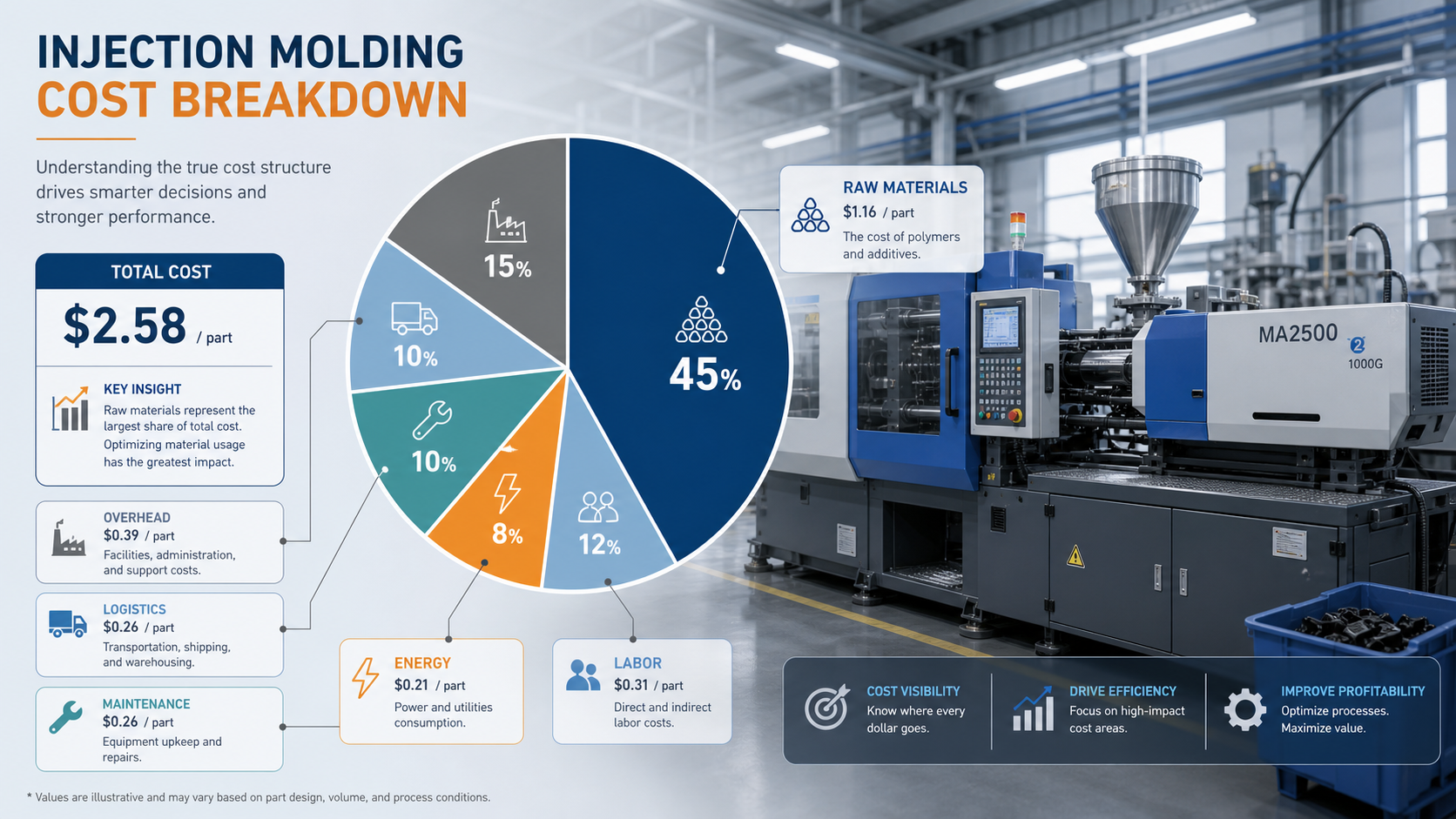
Once the mold is built, the recurring cost of each shot is driven by three components: material, machine time, and overhead.
Material Cost (40–60% of Unit Price)
Material dominates part price. For commodity resins (PP, PE, PS), material runs $1.00–2.50/kg and contributes $0.02–0.15 per part. For engineering resins (PA6 with 30% GF, PBT, POM), expect $3.00–6.00/kg. For high-temperature or specialty resins (PEEK, PPS, LCP), material alone can reach $40–80/kg.
Supplier practice to watch: Many Chinese suppliers add 8–15% to raw material cost as a “material handling” markup. Some quote material at full list price while purchasing at discounted volume rates and pocketing the spread. Ask whether material is quoted at cost or cost-plus, and request resin brand and grade on every quote line.
Machine Hour Rate ($15–50/hr in China, $60–180/hr in Western Markets)
The machine hour rate covers press depreciation, electricity, water, operator salary, and basic overhead. Rates vary by machine tonnage:
| Clamping Force (Ton) | Typical Rate — China (USD/hr) | Typical Rate — North America/Europe (USD/hr) |
|---|---|---|
| 80–120T | $4–10 | $35–55 |
| 160–250T | $8–18 | $45–75 |
| 300–500T | $15–30 | $60–120 |
| 650–1,200T | $25–50 | $90–180 |
Machine rates below $4/hr in China should trigger skepticism — at that level, the supplier is either losing money on the press or compensating through inflated material pricing.
Cycle Time and Its Leverage
A part that cycles in 18 seconds costs roughly half as much per unit as the same part cycling in 36 seconds (all else equal). Cycle time is the product of injection time, cooling time (typically 50–70% of total cycle), mold opening/closing, and part ejection. Optimizing cooling layout in the mold design phase — running larger water lines, using bubblers or baffles for deep cores, or specifying conformal cooling — can reduce cycle time by 20–40% and deliver a 6-month payback through reduced part unit prices.
Ten Questions to Ask Before You Accept Any Quote
These questions are designed to expose gaps in the quote — things the supplier left out intentionally or simply did not think of. A supplier that answers all ten comfortably is worth a deeper conversation. One that dodges three or more should be dropped immediately.
- “Is the steel grade certified? Can you provide the mill certificate with the mold?” Many suppliers say “P20” and deliver a lower-grade equivalent (e.g., 2738 or 2311 with reduced hardness). Require the mill certificate.
- “Does the tooling price include a mold-flow analysis, or is that billed separately?” Mold-flow analysis (Autodesk Moldflow or Moldex3D) typically costs $400–1,200 and is often excluded. Without it, you risk gate placement and warpage problems discovered only at trial.
- “How many spare ejector pins, spare core pins, and spare heater bands are included?” Standard practice is one spare ejector pin of each size, one spare core pin per cavity, and one spare heater band per zone. If zero spares are included, add $200–600 to initial budget.
- “What texture depth and standard are included, and is there a per-side charge?” Texture (e.g., VDI 24, MT-11010) costs $200–800 per side. Confirm it is included — not billed separately after mold acceptance.
- “Is PPAP (Production Part Approval Process) included, and to what level — Level 1, 2, or 3?” A full PPAP Level 3 submission (dimensional report, material cert, capability study, control plan) costs $800–2,500 and is rarely included in the base tooling price.
- “Is the mold warranty for lifetime or a fixed number of shots? What is covered — just the cavity/core, or also the hot-runner system and ejector mechanism?” Most suppliers warrant against manufacturing defects for 100,000–200,000 shots, but many exclude hot-runner components (which carry their own manufacturer warranty). Get the exclusion list in writing.
- “What is the maintenance interval, and do you provide a recommended spare-parts list with lead times?” Every mold needs periodic preventative maintenance — cleaning, lubrication, sharpening. A supplier without a documented PM plan has not thought about your mold beyond delivery.
- “Does the part unit price include deflashing, de-gating, and packaging? If not, what are the secondary operation adders?” Secondary operations are the most commonly omitted costs in injection molding quotes. A part that arrives still attached to the runner is not a finished part.
- “What is the payment structure — and what milestone gates release each payment?” Standard terms are 30–50% deposit with mold design sign-off, 30–40% at first trial (T1), and 15–20% at PPAP approval or shipment. Avoid 100% upfront, and ensure the final 10–15% is held until at least T1 samples are approved.
- “Can you provide three references for projects with similar part size, material, and volume within the last 12 months?” If a supplier hesitates here, they may not have relevant experience. A reference check takes 15 minutes and can save tens of thousands of dollars in failed tooling.
Quick Reference: Cost Ranges by Part Complexity
The table below provides rough order-of-magnitude ranges for mold tooling and unit price, based on part complexity for parts weighing 20–200 grams in commodity-grade P20 steel, produced in China. Add 25–50% for Western European or North American tool shops. Add 30–80% for H13 or S136 steel.
| Part Complexity | Example Parts | Mold Tooling (Single Cavity, P20, China) | Unit Price Range (Material + Machine) | Typical Lead Time |
|---|---|---|---|---|
| Simple (no side actions, open-close only) | Flat caps, spacers, simple bushings, nameplates | $1,800–4,500 | $0.08–0.35 | 4–6 weeks |
| Moderate (1–2 side actions, basic ribs) | Enclosures, brackets, housings, connectors | $4,500–12,000 | $0.25–0.85 | 6–9 weeks |
| Complex (3+ side actions, threads, tight tolerances) | Automotive interior trim, medical device housings, multi-port manifolds | $12,000–35,000 | $0.60–2.50 | 10–16 weeks |
| High-Precision (lens-grade polish, <0.02mm tol., cleanroom) | Optical lenses, microfluidic chips, implantable device components | $30,000–120,000+ | $1.50–15.00+ | 14–24 weeks |
Note: These ranges assume a single-cavity mold in P20 with no hot runner, standard SPI B-2 finish, and no secondary operations included. Every additional feature — slides, texture, hot runner, conformal cooling — pushes the number toward the high end of the band or above it.
Hidden Costs That Ambush Budgets
Most first-time buyers budget for the three buckets and stop. The items below are the most common budget killers — none are unreasonable to pay, but all should be confirmed as included or excluded before you sign a purchase order.
| Hidden Cost Item | Typical Range (China) | Why It Gets Missed |
|---|---|---|
| Design-for-Manufacturing (DFM) revisions | $300–1,500 | Some shops charge for DFM reports; others bundle them. Confirm in writing. |
| Mold-flow analysis | $400–1,200 | Often excluded from tooling quotes; added as an engineering line item. |
| Texture / grain | $300–2,000 per side | Quoted mold may assume as-machined finish or SPI B-2 only. |
| PPAP / dimensional report | $800–2,500 | Level 3 PPAP requires CMM measurement, capability studies, and control plans. |
| Packaging design and custom packaging | $0.02–0.15 per part | Bulk-pack in polybags is typically included; custom retail packaging is not. |
| Mold modifications after T1 trial | $500–3,000 per change | Most quotes cover minor adjustments (gate size, vent depths). Dimensional changes are extra. |
| Mold maintenance (preventative) | $200–800 per service interval | Often ignored until flash or short shots appear — by which point repair cost is higher. |
| Freight and import duties | $500–2,500 (sea freight) or $1,500–5,000 (air freight) | Molds weigh 80–800 kg. Sea freight ex-China to US runs $200–600/cbm plus duties. |
How to Normalize Injection Molding Quotes
Before comparing prices, place every supplier response into one quotation matrix. Blank cells are not minor administrative details; they are unpriced risk. Require each supplier to state assumptions rather than allowing “standard tooling” or “standard inspection” to stand without a definition.
| Quotation Line | Minimum Information Required | Risk If It Is Missing |
|---|---|---|
| Mold construction | Mold base supplier, cavity/core steel, hardness, heat treatment, cavity count, runner type, slides/lifters, cooling layout | Suppliers may quote materially different tool lives under the same general description. |
| Mold ownership and transfer | Legal owner, storage period, maintenance responsibility, transfer documentation, export crating and transfer charge | The buyer may discover that the mold cannot be moved or that drawings and process records are unavailable. |
| Trial and approval | Number of T0/T1 trials, sample quantity, dimensional report, material certificates, correction allowance | Sampling, inspection, and routine mold corrections may appear later as additional invoices. |
| Part price basis | Resin manufacturer and grade, color, regrind allowance, part and runner weight, cycle time, cavities, machine size, scrap assumption | The price cannot be recalculated when resin, cycle time, or production volume changes. |
| Quality level | Critical dimensions, sampling plan, CMM or gauge requirements, capability targets, FAI/PPAP documentation | Suppliers may quote basic visual inspection against a requirement that actually needs documented process capability. |
| Commercial basis | Currency, Incoterm, payment schedule, validity period, tax, freight, duty, packaging, warranty | A factory price can appear lower while producing a higher landed and qualified cost. |
Use Total Landed Program Cost, Not Piece Price Alone
A practical sourcing model is:
Total landed program cost = tooling and NRE + (approved quantity x finished-part unit price) + validation + packaging + freight and duty + expected maintenance and engineering changes.
For example, Supplier A may quote a $9,000 mold and a $1.10 part, while Supplier B quotes a $14,000 mold and a $0.78 part. At 10,000 parts, Supplier A appears lower before qualification and logistics. At 100,000 parts, the $0.32 unit-price difference is worth $32,000 and can outweigh the higher tooling investment. The calculation must also check whether both suppliers assumed the same resin, cavity count, cycle time, scrap rate, quality documentation, and delivery term.
Separate Price Uncertainty from Technical Risk
Ask the supplier to mark each quotation line as fixed, estimated, or dependent on DFM/T1 results. Mold price can usually become fixed after DFM approval. Part price may remain conditional on verified cycle time, runner weight, final resin pricing, and packaging. This distinction lets procurement compare commercial exposure without forcing engineering assumptions into a falsely precise number.
RFQ Checklist for an Accurate Injection Molding Cost
The quality of the quotation depends on the quality of the RFQ package. Send the same controlled package to every supplier and identify unresolved assumptions explicitly.
- 3D CAD: STEP or Parasolid file at the current revision.
- 2D drawing: critical dimensions, tolerances, datum scheme, threads, inserts, surface finish, texture, and cosmetic zones.
- Demand profile: prototype quantity, first order, annual volume, peak monthly demand, and expected program life.
- Material specification: polymer family plus exact manufacturer/grade where performance or compliance depends on it; include color, filler, flame rating, UV package, and regrind restrictions.
- Tooling requirement: target tool life, preferred cavity count, hot- or cold-runner preference, mold ownership, storage, maintenance, and transfer expectations.
- Quality plan: FAI, dimensional report, material certificate, capability study, PPAP level, gauge requirements, and traceability.
- Delivered-part scope: degating, insert installation, assembly, printing, welding, cleaning, individual packaging, labeling, and export packing.
- Commercial basis: delivery location, Incoterm, desired lead time, quotation currency, payment terms, and whether freight and duty must be included.
If the design is not production-ready, request a documented DFM review before locking the tool price. Gate location, draft, wall transitions, undercuts, tolerance allocation, and expected shrinkage can change both the mold concept and the recurring part cost. Use the gate design guide, tool steel selection guide, and tolerance stack-up guide to define those decisions before supplier comparison.
When the Lowest Quote Is the Right Quote
The lowest quote can be the best choice when the tool specification is equivalent, the supplier has demonstrated the required process and inspection capability, exclusions are transparent, and the total landed cost remains lowest at the expected volume. A higher quotation is not automatically better. The objective is evidence-based equivalence, followed by commercial comparison.
When to Reject a Low Quote
Reject or clarify a quotation when the supplier cannot identify mold steel and hardness, does not state cavities and cycle-time assumptions, substitutes an unspecified resin, excludes dimensional approval, cannot explain mold ownership, or offers a piece price without runner weight and secondary-operation scope. Those omissions transfer cost and schedule risk to the buyer rather than eliminating it.
For a manufacturing review, send the CAD model, drawing, resin requirement, annual volume, and inspection level through the form below. Nylon Plastic can compare tooling route, expected mold life, unit-cost drivers, and prototype-to-production options before quotation.
Frequently Asked Questions
How much does a mold for a small plastic part (under 30 grams) cost?
For a simple part (no side actions, open-close only, P20 steel, single cavity, no hot runner) manufactured in China, expect $1,800–4,500. For the same part with a two-cavity configuration, expect $3,000–7,500. Add 25–50% for Western tool shops. If the part requires side actions, tight tolerances (under ±0.05 mm), or a high-gloss SPI A-2 finish, move the range up to $5,000–15,000. The single largest variable at this size range is whether a hot-runner system is required — a single-drop hot runner alone adds $1,200–3,500 to tooling cost.
How do I verify that the supplier used the steel grade they quoted?
Three methods, in order of reliability: (1) Require the mill certificate — a traceable document from the steel mill (e.g., Bohler, ASSAB, Daido) showing heat number, chemical composition, and hardness. Match the heat number to the physical stamp on the mold base. (2) Request a portable hardness test during a video inspection — a calibrated Leeb hardness tester applied to the cavity surface takes 30 seconds and gives an immediate reading. P20 should read 28–32 HRC; H13 should read 48–52 HRC. (3) For high-value molds ($30,000+), commission a third-party inspection through a firm like SGS, Bureau Veritas, or TUV, which can perform handheld XRF (X-ray fluorescence) analysis to verify alloy composition against the mill certificate. This costs $300–800 and is standard practice in the automotive and medical sectors.
When does a hot runner system pay off versus a cold runner?
The break-even calculation depends on material waste and cycle time. A cold runner system leaves a solidified sprue and runner that must be reground or discarded — for a multi-cavity mold producing small parts, the runner can equal 30–60% of the shot weight. Rule of thumb: if the runner-to-part weight ratio exceeds 25%, a hot runner pays for itself within 50,000–100,000 shots through material savings alone. Additionally, hot runners reduce cycle time by 5–15% (no runner cooling time) and eliminate regrind handling. For high-value engineering resins (PA66 GF30 at $4–6/kg, or PEEK at $50+/kg), the payback is even faster — sometimes under 20,000 shots. For commodity PP at $1.50/kg, the math is less favorable and a cold runner with regrind reuse often makes more sense below 100,000 units.
Should I pay for a mold-flow analysis separately, or should it be included?
It depends on part complexity. For simple parts (uniform wall thickness, single gate location, no flow-length concerns), a mold-flow analysis provides limited additional value — a competent toolmaker can predict fill behavior from experience. However, for any part with thin walls (under 1.2 mm), long flow-length-to-thickness ratios (over 150:1), multiple gate locations, or glass-filled resins, a mold-flow analysis is worth its cost. Without one, you risk weld-line placement in structurally critical areas, air traps causing burn marks, and warpage from differential shrinkage. The $400–1,200 analysis cost is a fraction of what it costs to re-cut a gate or add a vent after T1. If the supplier pushes back on including it, offer to pay for it yourself and own the report — this way, the data serves your project even if you change suppliers later.
Related Reading
- Low-Volume Injection Molding for Small-Batch Production
- How to Reduce Injection Molding Part Cost
- How to Reduce Injection Molding Lead Time
Planning note: Price and mold-life ranges on this page are comparison benchmarks, not a fixed Nylon Plastic quotation. For drawing-specific DFM, tooling and part-price review, use our plastic injection molding services and submit the drawing, material and volume.