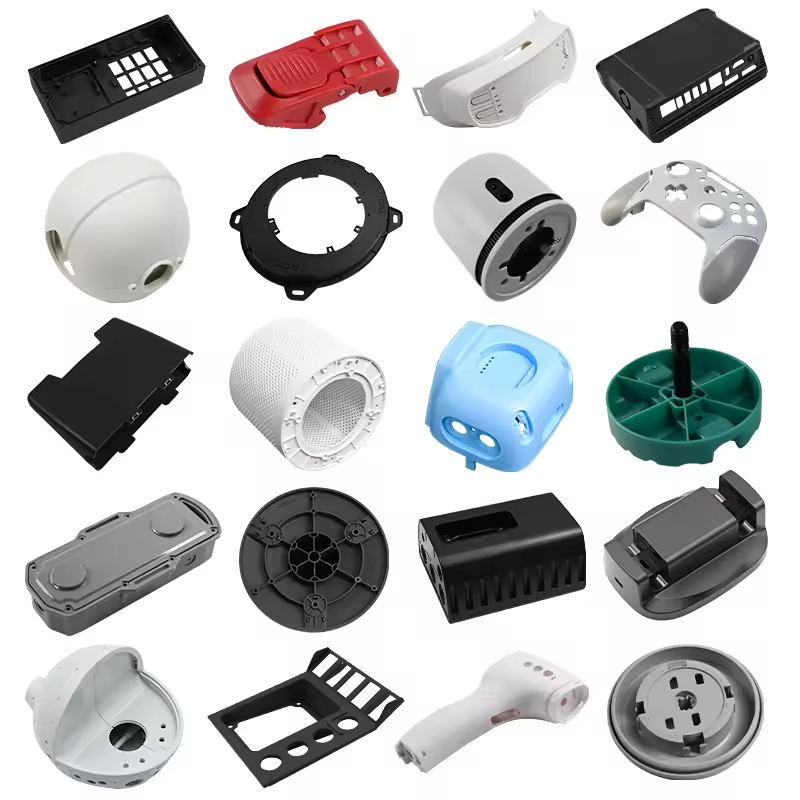
This injection molding weld guide explains practical considerations for material selection, design review, manufacturing, and sourcing decisions.
What Are Weld Lines?
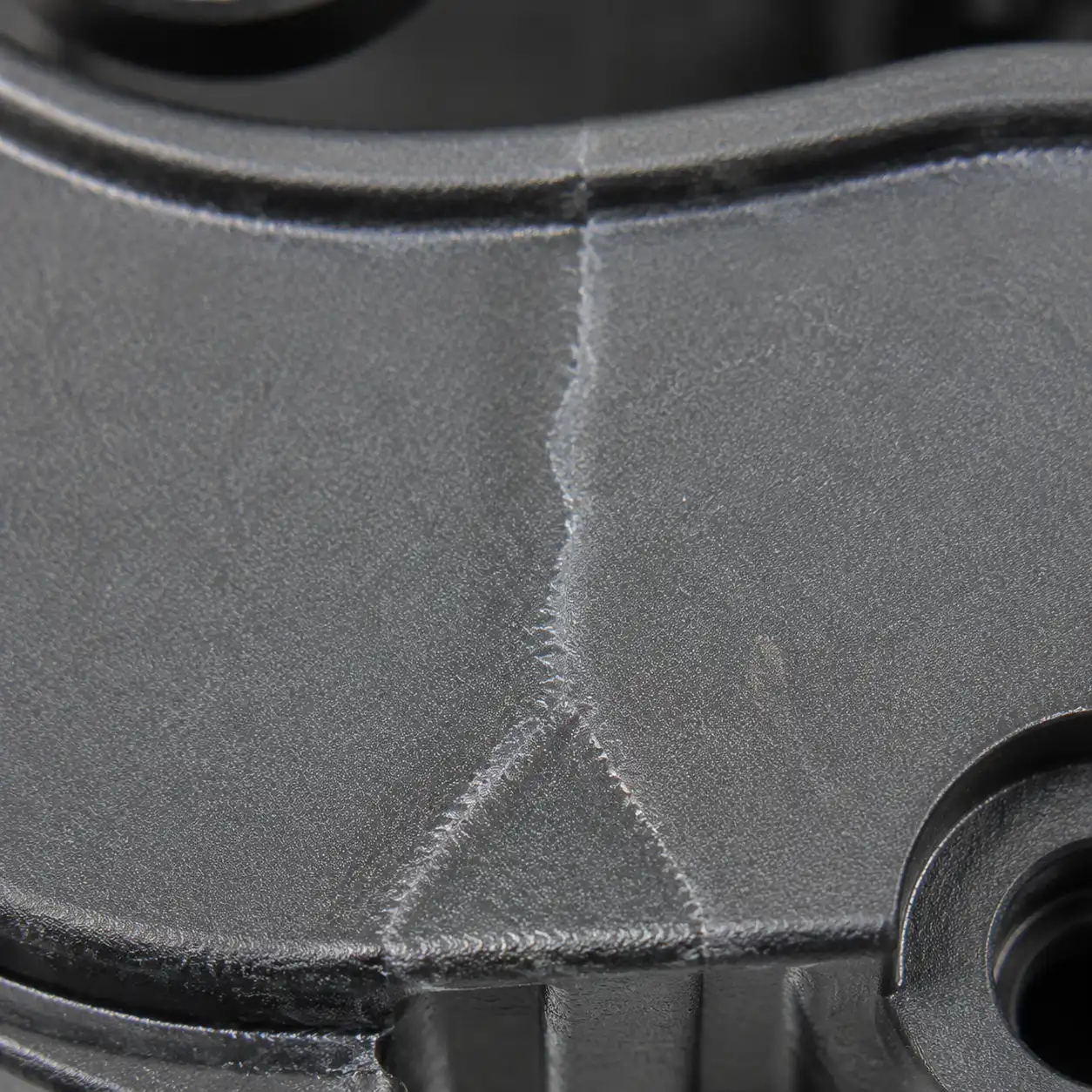
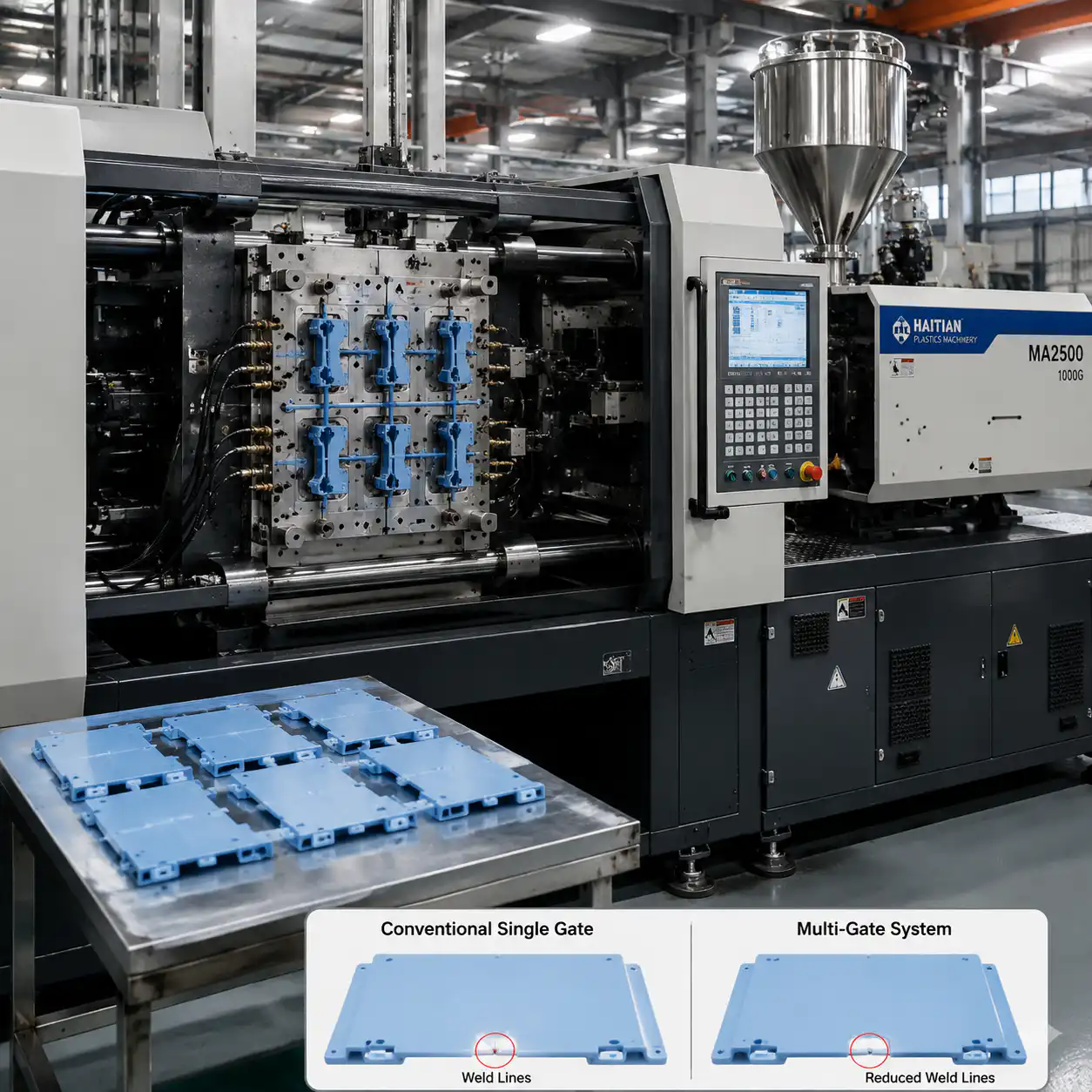
A weld line (also called a knit line) is a linear defect that forms when two or more molten polymer flow fronts meet during the injection molding process and fail to fully intermingle at the molecular level. The result is a visible line or a mechanically weaker zone on the part surface — and, more critically, through the wall thickness.
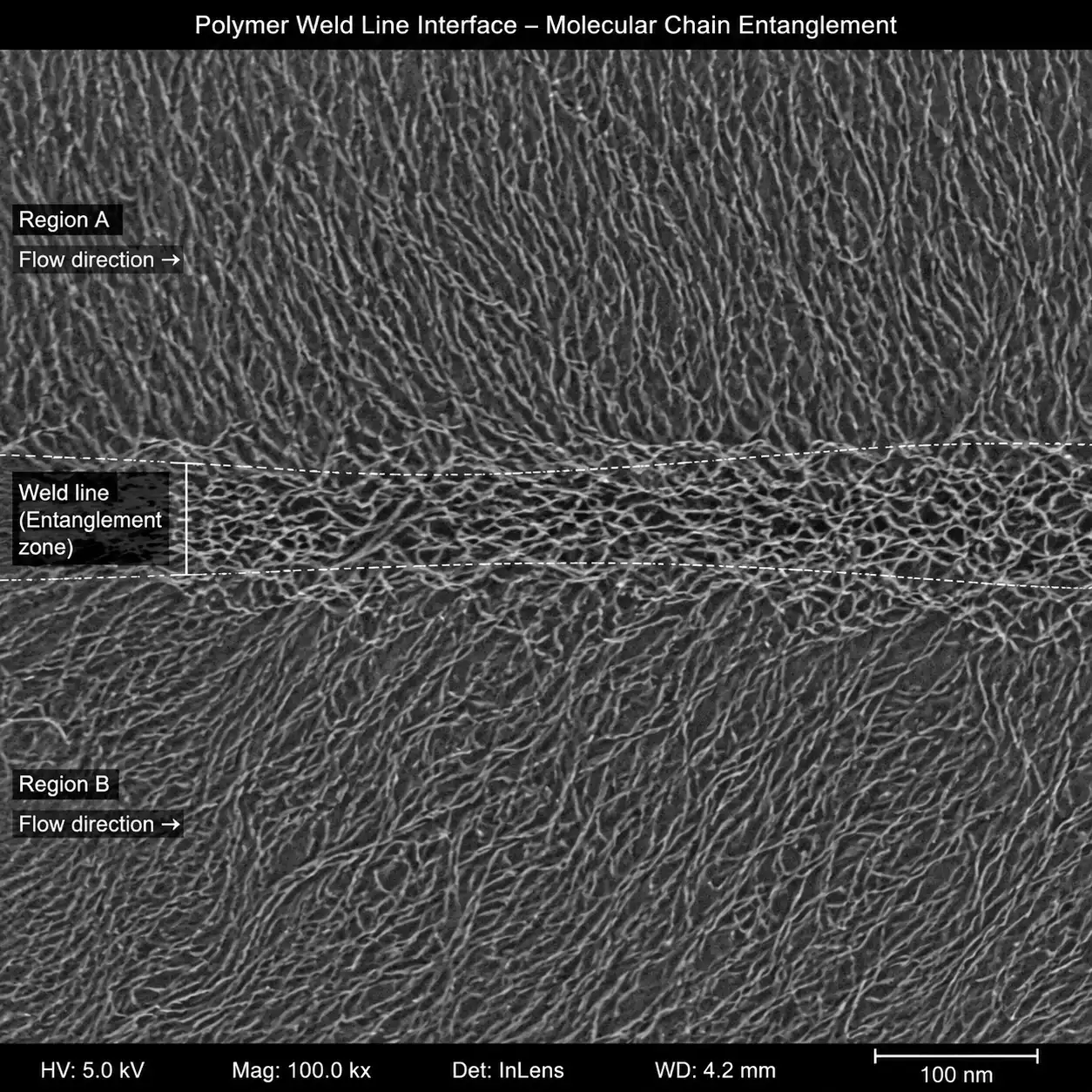
Weld lines are mechanically defined as regions of incomplete polymer chain entanglement. When flow fronts converge, the polymer molecules at the advancing front have already begun to cool and orient parallel to the flow direction. At the meeting plane, chains from opposite sides merely abut rather than interpenetrate, creating a boundary that behaves like a micro-crack under tensile or impact loading.
Among injection molding defects, weld lines are uniquely dangerous because they often pass visual inspection at the surface while creating a 20-70% reduction in local mechanical strength — making them the #1 hidden structural defect in molded parts.
What Causes Weld Lines?
Weld lines are not random. They form wherever flow is split and recombined during cavity filling. Three primary scenarios account for over 90% of weld line occurrences:
1. Flow Fronts Meeting After an Obstruction (Hole or Insert)
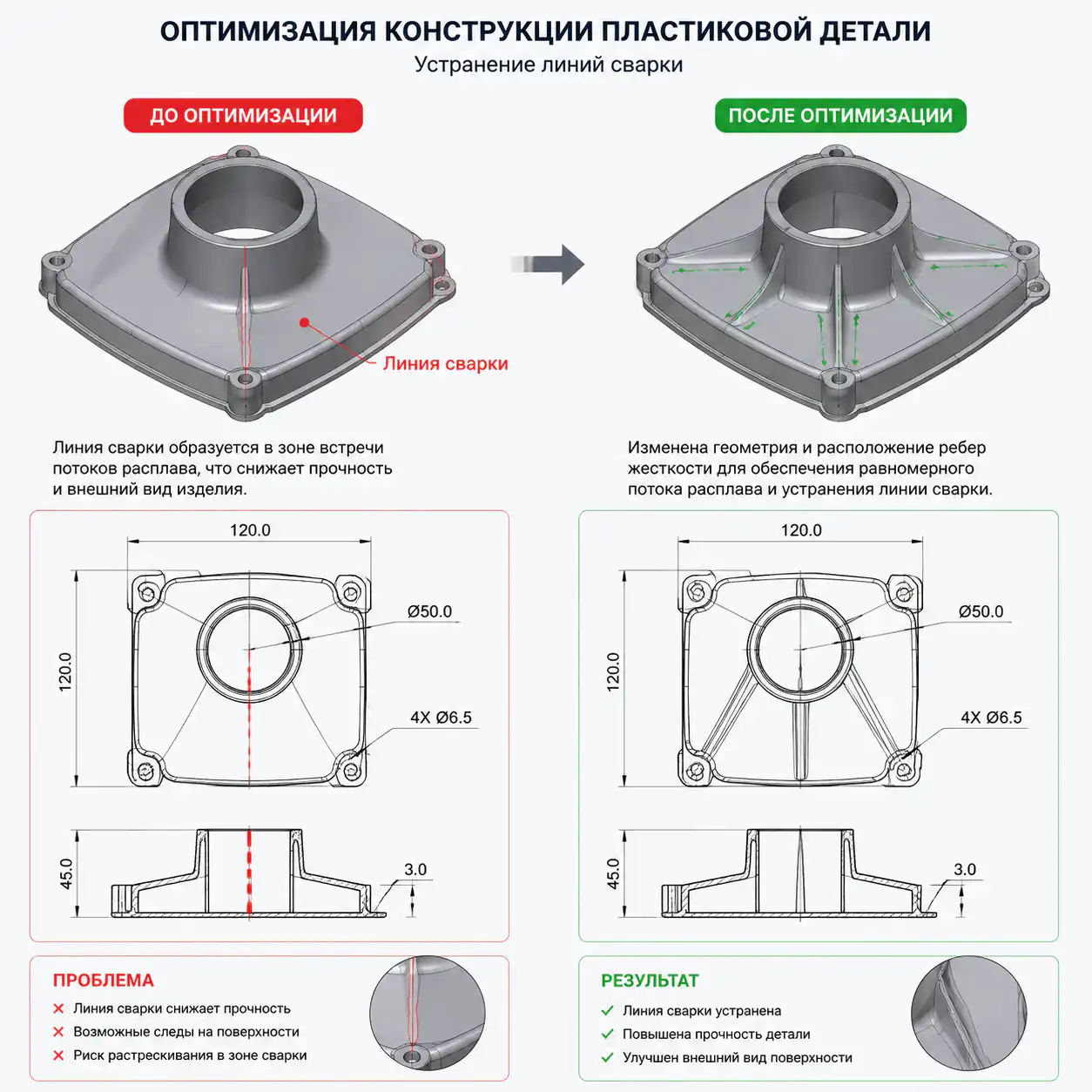
When molten polymer encounters a core pin, insert, or any obstacle in the cavity, the melt stream splits into two fronts that travel around the obstruction and rejoin on the downstream side. This is the most common weld line scenario — present in virtually every part with holes, slots, or metal inserts.
2. Multi-Gate Convergence
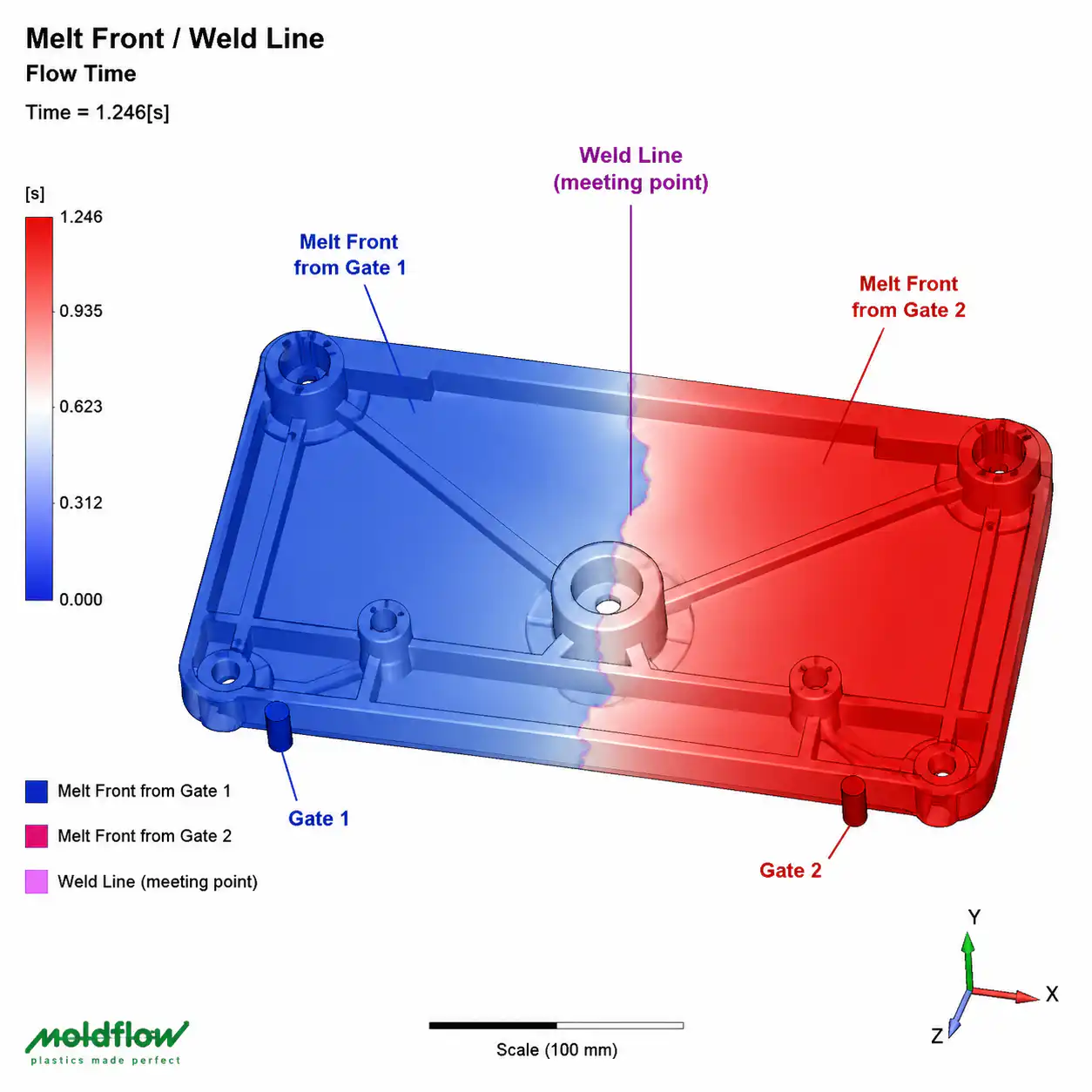
When a cavity is filled from two or more gates simultaneously, the flow fronts from each gate eventually meet. The location and angle of this meeting define the weld line. High gate counts for filling large parts almost guarantee weld lines, making gate layout optimization a critical design decision.
3. Wall Thickness Variation
Abrupt changes in wall thickness cause differential flow rates. Polymer in the thicker section flows faster (lower resistance), overtaking the thinner section flow and creating a weld line where the two fronts recombine. This mechanism is particularly insidious because it is often overlooked during part design.
Types of Weld Lines: Cold, Hot, and Merge Lines
Not all weld lines are created equal. Understanding the distinction is essential for proper risk assessment and mitigation strategy:
| Type | Formation Temperature | Appearance | Strength Retention |
|---|---|---|---|
| Cold Weld Line | Below melt temperature | Sharp, V-notch groove on surface | 50-70% loss (worst case) |
| Hot Weld Line | Above melt temperature | Subtle line, may be invisible | 10-30% loss |
| Merge Line | Near melt temperature, >135 degree meeting angle | Often invisible | 5-15% loss (best case) |
Cold weld lines form when flow fronts have cooled significantly before meeting — common at the end of fill, in thin-walled sections, or with long flow paths. The polymer skin has already frozen, leaving only a thin molten core to bond. The result is a sharp surface notch and severe strength degradation.
Hot weld lines form when fronts meet while still fully molten, typically occurring earlier in the filling sequence. The molecular diffusion and chain entanglement are better, but still well below bulk material levels because chains at the advancing front are oriented and have limited mobility perpendicular to the flow.
Merge lines are a special subclass where fronts meet at a high angle (above approximately 135 degrees) and at temperatures near or above the melt point. The acute meeting angle promotes better mixing and higher entanglement density, yielding substantially better mechanical properties than typical weld lines.
Material Sensitivity: How Different Plastics Handle Weld Lines
Weld line strength depends heavily on the base polymer. Amorphous, semi-crystalline, and filled materials behave entirely differently at the weld plane:
| Material | Type | Weld Line Strength Retention (%) | Key Behavior |
|---|---|---|---|
| PA66 (unfilled) | Semi-crystalline | 75-85% | Good weld strength; hydrogen bonding aids recovery |
| PA66 GF30 | Semi-crystalline + GF | 50-60% | Fibers orient parallel to weld line — no bridging |
| PA6 | Semi-crystalline | 70-80% | Similar to PA66, slightly lower Tg helps |
| PP (unfilled) | Semi-crystalline | 80-95% | Excellent weldability; slow crystallization aids healing |
| PP GF30 | Semi-crystalline + GF | 45-55% | Glass fibers severely degrade weld strength |
| PC (unfilled) | Amorphous | 85-95% | Best unfilled weld retention; high melt strength |
| POM | Semi-crystalline | 60-75% | Fast crystallization hurts; high mold temp helps |
| ABS | Amorphous | 80-90% | Good weld retention; rubber phase helps toughness |
| PPS GF40 | Semi-crystalline + GF | 35-50% | Worst-case weld strength; avoid structural welds |
The critical takeaway: glass fiber reinforcement amplifies weld line weakness. Fibers at the weld plane align parallel to the interface rather than bridging across it, so the weld region behaves essentially like the unfilled matrix — minus the fiber reinforcement the part was designed to rely on. A PA66 GF30 part may drop from 180 MPa tensile strength to 90-110 MPa at the weld line.
Weld Line Prediction Using Moldflow Simulation
Modern DFM (Design for Manufacturability) workflows make weld lines predictable before steel is cut. Autodesk Moldflow and similar simulation packages can identify all weld line locations during the filling analysis phase. If you want to see how those reports are interpreted, our mold flow analysis and DFM guide breaks down the most useful outputs.
Key Moldflow outputs to examine in your DFM report:
- Weld line result plot: Displays all weld line locations as colored lines. Pay attention to lines in high-stress regions identified by your FEA.
- Temperature at flow front result: The single most important predictor of weld line quality. If the temperature at flow front at the meeting point is above the material’s no-flow temperature, you are in hot weld line territory. Below it, expect a cold weld line.
- Meeting angle: Angles below 90 degrees produce poor entanglement. Angles above 135 degrees are merge-line territory. Most Moldflow packages display this as a numerical overlay.
- Fill time contour: Check whether both flow fronts arrive simultaneously. A time differential means one front is stagnant while the other advances, worsening the weld.
- Air trap result: Weld lines and air traps often coincide. A trapped air pocket at the weld location can create additional voids and burn marks.
A thorough DFM report should flag every weld line location, classify it by predicted severity (temperature + angle + stress location), and recommend specific mitigation for lines in structurally critical zones.
Prevention Strategies: Design-Level Solutions
Preventing weld lines at the design stage is always cheaper than compensating through processing. Here are the primary design-level strategies, ranked by effectiveness:
1. Gate Relocation
The single most powerful lever. Moving the gate changes the entire flow pattern. Relocate gates so that weld lines shift to low-stress, non-cosmetic regions of the part — or, ideally, to the very end of fill where they exit into an overflow well. Even a 5 mm gate position shift can dramatically alter weld line location and severity.
2. Wall Thickness Optimization
Eliminate abrupt thickness transitions that cause differential flow rates. Gradual transitions (3:1 ramp rule) allow flow fronts to stay better synchronized. In multi-thickness parts, consider localized thinning or thickening to steer the weld line position.
3. Flow Leaders and Deflectors
Flow leaders are local wall thickness increases that create preferential flow paths, steering the melt to arrive at the meeting point simultaneously and at higher temperature. This is a targeted, low-cost mold modification compared to gate relocation.
4. Overflow Wells
Position overflow tabs or wells at the weld line location. The weld line forms inside the overflow, which is then trimmed off post-molding. This is the nuclear option — it eliminates the weld line from the functional part entirely — but adds material waste and a secondary trimming operation.
5. Sequential Valve Gating
For multi-gate molds, sequential valve gating opens gates in a programmed sequence rather than simultaneously. This creates a single continuous flow front that sweeps across the cavity, eliminating multi-gate weld lines. The cost is higher tooling complexity and controller hardware, but for large structural parts (automotive bumper beams, instrument panel carriers), it is the standard approach.
Processing Fixes: Optimizing Weld Line Strength Through Parameters
When mold modifications are not feasible (existing tooling, budget constraints, or tight timelines), processing adjustments can improve weld line strength by 10-30%:
| Parameter | Direction | Effect on Weld Line | Limitations |
|---|---|---|---|
| Melt Temperature | Increase 10-20 degrees C | Higher temp = better molecular diffusion at meeting plane. Strongest single processing lever. | Material degradation risk, longer cycle time, flash |
| Mold Temperature | Increase 10-30 degrees C | Slows skin freezing; more time for chain entanglement before solidification | Longer cycle time, dimensional stability concerns |
| Injection Speed | Increase (faster fill) | Reduces cooling during filling; fronts meet hotter. Also increases shear heating. | Jetting, burn marks, gas traps, flash |
| Holding Pressure | Increase + extend time | Compresses the weld zone; reduces voids and improves density | Flash, overpacking, molded-in stress |
| Back Pressure | Moderate increase | Better melt homogeneity; consistent viscosity aids predictable flow front behavior | Excessive shear heating, fiber breakage in GF materials |
Practical processing sequence for weld line optimization: Start by raising melt and mold temperature to the upper end of the material supplier’s recommended range. Then increase injection speed incrementally while watching for flash and burn marks. Finally, dial in holding pressure and time using short-shot studies to confirm the weld line zone is fully packed. This sequence typically recovers 15-25% of the lost weld strength — not a replacement for good design, but often the difference between passing and failing a structural test.
Testing Weld Line Strength
Verifying weld line performance requires targeted testing. Standard material datasheet values assume no weld lines, so they are dangerously misleading for parts with significant weld zones:
Tensile Testing (ISO 527 / ASTM D638)
Mold tensile bars with the weld line at the gauge center (use a film gate at both ends). Compare weld-line specimen strength to unwelded control specimens from the same mold. The ratio gives you actual weld line strength retention for your material, mold, and process combination. This should be standard procedure for any structural part with weld lines.
Impact Testing (ISO 179 / ASTM D256)
Weld lines are especially damaging to impact strength — often showing 70-90% reduction even in materials with good tensile weld retention. Charpy or Izod specimens notched at the weld line location provide critical safety validation for parts subject to shock loading.
Visual Inspection Standards
For cosmetic surfaces, establish clear accept/reject criteria. Dimensional standards like DIN 16742 provide classification systems for weld line visibility. Generally: Class A surfaces (visible in use) should show no visible weld line groove under specified lighting; Class B surfaces (visible but non-cosmetic) allow a faint line; Class C surfaces (hidden) have no cosmetic restriction but still require mechanical validation. Surface texture and gloss targets also matter here, which we cover in the surface finishing guide.
For detailed PA66 GF30 properties and grade selection, see our glass-filled nylon grade comparison guide covering GF15, GF30, and GF60 stiffness, heat, warpage, and molding data.
Frequently Asked Questions
Are weld lines always bad, or are they sometimes acceptable?
Weld lines are not universally catastrophic. In non-structural, non-cosmetic regions of a part they are often acceptable without modification. The key question is: Is the stress at the weld line location below the reduced strength of the weld zone? In a PC enclosure with a hole for a cable pass-through in a low-stress area, a weld line is likely fine. In a PA66 GF30 engine mount bracket with the weld line at the bolt hole — where vibration and tensile loads concentrate — it is almost certainly a failure risk. Always apply the location-based risk assessment: stress level at weld line multiplied by weld strength retention equals actual safety factor. If that safety factor is below your design requirement, the weld line is unacceptable.
How much strength does a weld line lose in PA66 GF30?
In PA66 with 30% glass fiber, tensile strength at the weld line typically drops to 50-60% of the unwelded material strength. For a typical PA66 GF30 with 170-190 MPa tensile strength, the weld line zone strength is approximately 85-115 MPa. Impact strength reduction is even more severe — often down to 20-30% of the unwelded value — because glass fibers at the weld plane provide essentially zero bridging across the interface. The polymer matrix alone must carry the load. This is why GF materials demand the most aggressive weld line mitigation strategy, and why weld line location must be a primary consideration during gate placement design for any glass-filled material.
Can weld lines be completely eliminated?
In parts with holes, inserts, or multiple gates, weld lines cannot be completely eliminated in a physical sense — you are always splitting and recombining flow. However, you can effectively eliminate their mechanical impact through: (1) Overflow wells that shunt the weld line into a disposable tab, physically removing it from the functional part. (2) Sequential valve gating that creates a single uninterrupted flow front for multi-gate parts. (3) Design changes that shift the weld line to a non-structural zone where strength reduction is irrelevant. The phrase “weld-line-free part” in DFM reports usually means “no weld line in any functionally critical location,” not literal absence.
How accurate is Moldflow in predicting weld line location?
Moldflow weld line location prediction is highly reliable — typically within 1-3 mm of the actual position on the molded part when the mesh is properly refined and process settings match production. The location accuracy comes from the solver’s ability to track flow front advancement, which is fundamentally correct physics. Strength prediction is less reliable and should be treated as a comparative ranking tool, not an absolute predictor. Moldflow’s weld line strength outputs are based on empirical correlations with meeting angle and temperature at the flow front and should be validated with physical tensile bar testing for safety-critical applications. For DFM purposes: trust the location, verify the strength prediction with real molded specimens.