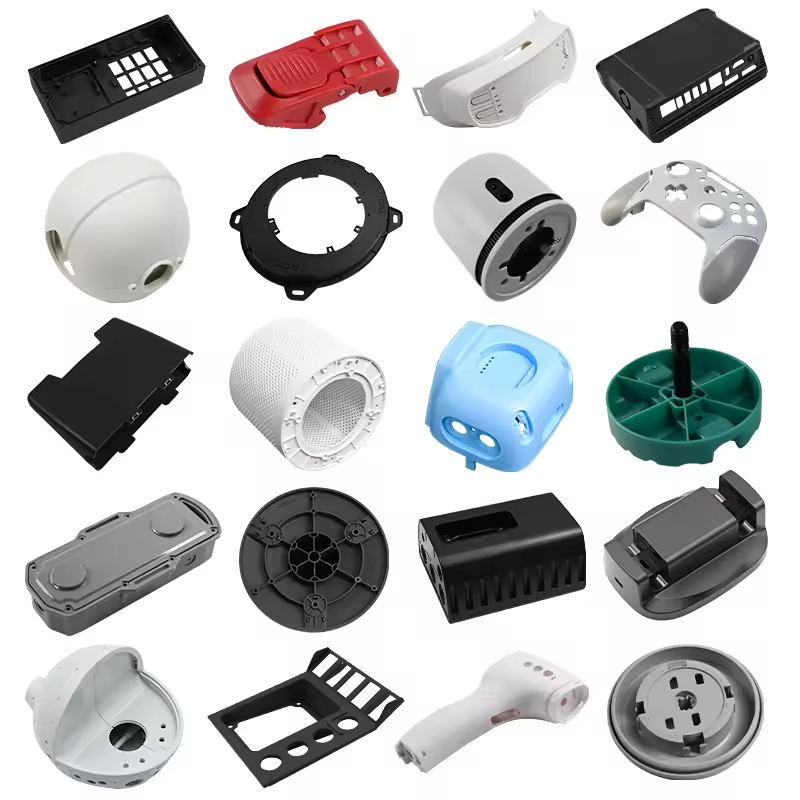
Polyethylene injection molding is used for HDPE and LDPE parts such as caps, containers, clips, covers, handles and chemical-resistant components. PE offers low density, good chemical resistance and toughness, but it has high shrinkage and can warp if wall thickness, gate location and cooling are not designed correctly.
PE is familiar as a commodity plastic, but molded part performance still depends on grade selection. HDPE, LDPE and LLDPE differ in stiffness, flexibility, impact behavior, shrinkage and environmental stress crack resistance.
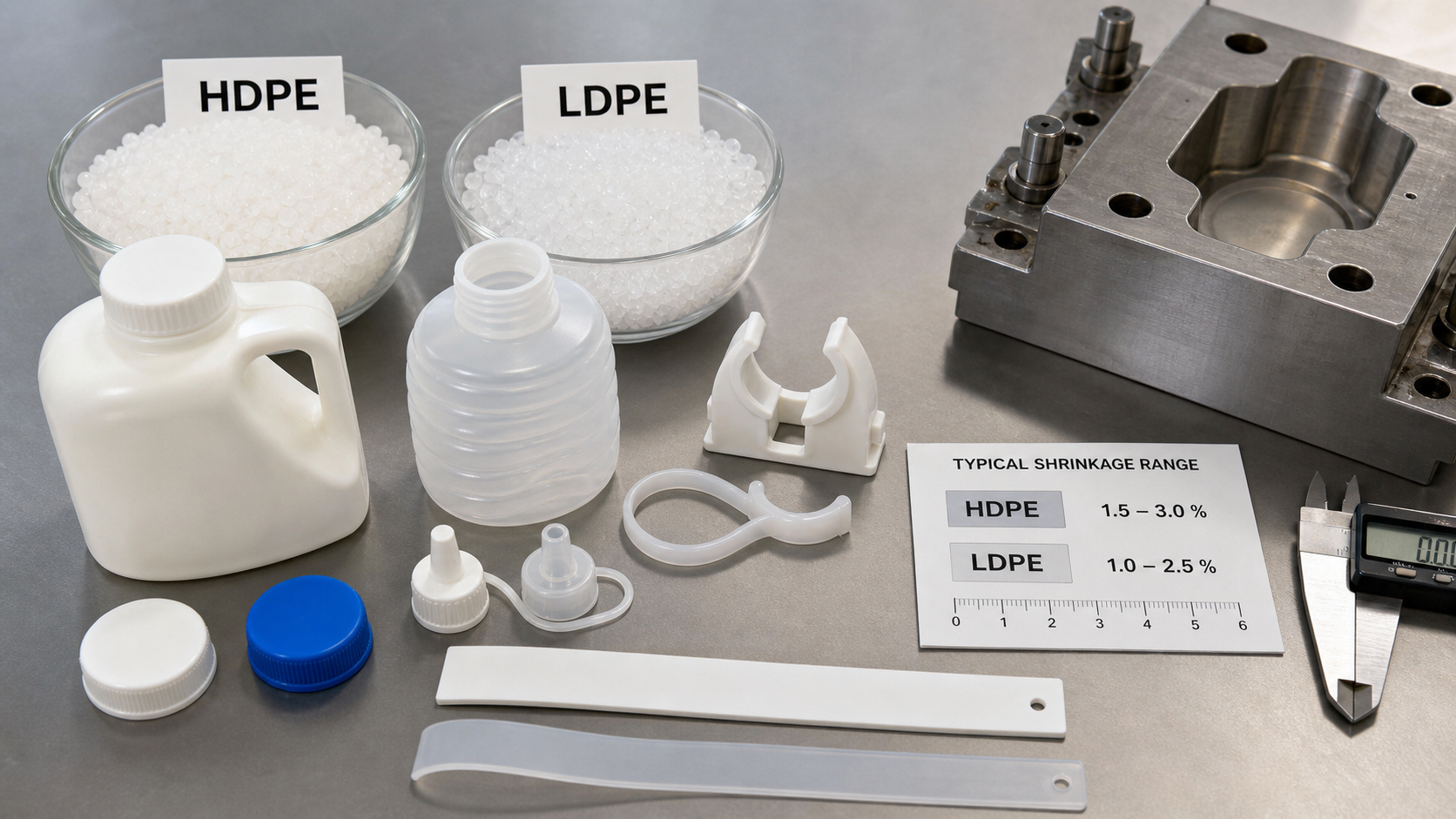
HDPE vs LDPE for Injection Molding
The best polyethylene grade depends on stiffness, flexibility, chemical exposure and dimensional control.
| PE material | Typical behavior | Common molded parts |
|---|---|---|
| HDPE | Stiffer, tougher and more chemical resistant | Caps, containers, housings, clips and industrial parts. |
| LDPE | Softer and more flexible | Flexible covers, soft caps and squeeze-related parts. |
| LLDPE | Good toughness and flexibility | Flexible molded components and impact-resistant parts. |
| Filled PE | Improved stiffness or lower shrinkage | Special industrial parts with custom requirements. |
| UV-stabilized PE | Better outdoor durability | Outdoor covers, containers and hardware. |
Polyethylene DFM Checklist
- Plan for higher shrinkage than many amorphous plastics.
- Keep wall thickness consistent to reduce warpage.
- Use gate locations that support balanced filling and packing.
- Add ribs carefully because PE shrinkage can show sink or distortion.
- Specify chemical exposure, outdoor exposure and flexibility requirements.
PE vs PP for Molded Parts
Polyethylene and polypropylene overlap in many low-cost molded parts. PP is often stiffer and better for living hinges, while PE can be stronger in impact and chemical applications depending on grade.
| Requirement | PE advantage | PP advantage |
|---|---|---|
| Low temperature toughness | Often good, especially HDPE | Grade-dependent. |
| Living hinge | Possible but less common | Often excellent. |
| Chemical resistance | Good for many chemicals | Also good for many chemicals. |
| Dimensional control | Higher shrinkage can be challenging | Also shrinks, but grade options vary. |
| Stiff lightweight part | HDPE can work | PP often provides good stiffness-to-cost balance. |
Related Reading
Polyethylene should be selected against PP, POM, nylon and TPE when the part needs chemical resistance, toughness, flexibility or low cost.
- Polypropylene injection molding guide
- Chemical resistance guide
- Plastic injection molding materials guide
Frequently Asked Questions
Can polyethylene be injection molded?
Yes. HDPE, LDPE and LLDPE can be injection molded into caps, clips, containers, covers and other custom plastic parts.
Does polyethylene shrink a lot in injection molding?
Yes. PE has relatively high shrinkage, so mold design, wall thickness, cooling and gate location must be planned carefully.
Is HDPE or LDPE better for molded parts?
HDPE is stiffer and more common for structural or container-like parts, while LDPE is softer and more flexible.
Is polyethylene better than polypropylene?
It depends. PE can offer good impact and chemical resistance, while PP is often chosen for stiffness, low cost and living hinge performance.
Request a PE Molded-Part Review
For HDPE, LDPE or LLDPE caps, covers, clips or industrial components, send the drawing and the stiffness, flexibility and exposure requirements. Nylon Plastic can review material selection, DFM, tooling and sample scope before quotation.
What to include in your request
- Specify the exact PE grade or permitted alternative, color, virgin or recycled-content rules, CAD and drawing revision.
- Include load, chemical concentration and temperature, outdoor exposure, snap-fit or seal function and critical assembly dimensions.
- Define the relevant chemical or stress-cracking evaluation, fit or leak test, sample conditioning, appearance reference and required material records.
- State initial and annual quantity, destination, packaging and target timing.
Compare quotes for the same resin, mold, samples, inspection and repeat-production scope. Agree functional test methods and responsibility before tooling release; an HDPE or LDPE family name alone does not approve chemical-service or sealing performance.