
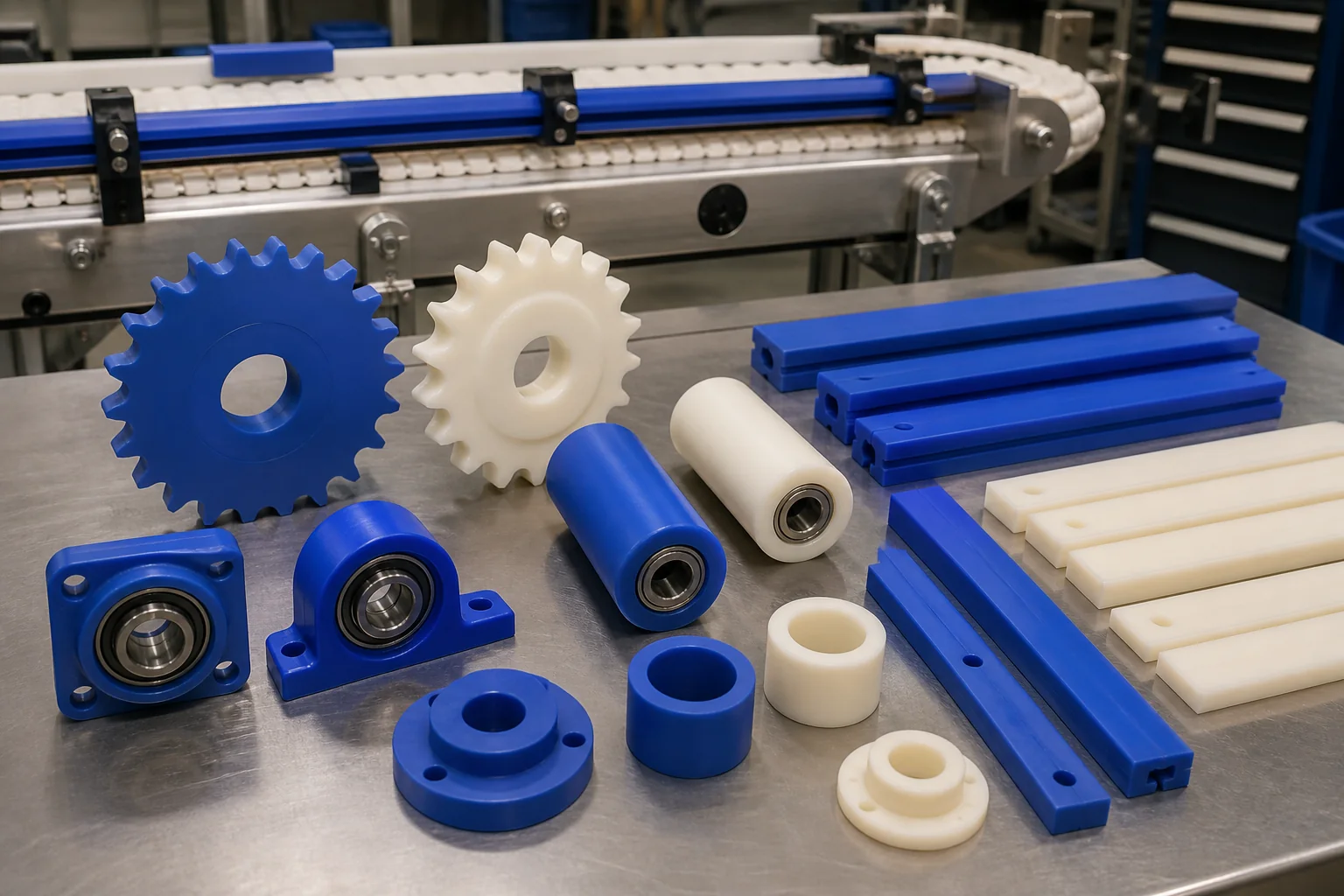
nylatron machining services produce gears, rollers, sheaves, bushings, bearing pads, guide blocks and other wear components from a family of high-performance nylon stock shapes. The best grade is selected from load, speed, lubrication, impact, moisture, temperature and dimensional requirements rather than color alone.
Nylatron is a trade name used by Mitsubishi Chemical Group for multiple nylon materials; it is not one universal resin grade. Buyers should specify the exact grade or approve an equivalent material based on documented properties before stock is purchased.
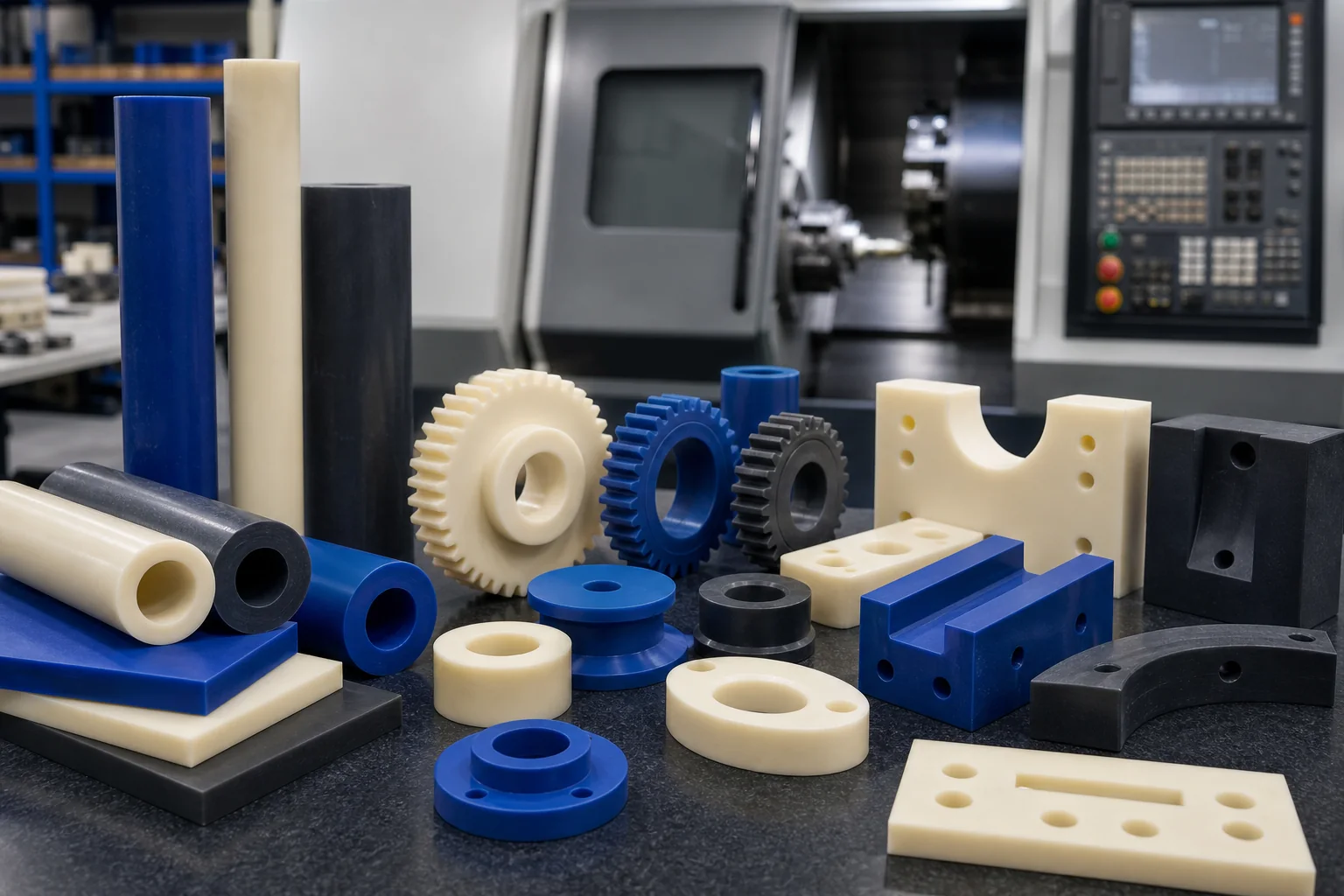
For conveyor, lifting, packaging and industrial equipment buyers
When Machined Cast Nylon Is the Right Choice
Use machined cast nylon when a component needs higher load capacity and stiffness than UHMW while retaining useful wear, impact and noise-reduction behavior.
- Best fit: large gears, rollers, sheaves, pads, guides and replaceable bearing components
- Grade priority: distinguish unfilled, lubricant-modified, MoS2-filled and other wear grades by duty
- Design priority: allow for moisture, thermal movement, creep and press-fit stress
Nylatron Grade and Application Snapshot
| Decision Point | Cast Nylon Takeaway | Buyer Note |
|---|---|---|
| Grade identity | Nylatron includes multiple PA6 and PA66-based stock grades | Request the exact grade and current data sheet |
| Wear behavior | Suitable for many sliding, rolling and bearing applications | Confirm pressure, speed, mating material and lubrication |
| Moisture response | Nylon absorbs moisture and may change dimensions | State service humidity, immersion and inspection conditioning |
| Part size | Cast nylon stock supports large gears, rollers and near-net shapes | Compare stock yield, machining allowance and annual demand |
| Tolerance | Functional fits are possible with a material-aware strategy | Do not apply metal tolerances to every dimension |
Grade Selection Before Nylatron Machining
An unfilled cast PA6 grade is a common starting point for general mechanical components. Lubricant-modified or MoS2-filled grades may improve friction and wear behavior in specific duty cycles, while PA66-based stock can offer a different balance of stiffness, temperature response and moisture behavior. Grade color is not a substitute for a manufacturer designation.
Mitsubishi Chemical Group describes Nylatron and Ertalon as ranges of wear-resistant nylon grades and publishes separate data sheets for individual products. A buyer should compare the exact current data sheet, not combine values from different grades into one specification.
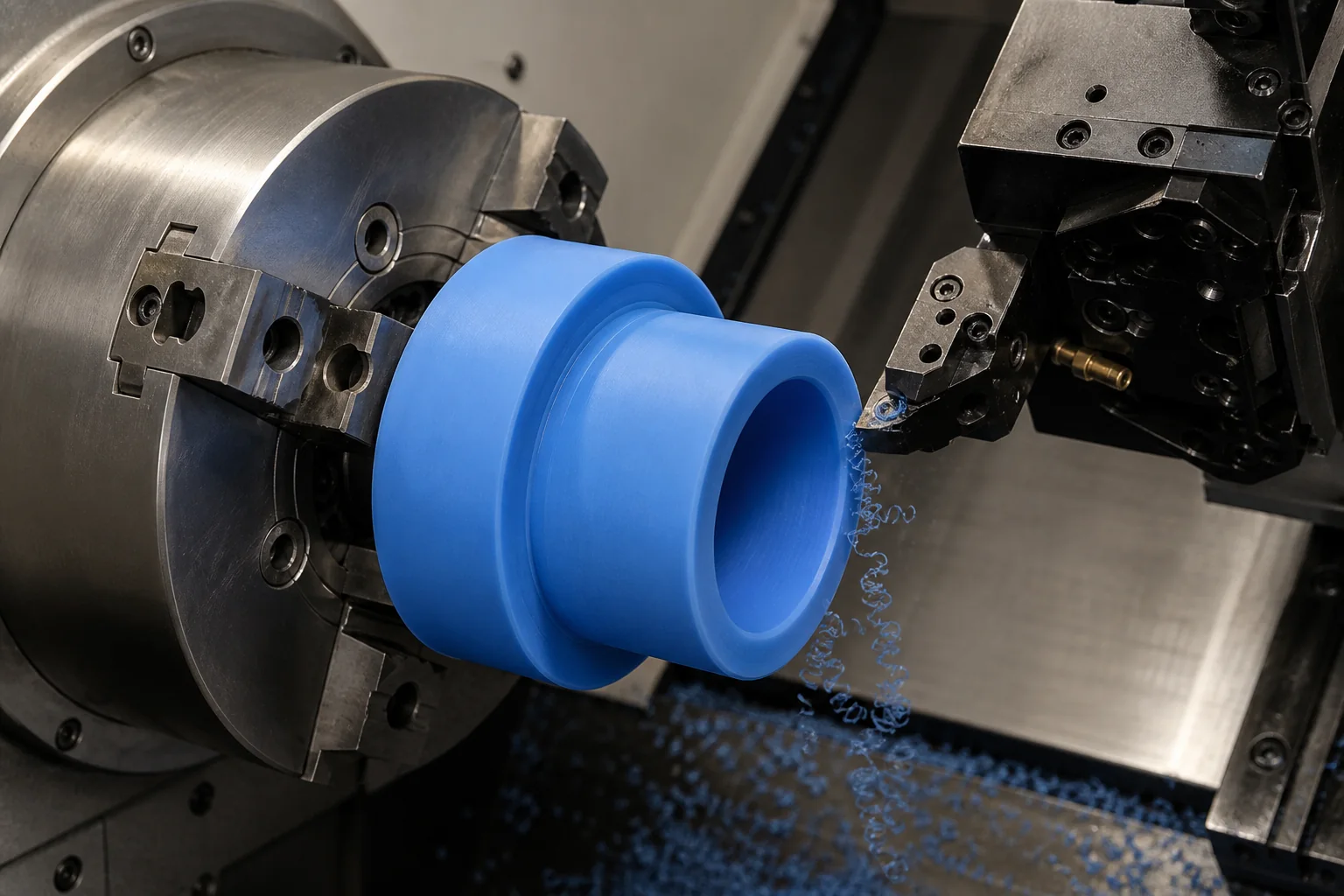
Machining strategy must control heat, clamp distortion and residual stress. Large blanks may benefit from staged roughing and finishing. Bores, press fits and long bearing surfaces should be reviewed against actual temperature and moisture because a dry inspection result may not represent the installed condition.
Application and Material Matrix
| Application | Material Direction | RFQ Detail to Confirm |
|---|---|---|
| Gear or sprocket | Unfilled or wear-modified cast nylon after load review | Torque, speed, tooth form, mating gear, lubrication and shock |
| Roller or sheave | Cast nylon selected for bearing and rim duty | Shaft fit, bearing arrangement, line load and speed |
| Bushing or bearing pad | Lubricant-modified or suitable wear grade | PV conditions, clearance, housing fit and service temperature |
| Wear strip or guide block | Cast nylon or UHMW after friction and load comparison | Contact pressure, mating surface, noise and replacement interval |
| Large structural wear component | Cast PA6 stock or near-net shape | Blank size, wall variation, machining allowance and stability |
Common Project Risks and Practical Fixes
| Risk | Why It Happens | Practical Fix |
|---|---|---|
| Wrong grade arrives | The PO says only blue nylon or Nylatron | Specify the full grade designation and required documentation |
| Bore becomes tight in service | Moisture, heat or press-fit stress was ignored | Design clearance from installed conditions and validate assembly |
| Large part changes shape | Residual stress and unbalanced machining release movement | Use staged machining, supported workholding and stabilization |
| Wear life is shorter than expected | Load, speed, alignment or mating surface was not shared | Review the full tribological system instead of resin alone |
| Quote is higher than expected | The selected blank creates poor material yield | Compare tube, plate, rod, casting allowance and near-net options |
Nylatron vs POM, UHMW and PEEK for Wear Parts
POM typically offers lower moisture absorption and strong dimensional stability for precision mechanisms, while cast nylon can support larger parts and higher impact or bearing loads in many applications. UHMW often provides lower friction and excellent impact behavior but is less stiff. PEEK supports more demanding temperature and chemical conditions at a much higher material cost.
The right choice depends on the wear pair, load, speed, temperature, moisture, geometry and replacement economics. A procurement comparison should use the same duty cycle and tolerance assumptions for every candidate material.
Related Reading
- Plastic Bearing Materials and Self-Lubricating Grades
- Custom Machined Plastic Parts
- CNC Plastic Milling Services
- Nylon Chemical Compatibility Chart
Frequently Asked Questions
Is Nylatron one material grade?
No. Nylatron is a trade name covering multiple nylon stock-shape grades. The exact product designation should be specified on the RFQ and purchase order.
What parts are commonly made with Nylatron machining services?
Common parts include gears, rollers, sheaves, bushings, bearing pads, wear strips, guides and large industrial wear components.
Can Nylatron hold tight tolerances?
Critical fits can be controlled, but tolerance depends on grade, part size, wall thickness, moisture, temperature, workholding and conditioning.
How do I choose between Nylatron and POM?
Choose from load, impact, moisture, dimensional stability, wear pair and part size. POM often favors precision and low moisture uptake; cast nylon can favor larger or higher-load wear parts.
What information is needed for a Nylatron machining quote?
Provide the drawing, exact grade, quantity, load, speed, mating material, lubrication, environment, critical fits and inspection requirements.
Request a Nylatron Machined Parts Review
For a gear, sheave, roller, bushing or wear component specified in Nylatron, send the drawing and the full manufacturer grade designation. Nylon Plastic has supported engineering-plastic selection and custom manufacturing since 2005; the review identifies stock, machining, dimensional and conditioning questions before quotation.
What to include in your request
- Name the exact grade: include manufacturer designation, color and approved equivalent policy.
- Define the duty: provide load, speed, cycle, mating surface, shock and lubrication conditions.
- State the environment: list temperature, humidity, water, chemicals, UV and cleaning exposure.
- Mark critical fits: identify shaft, bearing, seal, gear and mounting interfaces separately.
- Explain assembly: include press fits, fastener torque, inserts, split lines and replacement method.
- Set inspection conditions: agree on conditioning, temperature, datums and report requirements.
- Share quantities: prototype, batch and annual demand affect stock size, fixtures and cost.
- Supply and approval: stock form and source, machining allowance, material documentation and traceability, sample acceptance, destination and packaging. For a material-only request, identify the exact grade and required documents.
Ask the quote to state the actual manufacturer grade and stock source, permitted substitution policy, machining, stabilization or stress relief, inspection condition and packaging. Approve any equivalent before stock purchase; color or a generic nylon name is not enough. Agree the installed-fit or service check separately from material documentation. Nylatron is a Mitsubishi Chemical Group material family; grade selection does not establish approval of the finished assembly.

