
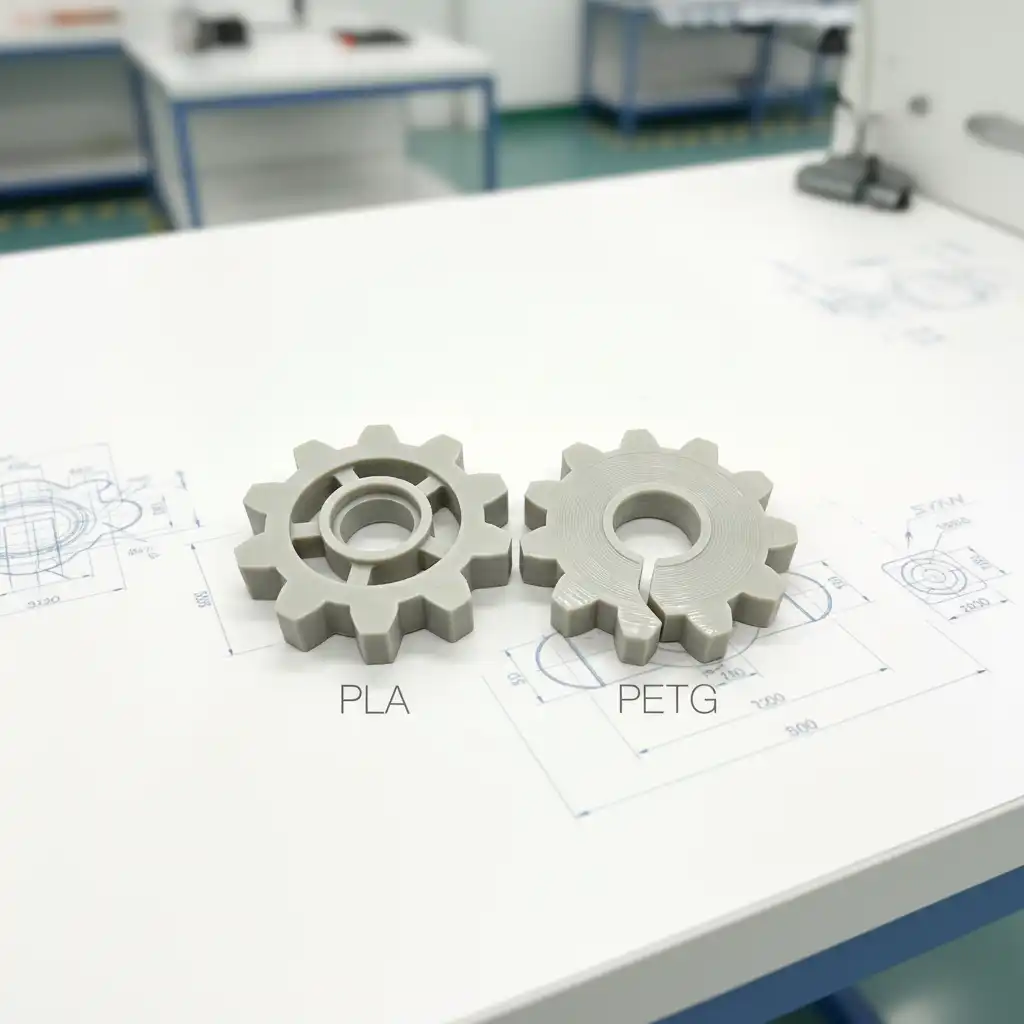
PLA vs PETG is one of the most common debates among 3D printing hobbyists and professionals alike. Both filaments are popular, easy to use, and produce high-quality parts. However, they have distinct differences in mechanical properties, temperature resistance, ease of printing, and post-processing. Choosing the right one for your project can mean the difference between a part that performs flawlessly and one that fails under stress. This guide provides a head‑to‑head comparison to help you decide once and for all.
What Are PLA and PETG? A Quick Overview
- PLA (Polylactic Acid): A biodegradable thermoplastic derived from renewable resources like cornstarch or sugarcane. It is the most beginner‑friendly filament, known for its low warp, sharp details, and pleasant odor when printing.
- PETG (Polyethylene Terephthalate Glycol): A modified version of the polyester used in water bottles. The glycol addition makes it less brittle, more durable, and easier to print than standard PET. It combines the simplicity of PLA with the strength and temperature resistance of ABS.
At a Glance: Key Differences
| Property | PLA | PETG |
|---|---|---|
| Printing Temperature | 190–220°C | 220–250°C |
| Bed Temperature | 30–60°C (optional) | 60–80°C (required) |
| Heated Bed Needed | No | Yes |
| Enclosure Required | No | Recommended for large parts |
| Odor | Sweet, pleasant | Odorless |
| Warping | Very low | Low to moderate |
| Layer Adhesion | Good | Excellent |
| Strength | Moderate | High |
| Flexibility | Rigid, brittle | Tough, slight flexibility |
| Temperature Resistance | ~50–60°C | ~70–80°C |
| UV Resistance | Poor | Good |
| Chemical Resistance | Poor | Good |
| Moisture Absorption | Low | Moderate |
| Post‑Processing | Easy to sand, glue, paint | More difficult, requires specific methods |
| Cost | $20–30/kg | $25–35/kg |
Printability: Which Is Easier?
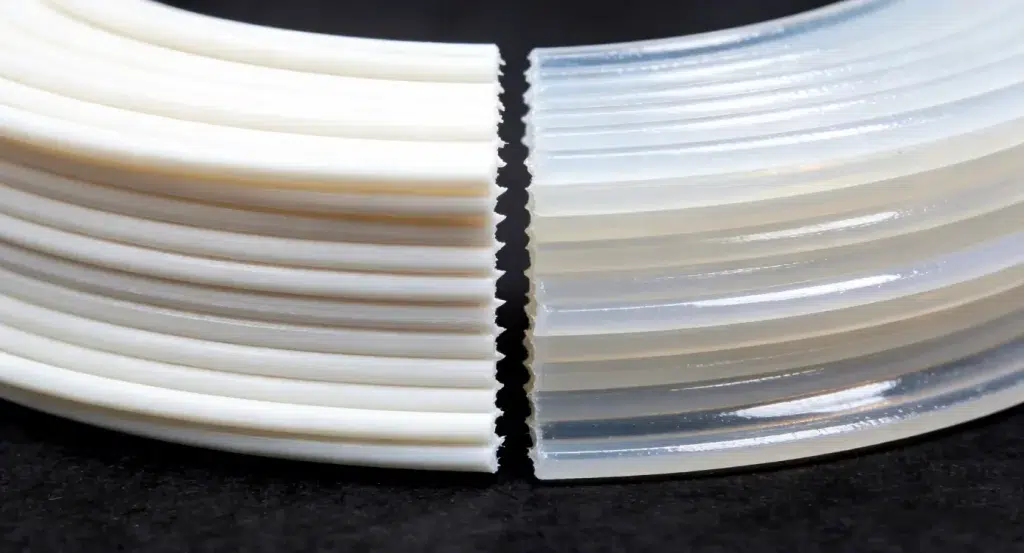
PLA is the undisputed champion for beginners. It does not require a heated bed, an enclosure, or active ventilation. It prints at low temperatures, has almost no warping, and adheres to most surfaces (blue tape, glue stick, PEI). Fine details and overhangs are easier because PLA cools quickly and can be printed with part cooling fans at 100%. The only caveat is that PLA can be brittle and may snap in a Bowden tube if left under tension for too long.
PETG is also user‑friendly but has a few extra requirements. A heated bed (70–80°C) is essential to prevent warping, especially on larger prints. PETG is more prone to stringing and oozing because it has a higher melt viscosity. It also requires a higher printing temperature (220–250°C) and slower print speeds for best results. PETG adheres very strongly to PEI and glass; a release agent (like glue stick) is often needed to avoid damaging the build plate. An enclosure is not strictly necessary but can help with large prints and eliminate drafts.
Winner for printability: PLA – especially for beginners and complex, detailed models.

Mechanical Properties: Strength, Flexibility, and Durability
| Mechanical Aspect | PLA | PETG |
|---|---|---|
| Tensile Strength | ~50–60 MPa | ~45–55 MPa (similar, but PETG is tougher) |
| Impact Resistance | Low (brittle, shatters) | High (bends, doesn’t break easily) |
| Flexural Modulus (Stiffness) | ~3.5–4.0 GPa | ~2.0–2.5 GPa (more flexible) |
| Elongation at Break | ~5–10% | ~20–50% |
| Layer Adhesion | Good | Excellent (parts are almost isotropic) |
- PLA is strong but brittle. It holds up well under constant, static loads but will snap or shatter under sudden impact. It has excellent stiffness, making it suitable for decorative models, gears, and housings that do not undergo high stress.
- PETG is tough and impact‑resistant. It absorbs shocks and bends rather than breaking. This makes it ideal for functional parts that may be dropped, bumped, or subjected to vibration. PETG also has superior layer adhesion, meaning parts are less likely to delaminate along layer lines.
Winner for mechanical performance: PETG – for durable, functional parts.
Temperature and Environmental Resistance
One of the biggest differentiators in the PLA vs PETG debate is how each behaves in heat and outdoors.
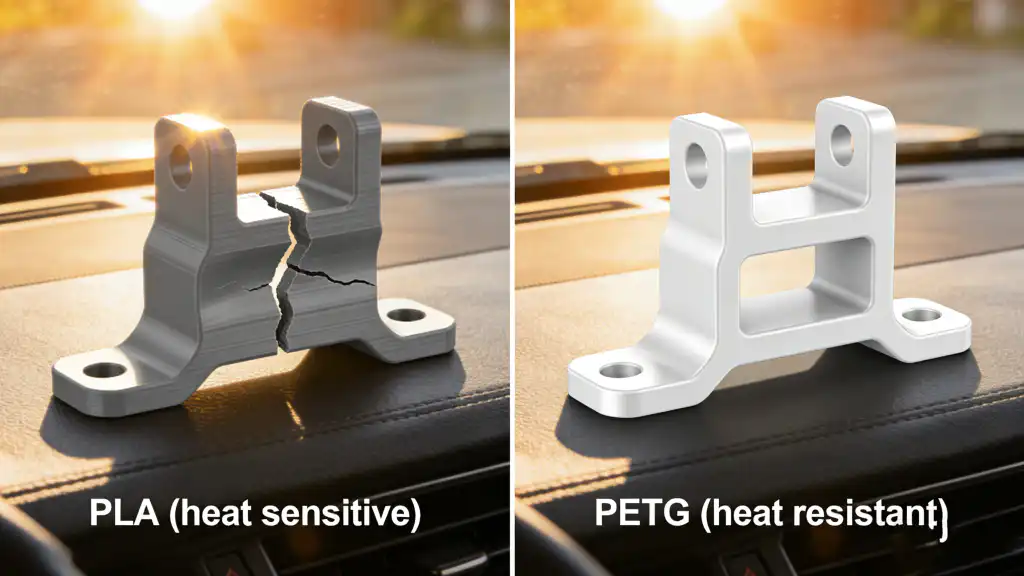
- PLA begins to soften at around 50–60°C. A part left in a car on a sunny day can easily warp or lose its shape. PLA is also poor in UV light and will degrade over time when exposed to sunlight. It is not resistant to most chemicals (acetone, alcohol, gasoline).
- PETG can withstand temperatures up to 70–80°C (some grades even higher). It has good UV resistance, making it suitable for outdoor applications like garden equipment or automotive exterior parts (though not engine bay). PETG also resists oils, acids, and many solvents.
Winner for harsh environments: PETG – for heat, UV, and chemical exposure.
Applications: When to Choose PLA vs PETG
| Application | Recommended Filament | Reason |
|---|---|---|
| Decorative models, figurines, cosplay props | PLA | High detail, easy sanding/painting, low cost. |
| Mechanical parts (gears, brackets, hinges) | PETG | Toughness, impact resistance, good layer adhesion. |
| Enclosures for electronics (Raspberry Pi, etc.) | PETG | Higher heat resistance prevents warping near warm components. |
| Prototypes that need to look good | PLA | Fast printing, no warping, great surface finish. |
| Functional prototypes for testing | PETG | Durable, can simulate injection‑molded part behavior. |
| Outdoor signs or planters | PETG | UV and moisture resistant. |
| Parts that need to be glued or painted | PLA | Adheres well to standard glues and paints. |
| Food contact items (not long‑term) | PETG | Food‑safe (if printed with stainless nozzle and cleaned). PLA is not typically food‑safe due to additives. |
Post‑Processing: Sanding, Gluing, and Painting
- PLA is very easy to post‑process. It sands smoothly, can be glued with cyanoacrylate (super glue) or epoxy, and accepts most acrylic paints. It can also be welded with a soldering iron. However, PLA is not soluble in common solvents.
- PETG is more challenging to finish. Sanding tends to create “fuzzies” rather than a smooth surface. It requires specific glues (e.g., Loctite 401 or specialized PETG glue). Painting PETG also requires an adhesion promoter (like a primer) because paint may peel off easily.
Winner for post‑processing: PLA – easier to sand, glue, and paint.
Printing Tips for PLA and PETG
| Aspect | PLA Tips | PETG Tips |
|---|---|---|
| Nozzle | Brass nozzle works fine. | Hardened steel recommended if printing abrasive glow‑in‑dark or wood‑filled variants. |
| Bed adhesion | Blue tape, glue stick, PEI. | Glue stick on glass or PEI (acts as release agent). |
| Cooling fan | 100% for best overhangs. | 20–50% to improve layer adhesion and prevent warping. |
| Stringing | Minimal. | Increase retraction distance/speed; reduce nozzle temperature. |
| Storage | Keep dry but less critical. | Must be stored in a sealed bag with desiccant; dry at 60°C before use if needed. |
| First layer | No special requirements. | Print slower (20–30 mm/s) and increase bed temperature. |
FAQ: PLA vs PETG
Q1: Is PETG stronger than PLA?
A: In terms of impact resistance and toughness, yes. PETG bends rather than shatters. For tensile strength, they are comparable. For stiffness, PLA is actually stiffer.
Q2: Can I print PETG on an open‑frame printer like an Ender 3?
A: Yes. Many users successfully print PETG on open printers. However, avoid drafts and consider printing with a draft shield for large parts to prevent warping.
Q3: Which filament is better for outdoor use?
A: PETG. It has far better UV and moisture resistance than PLA, which degrades quickly in sunlight.
Q4: Does PLA smell bad when printing?
A: No. PLA has a sweet, candy‑like smell that most people find pleasant. PETG is virtually odorless.
Q5: Which is more brittle, PLA or PETG?
A: PLA is more brittle. It snaps under sudden force. PETG is more ductile and absorbs impacts.
Q6: Can I use the same nozzle for both PLA and PETG?
A: Yes, a standard brass 0.4mm nozzle works for both. However, if you print high‑temperature or abrasive filaments, consider switching to hardened steel.
Q7: Which filament is cheaper?
A: PLA is generally $5–10 per kg cheaper than PETG. The gap has narrowed, but PLA remains the most cost‑effective for large prints.
Q8: Do I need an enclosure for PETG?
A: Not always. For small parts, an open printer is fine. For large, flat parts or in a drafty room, an enclosure helps prevent warping and curling.
Q9: Can I recycle PLA and PETG?
A: PLA is biodegradable under industrial composting conditions (not home compost). PETG is recyclable with #1 plastics in some facilities, but not widely accepted. Neither should be thrown in regular recycling without checking local rules.
Q10: Where can I buy high‑quality PLA and PETG filament?
A: Many reputable brands offer both. For custom formulation or large‑volume material supply, contact our team . Nylon Plastic also provides advanced engineering materials for demanding applications.
Conclusion: Which One Should You Choose?
The PLA vs PETG decision ultimately depends on your specific project requirements:
- Choose PLA if: You are a beginner, printing decorative items, prototypes that won’t see stress or heat, or you need high detail and ease of post‑processing.
- Choose PETG if: You need functional parts that will be handled, exposed to sunlight or mild heat, require impact resistance, or you want a durable material that is almost as easy to print as PLA.
For most users, it’s not an either/or situation. Having both filaments in your workshop allows you to pick the right tool for each job. Start with PLA to master the basics, then add PETG to your material library for tougher, more practical prints.
Ready to explore advanced materials beyond PLA and PETG? Nylon Plastic offers a full range of engineering filaments including PA6-CF , PET‑CF, and PC‑ABS. Visit our material selection hub for expert guidance. Contact us for custom material solutions or large‑volume supply.
 English
 Dutch
Dutch German
 French
 Korean
 Russian
 Japanese
 Spanish
 Vietnamese
 Chinese
 Portuguese
 Arabic